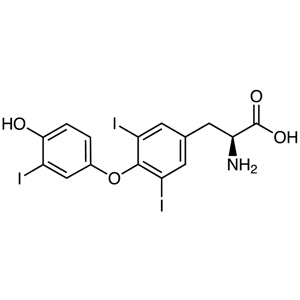
3,3',5-Triiodo-L-thyronine is a chemical compound classified as a thyroid hormone, widely used in biochemical and pharmacological research. It plays a crucial role in understanding the biological mechanisms of thyroid hormones within the human body. In the laboratory, this compound serves as a key reagent in the synthesis of bioactive compounds and as a tool for studying cellular responses to hormonal stimulation. Its significance lies in its ability to influence metabolic processes and gene regulation, making it an essential component in various experimental setups.
This compound is preferred due to its high purity and consistent quality, ensuring reliable and reproducible results in research. Its molecular structure is complex yet stable under specific conditions, allowing for effective use in chemical reactions. It is soluble in organic solvents such as ethyl acetate and ethanol, which enhances its versatility in laboratory applications. The reactivity and stability of 3,3',5-Triiodo-L-thyronine make it a trusted material for researchers aiming to achieve accurate and meaningful experimental outcomes.
In Indonesian laboratories, 3,3',5-Triiodo-L-thyronine is extensively used in endocrinology, biochemical, and pharmacological studies. It is a common choice for researchers investigating thyroid hormone function, metabolism, and genetic regulation. Its availability and reliability make it a preferred material for both academic and industrial research settings in Indonesia.
TCI brochures (PDF)
- Regenerative Medicine Research Reagents 2016-03-18 · p. 2
- Amino Acids and Peptide Synthesis Reagents 2025-08-14 · p. 6
- Endocrinology research utilizes this compound to study thyroid hormone mechanisms and their effects on metabolic processes.
- Biochemical experiments employ it to investigate hormone signaling pathways and cellular responses to hormonal stimuli.
- Pharmacological studies use it to evaluate the interaction of thyroid hormones with drug targets and biological systems.
- Genetic regulation research incorporates it to analyze how thyroid hormones influence gene expression and cellular function.
- Metabolic studies rely on it to explore the role of thyroid hormones in energy metabolism and homeostasis.
| Brand | TCI |
|---|---|
| CAS number | 6893-02-3 |
| Molecular formula | — |
| Purity | — |
| Category | Chemistry > Chemical Biology > Peptide Chemistry |
| Pack sizes | Available in various quantities as per standard laboratory supply |
| Physical form | Solid powder |
| Storage | Store in a cool, dry place away from light and moisture |
3,3',5-Triiodo-L-thyronine should be stored in a cool, dry environment to maintain its stability and prevent degradation. It is recommended to keep it in a tightly sealed container to avoid exposure to moisture and air. Due to its reactivity, it should be handled with care using appropriate personal protective equipment. The compound is best stored in a desiccator or airtight container to ensure long-term consistency. It is important to avoid direct sunlight and high humidity to preserve its chemical integrity. Proper storage conditions are essential to maintain its effectiveness and reliability in laboratory applications.
—
Product Categories
- Biochemicals and ReagentsAmino AcidsBiologically-modified Amino Acids
- Cell BiologyCell Signaling and NeuroscienceCytokines, Growth Factors and Hormones
- Cell BiologyStem Cell BiologyRegenerative Medicine Research Reagents
- Molecular BiologyRegenerative Medicine Research Reagents
- Pharmaceutical Development and Drug Discovery ResearchPeptide ChemistryAmino Acid Derivatives [Peptide Chemistry]
Produk Terkait
-
3,5-Diiodo-L-thyronine TCI D1119
Regular price From Rp 1.140.300,00Regular priceRp 812.700,00Sale price From Rp 1.140.300,00 -
DL-Thyronine TCI T0241
Regular price Rp 2.677.500,00Regular priceRp 1.887.900,00Sale price Rp 2.677.500,00 -
L-Proline TCI P0481
Regular price From Rp 1.033.200,00Regular priceRp 738.150,00Sale price From Rp 1.033.200,00 -
L-O-Phosphoserine TCI P0773
Regular price From Rp 2.121.000,00Regular priceRp 1.498.350,00Sale price From Rp 2.121.000,00 -
Progesterone TCI P0478
Regular price From Rp 1.113.000,00Regular priceRp 793.800,00Sale price From Rp 1.113.000,00 -
Jervine TCI J0009
Regular price Rp 8.055.600,00Regular priceRp 5.649.000,00Sale price Rp 8.055.600,00 -
Hydrocortisone TCI H0533
Regular price From Rp 822.150,00Regular priceRp 590.100,00Sale price From Rp 822.150,00 -
Dexamethasone TCI D1961
Regular price Rp 1.988.700,00Regular priceRp 1.405.950,00Sale price Rp 1.988.700,00