TCI T1062 is Tetraphenylcyclopentadienone, a cyclic ketone built on a cyclopentadienone ring in which four positions carry phenyl groups. In the TCI catalogue it sits within the non-heterocyclic building block group. The compound has long been known in organic chemistry, both as a synthetic starting material and as a classic example of a diene used to teach the Diels-Alder reaction. In the laboratory, it gives access to large aromatic frameworks that are difficult to assemble directly.
The features that make this material a preferred choice come from its nature as an aryl-rich diene that carries a carbonyl bridge. In a Diels-Alder reaction with an alkyne, the addition is followed by loss of carbon monoxide, which produces a fully substituted benzene ring. This route is well known for building polyaryl compounds such as hexaphenylbenzene derivatives, which are often used in materials research and dendrimer work. Its rigid structure and extended conjugation also make it of interest for studies of optical and electronic properties.
In Indonesian laboratories, this material suits organic synthesis research groups, materials chemistry groups, and advanced teaching laboratories that want to demonstrate a classic cycloaddition and decarbonylation sequence. It can be used in small-scale synthesis work and in practical sessions that follow established procedures. Users should confirm that the item matches the requirements of their method before ordering.
Advantages (TCI brochure)
- Highly reactive with various dienophiles
- Can be converted to multi-substituted acenes by Diels-Alder cycloaddition with arynes or alkynes and subsequent decarbonylative aromatization
TCI brochures (PDF)
- Cyclopentadienone-type Building Blocks for Multi-substituted Acenes 2025-08-05 · p. 1
- Ligands 2025-12-01 · p. 19
Related TCI products
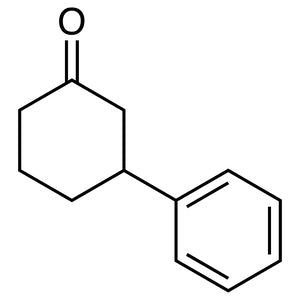
- TCI P3085 20795-53-3 3-Phenylcyclohexan-1-one
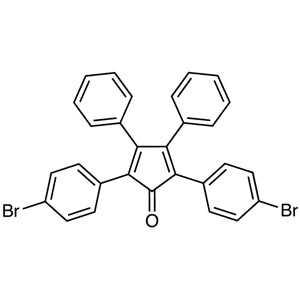
- TCI B5987 54523-24-9 2,5-Bis(4-bromophenyl)-3,4-diphenylcyclopenta-2,4-dienone
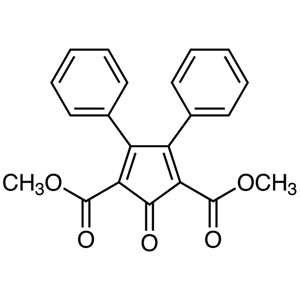
- TCI B1962 16691-79-5 2,5-Bis(methoxycarbonyl)-3,4-diphenylcyclopentadienone
- TCI D6101 886-38-4 2,3-Diphenylcycloprop-2-en-1-one
- TCI T2827 54458-61-6 2,3,4,5-Tetramethylcyclopent-2-en-1-one (cis- and trans- mixture)
- TCI P1311 1444-65-1 2-Phenylcyclohexanone
- Diels-Alder cycloaddition studies: the compound serves as an aryl-rich diene with a carbonyl bridge, so it reacts with alkynes in a way that is well documented and easy to follow.
- Synthesis of polyaryl benzenes: addition to an alkyne followed by loss of carbon monoxide gives a fully substituted benzene ring, which is a known route to hexaphenylbenzene-type compounds.
- Materials chemistry and dendrimer research: the large, rigid aromatic framework it provides is useful as a core or building unit in research on polyaryl materials and dendritic structures.
- Optical and electronic property studies: its rigid structure and extended conjugation make it an interesting subject for groups investigating how conjugated aromatic systems behave.
- Advanced teaching laboratories: it is a classic diene for demonstrating cycloaddition followed by decarbonylation, so students can see a well-established reaction in a practical session.
From the TCI brochure
- Conversion to multi-substituted acenes via Diels-Alder cycloaddition with arynes or alkynes and decarbonylative aromatization
| Brand | TCI |
|---|---|
| CAS number | 479-33-4 |
| Molecular formula | — |
| Purity | — |
| Category | Chemistry > Building Blocks > Non-Heterocyclic Building Blocks |
| Pack sizes | please refer to the available options on the product page |
| Physical form | — |
| Storage | follow the storage instructions on the label and the Safety Data Sheet |
- Product code: T1062
Store the material in its original, tightly closed container in a clean, dry place away from direct sunlight, heat sources, and incompatible chemicals. Follow the storage instructions on the label and in the Safety Data Sheet supplied with the product. Handle it in a well-ventilated area or a fume hood, and wear standard laboratory protective equipment: a lab coat, safety glasses, and chemical-resistant gloves. Avoid creating dust, and avoid contact with skin, eyes, and clothing. Keep the container labelled and closed after use. Dispose of waste according to the laboratory's procedures and local regulations.
—
Produk Terkait
-
3-Phenylcyclohexan-1-one TCI P3085
Regular price Rp 6.333.600,00Regular priceRp 4.428.900,00Sale price Rp 6.333.600,00 -
2,5-Bis(4-bromophenyl)-3,4-diphenylcyclopenta-2,4-dienone TCI B5987
Regular price From Rp 1.856.400,00Regular priceRp 1.313.550,00Sale price From Rp 1.856.400,00 -
2,5-Bis(methoxycarbonyl)-3,4-diphenylcyclopentadienone TCI B1962
Regular price From Rp 2.677.500,00Regular priceRp 1.887.900,00Sale price From Rp 2.677.500,00 -
2,3-Diphenylcycloprop-2-en-1-one TCI D6101
Regular price From Rp 1.378.650,00Regular priceRp 963.900,00Sale price From Rp 1.378.650,00 -
2,3,4,5-Tetramethylcyclopent-2-en-1-one(cis-andtrans-mixture) TCI T2827
Regular price Rp 3.683.400,00Regular priceRp 2.591.400,00Sale price Rp 3.683.400,00 -
2-Phenylcyclohexanone TCI P1311
Regular price From Rp 1.565.550,00Regular priceRp 1.094.100,00Sale price From Rp 1.565.550,00 -
4-Phenylcyclohexanone TCI P0975
Regular price From Rp 2.650.200,00Regular priceRp 1.853.250,00Sale price From Rp 2.650.200,00 -
3,4-Dimethylcyclopent-2-en-1-one TCI D6225
Regular price Rp 9.063.600,00Regular priceRp 6.353.550,00Sale price Rp 9.063.600,00