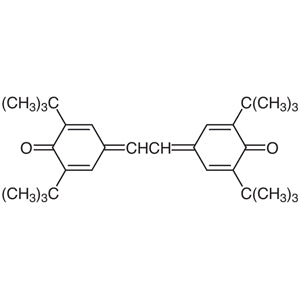
3,3',5,5'-Tetra-tert-butyl-4,4'-stilbenequinone from TCI (product code T1067) is a conjugated quinone built on a stilbene backbone, with four tert-butyl groups placed on the positions flanking the oxygen functions. TCI lists it in its catalog as a non-heterocyclic building block. Its structure is closely tied to the chemistry of hindered phenols, which are widely used as antioxidants, because compounds of this type commonly appear as oxidation products of those phenol derivatives. In the laboratory, it serves as a reference compound and a model system for researchers who want to understand how hindered phenolic antioxidants behave once they have been oxidized.
The long, conjugated system of double bonds gives this compound an interesting redox character. It can accept electrons and form radical or dianionic species, which makes it useful in electron-transfer studies. The four bulky tert-butyl groups shield the reactive centers and improve solubility in nonpolar organic solvents, and they also influence the stability of the reduced species that form. Together, these features make it a well-suited subject for studying the oxidation mechanisms of phenolic antioxidants, where both steric protection and electronic delocalization matter.
In Indonesian laboratories, this material is a good fit for research groups working in physical organic chemistry, polymer chemistry and plastic additives, and organic electrochemistry. These groups are typically interested in antioxidant behavior and in redox-active compounds. It can be incorporated into teaching and research projects that examine degradation pathways of stabilizers, or used as a well-defined standard when comparing related quinoid structures. The product is supplied in a 1 g pack.
TCI brochures (PDF)
- Polymer Additives 2026-04-16 · p. 8
Related TCI products
- TCI T4315 6337-43-5 Tetraethyl 2,2'-[1,4-Phenylenebis(methaneylylidene)]dimalonate
- TCI T0118 131-55-5 2,2',4,4'-Tetrahydroxybenzophenone
- TCI M1810 6386-38-5 Methyl 3-(3,5-Di-tert-butyl-4-hydroxyphenyl)propionate
- TCI M1082 5466-77-3 2-Ethylhexyl 4-Methoxycinnamate
- TCI H0266 131-57-7 2-Hydroxy-4-methoxybenzophenone
- TCI E1619 2549-90-8 [4-[(2-Ethylhexyl)oxy]-2-hydroxyphenyl](phenyl)methanone
- Physical organic chemistry studies: the conjugated quinone framework and bulky substituents make this compound a useful model for examining how electronic delocalization and steric hindrance affect reactivity and stability.
- Electron-transfer and redox studies: because the compound can accept electrons and form radical or dianionic species, it suits experiments that probe reduction behavior and the stability of the resulting charged intermediates.
- Antioxidant mechanism research: as a compound related to oxidation products of hindered phenols, it helps researchers study how phenolic antioxidants are consumed and what species form during oxidative processes.
- Polymer chemistry and plastic additive research: its link to hindered phenol chemistry makes it relevant to groups investigating stabilizer behavior, since compounds of this type commonly appear as oxidation products of such additives.
- Organic electrochemistry: the redox-active conjugated system and good solubility in nonpolar organic solvents make it convenient for voltammetric investigations of quinoid compounds in organic media.
| Brand | TCI |
|---|---|
| CAS number | 809-73-4 |
| Molecular formula | — |
| Purity | — |
| Category | Chemistry > Building Blocks > Non-Heterocyclic Building Blocks |
| Pack sizes | 1 g |
| Physical form | — |
| Storage | keep tightly closed in a cool, dry place, away from light and incompatible materials, and consult the product label and safety data sheet |
- Product code: T1067
Store the container tightly closed in a cool, dry, well-ventilated place, protected from direct light and heat, and away from strong oxidizing or reducing agents. The original supplier bottle is the most suitable container; if material is transferred, use a clean, dry, tightly sealing glass vial with a clear label. As with any laboratory chemical, handle it while wearing a lab coat, safety glasses, and chemical-resistant gloves, and work in a fume hood or well-ventilated area to avoid inhaling dust. Avoid contact with skin and eyes, and wash hands thoroughly after use. Always read the safety data sheet from the supplier before handling, and dispose of waste in line with your institution's chemical waste procedures.
—
Product Categories
Produk Terkait
-
Tetraethyl2,2'-[1,4-Phenylenebis(methaneylylidene)]dimalonate TCI T4315
Regular price From Rp 928.200,00Regular priceRp 648.900,00Sale price From Rp 928.200,00 -
2,2',4,4'-Tetrahydroxybenzophenone TCI T0118
Regular price Rp 980.700,00Regular priceRp 701.400,00Sale price Rp 980.700,00 -
Methyl3-(3,5-Di-tert-butyl-4-hydroxyphenyl)propionate TCI M1810
Regular price From Rp 610.050,00Regular priceRp 442.050,00Sale price From Rp 610.050,00 -
2-Ethylhexyl4-Methoxycinnamate TCI M1082
Regular price From Rp 1.113.000,00Regular priceRp 793.800,00Sale price From Rp 1.113.000,00 -
2-Hydroxy-4-methoxybenzophenone TCI H0266
Regular price From Rp 769.650,00Regular priceRp 553.350,00Sale price From Rp 769.650,00 -
[4-[(2-Ethylhexyl)oxy]-2-hydroxyphenyl](phenyl)methanone TCI E1619
Regular price From Rp 1.961.400,00Regular priceRp 1.387.050,00Sale price From Rp 1.961.400,00 -
N1-(2-Ethoxyphenyl)-N2-(2-ethylphenyl)oxalamide TCI E1382
Regular price From Rp 1.298.850,00Regular priceRp 924.000,00Sale price From Rp 1.298.850,00 -
3-(3,5-Di-tert-butyl-4-hydroxyphenyl)propionicAcid TCI D3452
Regular price From Rp 848.400,00Regular priceRp 609.000,00Sale price From Rp 848.400,00




![TCI E1619 2549-90-8 [4-[(2-Ethylhexyl)oxy]-2-hydroxyphenyl](phenyl)methanone](http://amiscientific.com/cdn/shop/files/TCI2510E1619_1f5b77d2-cbe0-48e2-a57f-1f00b93c9a42.jpg?v=1792641994&width=533)
![[4-[(2-Ethylhexyl)oxy]-2-hydroxyphenyl](phenyl)methanone (CAS 2549-90-8) - TCI E1619 - AMI Scientific](http://amiscientific.com/cdn/shop/files/TCI2510E1619.jpg?v=1767113127&width=533)