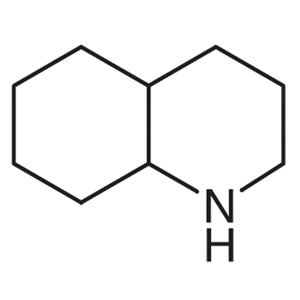
5,6,7,8-Tetrahydroquinoline is a heterocyclic compound that combines a pyridine ring with a saturated cyclohexane ring. Its structure is a partially hydrogenated form of quinoline, so the pyridine portion remains aromatic and weakly basic. This TCI T1150 product is used as a building block and intermediate in organic synthesis, and as a ligand or heterocyclic base in coordination chemistry and catalysis research. In the laboratory it serves as a versatile starting material for chemists who work with nitrogen-containing heterocycles and need a reliable reagent identified by CAS number 10500-57-9.
The nitrogen atom in the pyridine ring provides a lone pair of electrons that can act as a base or as a ligand toward metals. The saturated ring adds steric bulk and lipophilic character compared with simple pyridine. This combination appeals to researchers who want to tune the electronic and steric properties of a ligand. The material can also be functionalized on the pyridine ring or at the benzylic positions of the saturated ring, which opens many synthetic routes to more complex derivatives. Together, these features make it a preferred choice for heterocyclic chemistry work.
In Indonesian laboratories, this material is useful to organic chemistry, medicinal chemistry, and inorganic chemistry groups that work with nitrogen-containing heterocyclic compounds. It is typically used in small-scale synthesis, ligand development, and exploratory research where a well-defined heterocyclic building block is required. Supplied in 10 mL and 100 mL pack sizes, it is practical for both method development and repeated synthetic work, so a laboratory can choose the quantity that matches its project scale.
Related TCI products
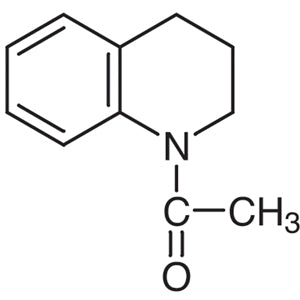
- TCI A1641 4169-19-1 1-Acetyl-1,2,3,4-tetrahydroquinoline
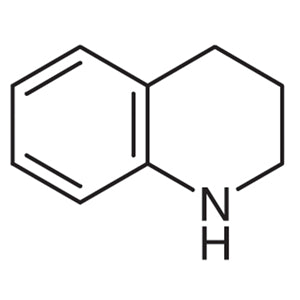
- TCI T0113 635-46-1 1,2,3,4-Tetrahydroquinoline
- TCI N0955 30450-62-5 7-Nitro-1,2,3,4-tetrahydroquinoline
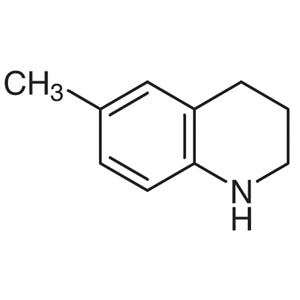
- TCI M1302 91-61-2 6-Methyl-1,2,3,4-tetrahydroquinoline
- TCI T2999 3476-89-9 1,2,3,4-Tetrahydroquinoxaline
- TCI T1403 34413-35-9 5,6,7,8-Tetrahydroquinoxaline
- Heterocyclic building block: the fused pyridine and saturated ring system gives synthetic chemists a ready scaffold that can be elaborated into more complex nitrogen-containing target molecules.
- Intermediate in organic synthesis: the compound can be functionalized on the pyridine ring or at the benzylic positions, allowing multi-step routes to a wide range of derivatives.
- Ligand in coordination chemistry: the pyridine nitrogen lone pair binds to metal centers, and the saturated ring contributes steric bulk that researchers can use to tune complex properties.
- Heterocyclic base in catalysis research: the weakly basic pyridine nitrogen can act as a base or ligand component, supporting studies of how electronic and steric features influence catalytic behavior.
- Medicinal chemistry exploration: the partially hydrogenated quinoline framework is a useful starting point for groups preparing nitrogen-containing heterocyclic compounds for structure-activity investigation.
| Brand | TCI (product code T1150) |
|---|---|
| CAS number | 10500-57-9 |
| Molecular formula | — |
| Purity | — |
| Category | Chemistry > Building Blocks > Heterocyclic Building Blocks |
| Pack sizes | 10 mL and 100 mL |
| Physical form | — |
| Storage | keep in a tightly closed container and follow the storage instructions on the label and safety data sheet |
- Product name: 5,6,7,8-Tetrahydroquinoline
Store the product in its original, tightly closed container in a cool, well-ventilated place, away from direct sunlight, heat sources, and incompatible materials such as strong oxidizers. Always follow the storage instructions on the label and in the supplier's safety data sheet. Handle the material in a fume hood or well-ventilated area, and wear suitable personal protective equipment, including safety glasses, chemical-resistant gloves, and a laboratory coat. Avoid contact with skin and eyes and avoid inhaling vapors. Close the container promptly after use, label any transferred portions clearly, and dispose of waste according to institutional and local regulations.
—
Produk Terkait
-
1-Acetyl-1,2,3,4-tetrahydroquinoline TCI A1641
Regular price From Rp 1.643.250,00Regular priceRp 1.164.450,00Sale price From Rp 1.643.250,00 -
1,2,3,4-Tetrahydroquinoline TCI T0113
Regular price From Rp 717.150,00Regular priceRp 516.600,00Sale price From Rp 717.150,00 -
7-Nitro-1,2,3,4-tetrahydroquinoline TCI N0955
Regular price From Rp 1.351.350,00Regular priceRp 960.750,00Sale price From Rp 1.351.350,00 -
6-Methyl-1,2,3,4-tetrahydroquinoline TCI M1302
Regular price Rp 2.227.050,00Regular priceRp 1.572.900,00Sale price Rp 2.227.050,00 -
1,2,3,4-Tetrahydroquinoxaline TCI T2999
Regular price From Rp 795.900,00Regular priceRp 572.250,00Sale price From Rp 795.900,00 -
5,6,7,8-Tetrahydroquinoxaline TCI T1403
Regular price From Rp 900.900,00Regular priceRp 645.750,00Sale price From Rp 900.900,00 -
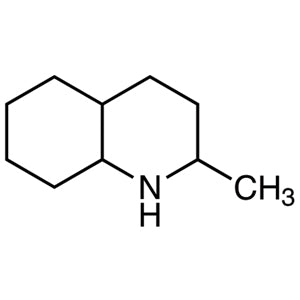
2-Methyldecahydroquinoline(mixtureofisomers) TCI M3189
Regular price From Rp 2.411.850,00Regular priceRp 1.702.050,00Sale price From Rp 2.411.850,00 -
trans-Decahydroquinoline TCI D2936
Regular price Rp 1.510.950,00Regular priceRp 1.072.050,00Sale price Rp 1.510.950,00