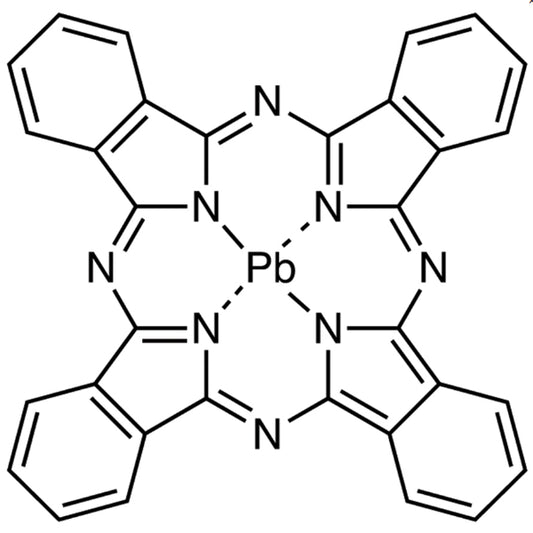
Lead [Catalysis and Inorganic Chemistry] — contains inorganic lead(II) compounds such as oxides, sulfides, carbonates, sulfates, fluorides, and phthalocyanines, representing a range of structural coordination geometries of main-group metals. These compounds serve as starting materials for inorganic materials synthesis and as precursors in coordination chemistry studies.
This category is used by inorganic and materials chemists to synthesize lead-based semiconductors, pigments, and functional materials, including crystal structure studies and the optical properties of metal phthalocyanines. Compounds such as Lead(II) Oxide and Lead(II) Sulfide also serve as starting points for metathesis reactions to obtain other lead salts with different anions.
Example products in this collection: TCI P0766 15187-16-3 Lead(II) Phthalocyanine, TCI B6371 21319-43-7 Bis(2,2,6,6-tetramethyl-3,5-heptanedionato)lead(II), TCI L0469 1317-36-8 Lead(II) Oxide, TCI C3569 15243-48-8 Cesium Lead Tribromide (Low water content), TCI L0458 1314-87-0 Lead(II) Sulfide, TCI C3570 18041-25-3 Cesium Lead Triiodide (Low water content), TCI L0451 598-63-0 Lead(II) Carbonate, TCI L0021 546-67-8 Lead Tetraacetate (contains Acetic Acid).
Pay attention to the crystal form or polymorphic phase, purity level, and particle size, as all three affect the reactivity and the results of synthesizing derived materials. All products are genuine Tokyo Chemical Industry (TCI) Japan products, with purity, packaging, and storage conditions listed on the page of each item.
Other categories at the same level under Main-group Elements [Catalysis and Inorganic Chemistry], often used together in one laboratory workflow:
Back to Main-group Elements [Catalysis and Inorganic Chemistry]. For large-volume procurement, special packaging, or specific grades, contact the AMI Scientific team — the official TCI Japan distributor in Indonesia — to check availability and lead time directly from Japan.