

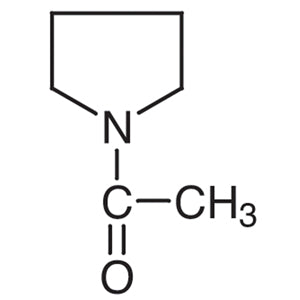
1-Acetylpyrrolidine is a key chemical compound widely used in organic laboratory settings for the synthesis of heterocyclic compounds. This compound is derived from the pyrrolidine ring with an acetyl group attached, making it a versatile building block in chemical reactions. Its structural simplicity and reactivity make it an essential reagent in the development of complex organic molecules. In research laboratories, it serves as a fundamental tool for chemists working on various synthetic pathways.
The stability and controlled reactivity of 1-Acetylpyrrolidine make it a preferred choice for researchers. It can participate in multiple reaction types, including acylation, alkylation, and nucleophilic reactions. Its ability to undergo ring-opening and substitution reactions enhances its utility in synthetic chemistry. The compound's predictable behavior under different reaction conditions ensures reliable results, making it a trusted material in both academic and industrial research.
In Indonesian laboratories, 1-Acetylpyrrolidine is commonly used in organic chemistry, pharmaceutical, and materials science research. Its availability and consistent chemical properties make it a go-to reagent for local scientists. Researchers in Indonesia rely on this compound for the development of new products and for quality testing of chemical materials. Its role in advancing scientific research is well-recognized in the region.
- Organic synthesis: 1-Acetylpyrrolidine is widely used in the synthesis of heterocyclic compounds due to its reactivity and structural versatility.
- Pharmaceutical research: This compound is a valuable reagent in the development of new drug molecules, contributing to the creation of complex pharmaceutical compounds.
- Material science studies: It is employed in the synthesis of polymers and other materials, offering a foundation for innovative material development.
- Reaction mechanism studies: Its participation in various chemical reactions makes it ideal for studying reaction mechanisms and catalytic processes.
- Quality control testing: 1-Acetylpyrrolidine is used to test the purity and stability of chemical compounds in quality assurance protocols.
| Brand | TCI |
|---|---|
| CAS number | 4030-18-6 |
| Molecular formula | — |
| Purity | — |
| Category | Chemistry > Building Blocks > Heterocyclic Building Blocks |
| Pack sizes | Available in various quantities as per standard laboratory supply sizes |
| Physical form | Liquid |
| Storage | Store in a cool, dry place away from direct sunlight |
1-Acetylpyrrolidine should be stored in a cool, dry place, away from direct sunlight and sources of heat. It is recommended to keep the compound in a tightly sealed container to prevent evaporation and contamination. The container should be made of a material that is chemically inert, such as glass or high-density polyethylene. Due to its chemical nature, it should be handled in a well-ventilated area, and appropriate personal protective equipment should be worn. Avoid contact with skin and eyes, and ensure proper disposal of any unused portions according to local regulations. Regular monitoring of storage conditions ensures the compound remains stable and safe for use in laboratory settings.
—
Produk Terkait
-
2-Acetylpyrrole TCI A0894
Regular price From Rp 980.700,00Regular price -
2-Acetylpyrazine TCI A0988
Regular price From Rp 1.035.300,00Regular price -
1-Methylpyrrolidine-2-thione TCI M1748
Regular price Rp 2.969.400,00Regular priceRp 2.091.600,00Sale price Rp 2.969.400,00 -
2-(2-Hydroxyethyl)-1-methylpyrrolidine TCI M0908
Regular price Rp 3.207.750,00Regular priceRp 2.258.550,00Sale price Rp 3.207.750,00 -
1-Methylpyrrolidine TCI M0415
Regular price Rp 900.900,00Regular priceRp 645.750,00Sale price Rp 900.900,00 -
1-Ethylpyrrolidine TCI E0510
Regular price Rp 2.121.000,00Regular priceRp 1.498.350,00Sale price Rp 2.121.000,00 -
tert-Butyl3-Carbamoylpyrrolidine-1-carboxylate TCI B5248
Regular price Rp 1.113.000,00Regular priceRp 793.800,00Sale price Rp 1.113.000,00 -
1-tert-Butoxycarbonylpyrrolidine TCI B3971
Regular price Rp 717.150,00Regular priceRp 516.600,00Sale price Rp 717.150,00


