


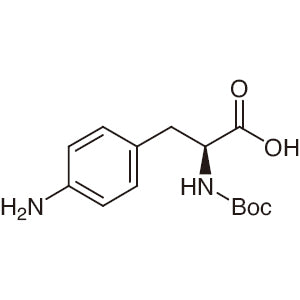
4-Amino-N-(tert-butoxycarbonyl)-L-phenylalanine is a chemical compound widely used in peptide and protein synthesis. This compound plays a crucial role in laboratory settings, particularly in the formation of peptide bonds through amino acid reactions. Its presence is essential in various biochemical and pharmaceutical research applications where the construction of complex molecular structures is required. As a key component in peptidization reactions, it enables the synthesis of peptides with high specificity and functionality.
The compound's stability and resistance to degradation make it a preferred choice for chemical reactions. The presence of the tert-butoxycarbonyl (Boc) group allows for the protection of the amino group, which is vital in controlled synthetic processes. This feature ensures that the compound remains chemically inert until the desired reaction conditions are met. Its ability to participate in a variety of chemical reactions without undergoing unwanted side reactions enhances its utility in laboratory synthesis.
In Indonesian laboratories, this compound is commonly used in biochemical, pharmacological, and life science research. It is a fundamental reagent in the development of new drugs, molecular analysis, and protein studies. Its availability supports researchers in conducting complex experiments, making it an essential component in the chemical toolkit of Indonesian laboratories.
TCI brochures (PDF)
- Amino Acids and Peptide Synthesis Reagents 2025-08-14 · p. 12
Related TCI products
- TCI B5350 68856-96-2 N-(tert-Butoxycarbonyl)-4-methoxy-D-phenylalanine
- TCI B5011 85466-66-6 N-(tert-Butoxycarbonyl)-N-methyl-D-phenylalanine
- TCI B4877 131724-45-3 N-(tert-Butoxycarbonyl)-4-cyano-L-phenylalanine
- TCI B4369 114873-07-3 N-(tert-Butoxycarbonyl)-4-trifluoromethyl-L-phenylalanine
- TCI B4289 147923-08-8 N-(tert-Butoxycarbonyl)-4-phenyl-L-phenylalanine
- TCI B3668 61280-75-9 N-(tert-Butoxycarbonyl)-4-nitro-D-phenylalanine
- Peptide Synthesis: This compound is ideal for synthesizing peptides due to its protected amino group, allowing precise control over reaction pathways.
- Drug Development: It is widely used in the creation of new pharmaceutical compounds, supporting the design of bioactive molecules.
- Molecular Analysis: Its chemical stability makes it suitable for use in molecular analysis techniques, ensuring accurate and reproducible results.
- Protein Research: It contributes to the study of protein structures and functions, aiding in understanding biological processes.
- Biochemical Studies: It is essential in biochemical experiments where the synthesis of functional molecules is required.
| Brand | TCI |
|---|---|
| CAS number | 55533-24-9 |
| Molecular formula | — |
| Purity | — |
| Category | Chemistry > Chemical Biology > Peptide Chemistry |
| Pack sizes | Available in various quantities as per standard laboratory requirements |
| Physical form | Solid |
| Storage | Store in a cool, dry place away from moisture and direct sunlight |
This compound should be stored in a cool, dry environment to maintain its chemical stability. It is recommended to keep it in a sealed container to prevent exposure to moisture and air. Avoid storing it near sources of heat or direct sunlight to minimize degradation. When handling, ensure proper laboratory safety practices are followed, including the use of gloves and safety goggles. The compound is non-hazardous under normal conditions but should be handled with care to prevent contamination. Regular inspection of storage conditions is advised to ensure the integrity of the material remains intact for experimental use.
—
Product Categories
- Chemical BiologyPeptide ChemistryAmino Acid Derivatives [Peptide Chemistry]
- Chemical BiologyPeptide ChemistryUnnatural Amino Acid Derivatives
- Pharmaceutical Development and Drug Discovery Research ReagentsPeptide ChemistryAmino Acid Derivatives [Peptide Chemistry]
- Pharmaceutical Development and Drug Discovery Research ReagentsPeptide ChemistryUnnatural Amino Acid Derivatives
Produk Terkait
-
N-(tert-Butoxycarbonyl)-4-methoxy-D-phenylalanine TCI B5350
Regular price From Rp 1.723.050,00Regular priceRp 1.220.100,00Sale price From Rp 1.723.050,00 -
N-(tert-Butoxycarbonyl)-N-methyl-D-phenylalanine TCI B5011
Regular price From Rp 1.643.250,00Regular priceRp 1.164.450,00Sale price From Rp 1.643.250,00 -
N-(tert-Butoxycarbonyl)-4-cyano-L-phenylalanine TCI B4877
Regular price From Rp 2.518.950,00Regular priceRp 1.776.600,00Sale price From Rp 2.518.950,00 -
N-(tert-Butoxycarbonyl)-4-trifluoromethyl-L-phenylalanine TCI B4369
Regular price Rp 6.306.300,00Regular priceRp 4.425.750,00Sale price Rp 6.306.300,00 -
N-(tert-Butoxycarbonyl)-4-phenyl-L-phenylalanine TCI B4289
Regular price Rp 2.623.950,00Regular priceRp 1.850.100,00Sale price Rp 2.623.950,00 -
N-(tert-Butoxycarbonyl)-4-nitro-D-phenylalanine TCI B3668
Regular price Rp 2.384.550,00Regular priceRp 1.683.150,00Sale price Rp 2.384.550,00 -
N-(tert-Butoxycarbonyl)-3,4-difluoro-L-phenylalanine TCI B3627
Regular price Rp 4.636.800,00Regular priceRp 3.258.150,00Sale price Rp 4.636.800,00 -
N-(tert-Butoxycarbonyl)-4-chloro-L-phenylalanine TCI B3614
Regular price From Rp 1.351.350,00Regular priceRp 960.750,00Sale price From Rp 1.351.350,00


