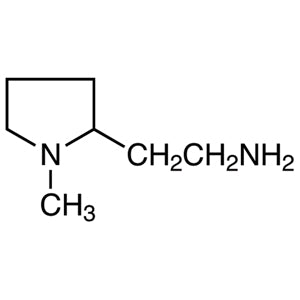
2-(2-Aminoethyl)-1-methylpyrrolidine is a versatile chemical compound widely used in organic reactions for the synthesis of complex molecules. As a key building block, it plays a crucial role in constructing heterocyclic structures that are essential in various chemical applications. Its molecular structure provides a stable foundation for further chemical modifications, making it an important tool in synthetic chemistry. This compound is commonly found in laboratory settings where researchers aim to develop new compounds with specific functional groups or molecular frameworks.
The compound’s high reactivity and the presence of both amino and cyclic groups make it a preferred choice for chemists. It can act as an electron donor and is suitable for a range of reactions such as substitution, reduction, and condensation. Its ability to participate in multiple chemical transformations enhances its utility in both research and educational environments. The stability of its molecular structure ensures that it remains effective under various reaction conditions, contributing to its widespread use in laboratory applications.
In Indonesian laboratories, 2-(2-Aminoethyl)-1-methylpyrrolidine is frequently used in organic chemistry research, particularly in the synthesis of pharmaceutical compounds and advanced materials. It is also integral to academic studies in chemistry and pharmaceutical technology, supporting both teaching and research activities. Its role in creating complex molecular structures makes it a valuable resource for scientists and students alike.
Related TCI products
- Synthesis of pharmacological compounds requiring heterocyclic structures due to its ability to form stable and reactive molecular frameworks.
- Development of intermediate compounds in organic reactions because of its versatility in undergoing substitution and condensation reactions.
- Creation of specialized chemical materials with desired properties due to its structural adaptability and functional group availability.
- Research on reactivity studies involving nitrogen-containing compounds due to its electron-donating capabilities and cyclic nature.
- Educational use in chemistry and pharmaceutical technology programs to demonstrate the principles of heterocyclic synthesis and molecular construction.
| Brand | TCI |
|---|---|
| CAS number | 51387-90-7 |
| Molecular formula | — |
| Purity | — |
| Category | Chemistry > Building Blocks > Heterocyclic Building Blocks |
| Pack sizes | — |
| Physical form | — |
| Storage | Store in a cool, dry place away from light and incompatible materials. |
This compound should be stored in a cool, dry environment, away from direct sunlight and sources of heat. It is recommended to use airtight containers to prevent moisture absorption and maintain its chemical integrity. Proper labeling of storage containers is essential to ensure safe handling and prevent accidental exposure. Due to its reactivity, it should be kept separate from strong oxidizing agents and incompatible substances. Laboratory personnel should wear appropriate personal protective equipment, such as gloves and safety goggles, when handling this material. Regular monitoring of storage conditions is advised to ensure the compound remains stable and suitable for use in chemical experiments.
—
Produk Terkait
-
N-(2-Aminoethyl)piperazine TCI A0304
Regular price From Rp 505.050,00Regular price -
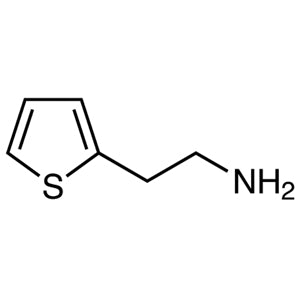
2-(2-Aminoethyl)thiophene TCI A1637
Regular price From Rp 743.400,00Regular price -
1-(2-Aminoethyl)pyrrolidine TCI A0884
Regular price From Rp 1.696.800,00Regular price -
4-(2-Aminoethyl)morpholine TCI A0883
Regular price From Rp 1.087.800,00Regular price -
1-Methylpyrrolidine-2-thione TCI M1748
Regular price Rp 2.916.900,00Regular price -
2-(2-Hydroxyethyl)-1-methylpyrrolidine TCI M0908
Regular price From Rp 3.155.250,00Regular price -
1-Methylpyrrolidine TCI M0415
Regular price From Rp 848.400,00Regular price -
1-Ethylpyrrolidine TCI E0510
Regular price From Rp 2.068.500,00Regular price