


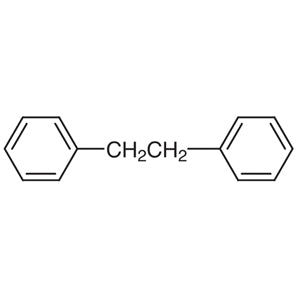
Dibenzyl is a chemical compound widely used in laboratory settings for its role in constructing complex molecular structures. As a building block in organic chemistry, it serves as a fundamental component in the synthesis of both heterocyclic and non-heterocyclic compounds. Its versatility makes it an essential tool for researchers aiming to develop new materials, pharmaceuticals, and chemical entities. Dibenzyl is particularly valued for its ability to participate in substitution and covalent reactions, enabling the creation of a wide range of chemical derivatives.
One of the key attributes of Dibenzyl is its chemical stability, which allows it to be used in various synthetic processes without undergoing unwanted side reactions. This stability ensures that the compound remains effective throughout the reaction sequence, making it a preferred choice for precise chemical synthesis. Additionally, its simple molecular structure contributes to its reactivity in controlled environments, allowing chemists to manipulate its properties with greater accuracy. These characteristics make Dibenzyl a reliable and consistent reagent in both academic and industrial research settings.
In Indonesian laboratories, Dibenzyl is commonly used in organic chemistry and pharmacology research. It is a staple in educational institutions and research centers where experiments require specific molecular structures. Its availability supports the development of new compounds and materials, facilitating scientific innovation. The compound's role in laboratory work is crucial, as it enables researchers to explore the properties and applications of various chemical substances in a controlled manner.
- Organic synthesis applications benefit from Dibenzyl's stability and reactivity, enabling the creation of complex molecular structures with precision.
- Pharmaceutical research utilizes Dibenzyl as a precursor in the development of new drug compounds, supporting the synthesis of bioactive molecules.
- Material science experiments rely on Dibenzyl for the production of advanced polymers and functional materials with tailored properties.
- Analytical chemistry processes use Dibenzyl as a standard reference compound for calibrating instruments and ensuring measurement accuracy.
- Educational laboratories incorporate Dibenzyl into teaching modules to demonstrate fundamental chemical reactions and synthesis techniques.
| Brand | TCI |
|---|---|
| CAS number | 103-29-7 |
| Molecular formula | — |
| Purity | — |
| Category | Chemistry > Building Blocks > Non-Heterocyclic Building Blocks |
| Pack sizes | Available in various quantities as per standard laboratory supply |
| Physical form | Liquid |
| Storage | Store in a cool, dry place away from light and incompatible materials |
Dibenzyl should be stored in a cool, dry environment, away from direct sunlight and sources of heat. It is recommended to keep it in a tightly sealed container made of materials that are chemically inert, such as glass or polyethylene. Due to its potential toxicity, it should be handled with appropriate personal protective equipment, including gloves and safety goggles. Proper ventilation is essential when working with this compound to minimize exposure. Laboratory personnel should be trained in safe handling procedures to ensure compliance with safety regulations and to prevent accidental contamination or exposure.
—
Produk Terkait
-
DibenzylEther TCI B0418
Regular price From Rp 530.250,00Regular priceRp 370.650,00Sale price From Rp 530.250,00 -
DibenzylAdipate TCI A0618
Regular price Rp 5.460.000,00Regular priceRp 3.817.800,00Sale price Rp 5.460.000,00 -
DibenzylSebacate TCI S0147
Regular price From Rp 1.246.350,00Regular priceRp 887.250,00Sale price From Rp 1.246.350,00 -
DibenzylPhosphate TCI P1120
Regular price From Rp 1.801.800,00Regular priceRp 1.275.750,00Sale price From Rp 1.801.800,00 -
DibenzylPhosphite TCI P1016
Regular price From Rp 3.578.400,00Regular priceRp 2.502.150,00Sale price From Rp 3.578.400,00 -
DibenzylMalonate TCI M1080
Regular price From Rp 1.696.800,00Regular priceRp 1.202.250,00Sale price From Rp 1.696.800,00 -
Dibenzyl(Chloromethyl)Phosphate TCI D5828
Regular price Rp 9.751.350,00Regular priceRp 6.834.450,00Sale price Rp 9.751.350,00


