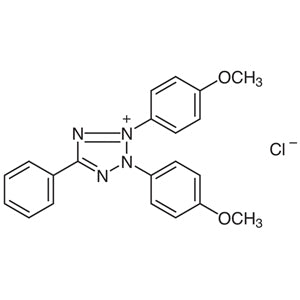
2,3-Bis(4-methoxyphenyl)-5-phenyltetrazolium Chloride is a chemical compound widely used in laboratory settings for various chemical reactions and analytical processes. It belongs to the category of heterocyclic compounds, which are known for their complex structures and versatility in organic synthesis. This compound plays a crucial role in both research and development, serving as a reagent or indicator in specific reactions. Its presence in laboratory workflows is essential for the synthesis of new compounds and for qualitative analysis. Due to its stability and controlled reactivity, it is favored in experiments requiring precision and consistency.
The compound's chemical properties make it a preferred choice for researchers. It exhibits a stable structure that resists decomposition under certain conditions, ensuring reliability in long-term experiments. Its controlled reactivity allows for efficient participation in targeted chemical reactions without unnecessary side effects. Additionally, its solubility characteristics make it suitable for use in a variety of solvents, enhancing its applicability across different experimental setups. These properties contribute to its popularity among scientists conducting high-precision chemical analyses.
In Indonesian laboratories, this compound is commonly used in chemical and pharmaceutical research. It is a go-to material for researchers who require high-quality reagents for their experiments. Its availability and performance make it a reliable choice for both academic and industrial applications. Its role in supporting scientific innovation is significant, particularly in the development of new compounds and analytical techniques.
Related TCI products
- TCI B1047 69231-13-6 2,3-Bis(4-nitrophenyl)-5-phenyltetrazolium Chloride
- TCI B0311 3-(4-Nitrophenyl)-5-methyl-2-phenyltetrazolium Chloride
- TCI B0333 55699-64-4 2-(2-Benzothiazolyl)-3,5-diphenyltetrazolium Bromide
- TCI B0325 38800-20-3 2,3-Diphenyl-5-(2-thienyl)tetrazolium Chloride
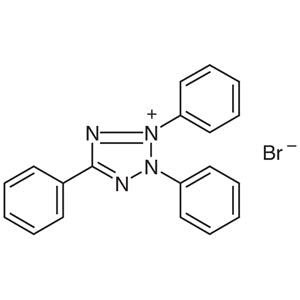
- TCI T0814 1096-80-6 2,3,5-Triphenyltetrazolium Bromide
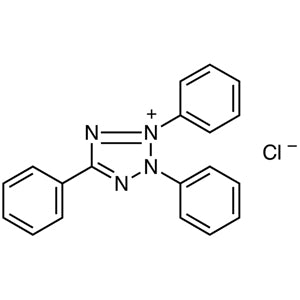
- TCI T0520 298-96-4 2,3,5-Triphenyltetrazolium Chloride
- Used in organic synthesis for the preparation of complex heterocyclic compounds due to its structural versatility and reactivity.
- Applied in qualitative analysis to detect specific functional groups or compounds in a sample through colorimetric reactions.
- Employed in pharmaceutical research for the development of new drug molecules due to its ability to participate in controlled chemical transformations.
- Utilized in spectroscopic studies to serve as a reference compound for identifying and characterizing other substances.
- Integrated into enzymatic assays as a substrate or indicator for measuring enzyme activity and reaction kinetics.
| Brand | TCI |
|---|---|
| CAS number | 104497-79-2 |
| Molecular formula | — |
| Purity | — |
| Category | Chemistry > Building Blocks > Heterocyclic Building Blocks |
| Pack sizes | Available in various quantities as per standard laboratory supply practices |
| Physical form | Solid powder |
| Storage | Store in a cool, dry place away from direct light and moisture |
This compound should be stored in a cool, dry environment to maintain its chemical stability. It is recommended to keep it in a sealed container to prevent exposure to moisture and air, which could affect its integrity. Suitable containers include glass or high-density polyethylene vessels that are resistant to chemical degradation. Laboratory personnel should handle the compound with care, using appropriate personal protective equipment such as gloves and safety goggles. It is important to ensure that the compound is stored away from incompatible materials to avoid any potential chemical reactions. Proper labeling and storage conditions help in maintaining the quality and usability of the compound for extended periods.
—
Produk Terkait
-
2,3-Bis(4-nitrophenyl)-5-phenyltetrazoliumChloride TCI B1047
Regular price Rp 3.446.100,00Regular price -
Chloride TCI B0311
Regular price Rp 1.326.150,00Regular price -
2-(2-Benzothiazolyl)-3,5-diphenyltetrazoliumBromide TCI B0333
Regular price Rp 1.378.650,00Regular price -
2,3-Diphenyl-5-(2-thienyl)tetrazoliumChloride TCI B0325
Regular price From Rp 1.696.800,00Regular price -
2,3,5-TriphenyltetrazoliumBromide TCI T0814
Regular price Rp 477.750,00Regular price -
2,3,5-TriphenyltetrazoliumChloride TCI T0520
Regular price From Rp 610.050,00Regular price -
5-Phenyltetrazole TCI P1109
Regular price Rp 1.353.450,00Regular price -
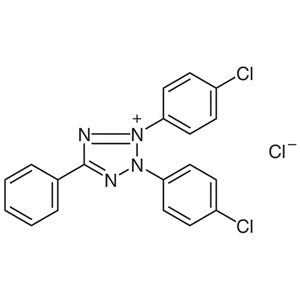
2,3-Bis(4-chlorophenyl)-5-phenyltetrazoliumChloride TCI B1052
Regular price Rp 1.829.100,00Regular price