


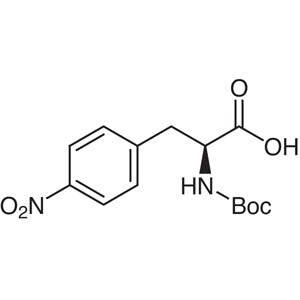
N-(tert-Butoxycarbonyl)-4-nitro-L-phenylalanine is a chemical compound widely used in organic and biochemical research, particularly in peptide synthesis. This compound plays a crucial role in laboratory settings where the controlled modification of amino acid side chains is required. Its tert-butoxycarbonyl (Boc) group acts as a protective group, preventing premature reactions during complex synthetic processes. This makes it an essential tool for chemists and biochemists working on the development of peptides and proteins.
The compound's unique chemical properties make it a preferred choice for researchers seeking precision and reliability in their synthetic workflows. The Boc group provides stability under various reaction conditions, allowing for selective deprotection when needed. Its ability to participate in peptide bond formation and other biochemical reactions enhances its versatility in laboratory applications. The compound's structural specificity ensures that it can be used in applications requiring high accuracy and reproducibility.
In Indonesian laboratories, this compound is commonly used in biomedical and pharmaceutical research. It is a key component in the synthesis of bioactive compounds, including potential drug candidates. Its role in the development of therapeutic agents and its use in academic and industrial research make it an important material for scientists in the region.
TCI brochures (PDF)
- Amino Acids and Peptide Synthesis Reagents 2025-08-14 · p. 13
Related TCI products
- TCI B5350 68856-96-2 N-(tert-Butoxycarbonyl)-4-methoxy-D-phenylalanine
- TCI B5011 85466-66-6 N-(tert-Butoxycarbonyl)-N-methyl-D-phenylalanine
- TCI B4877 131724-45-3 N-(tert-Butoxycarbonyl)-4-cyano-L-phenylalanine
- TCI B4369 114873-07-3 N-(tert-Butoxycarbonyl)-4-trifluoromethyl-L-phenylalanine
- TCI B4289 147923-08-8 N-(tert-Butoxycarbonyl)-4-phenyl-L-phenylalanine
- TCI B3668 61280-75-9 N-(tert-Butoxycarbonyl)-4-nitro-D-phenylalanine
- Peptide Synthesis: This compound is ideal for peptide synthesis due to its Boc protecting group, which allows for controlled deprotection and selective coupling reactions.
- Biochemical Research: Its use in biochemical studies enables the creation of complex molecules with specific functional groups, aiding in enzyme and receptor studies.
- Drug Development: The compound is frequently used in the development of pharmaceuticals, supporting the synthesis of bioactive peptides and proteins.
- Organic Chemistry Experiments: Its stability and reactivity make it suitable for various organic reactions, including coupling and modification reactions.
- Biomedical Research: It plays a key role in the development of therapeutic agents, supporting research in pharmacology and molecular biology.
| Brand | TCI |
|---|---|
| CAS number | 33305-77-0 |
| Molecular formula | — |
| Purity | — |
| Category | Chemistry > Chemical Biology > Peptide Chemistry |
| Pack sizes | Available in various quantities as per supplier specifications |
| Physical form | Solid powder |
| Storage | Store in a cool, dry place away from moisture and light |
This compound should be stored in a cool, dry environment to maintain its chemical integrity. It is recommended to keep it in a tightly sealed container to prevent exposure to moisture and air. Due to its chemical nature, it should be handled with appropriate personal protective equipment, such as gloves and safety goggles. It is advisable to store it away from incompatible substances to avoid any potential chemical reactions. Proper labeling of containers is essential for safe handling and storage in a laboratory setting. Regular inspection of storage conditions ensures the compound remains stable and suitable for use in research applications.
—
Product Categories
- Chemical BiologyPeptide ChemistryAmino Acid Derivatives [Peptide Chemistry]
- Chemical BiologyPeptide ChemistryUnnatural Amino Acid Derivatives
- Pharmaceutical Development and Drug Discovery Research ReagentsPeptide ChemistryAmino Acid Derivatives [Peptide Chemistry]
- Pharmaceutical Development and Drug Discovery Research ReagentsPeptide ChemistryUnnatural Amino Acid Derivatives
Produk Terkait
-
N-(tert-Butoxycarbonyl)-4-methoxy-D-phenylalanine TCI B5350
Regular price From Rp 1.723.050,00Regular priceRp 1.220.100,00Sale price From Rp 1.723.050,00 -
N-(tert-Butoxycarbonyl)-N-methyl-D-phenylalanine TCI B5011
Regular price From Rp 1.643.250,00Regular priceRp 1.164.450,00Sale price From Rp 1.643.250,00 -
N-(tert-Butoxycarbonyl)-4-cyano-L-phenylalanine TCI B4877
Regular price From Rp 2.518.950,00Regular priceRp 1.776.600,00Sale price From Rp 2.518.950,00 -
N-(tert-Butoxycarbonyl)-4-trifluoromethyl-L-phenylalanine TCI B4369
Regular price Rp 6.306.300,00Regular priceRp 4.425.750,00Sale price Rp 6.306.300,00 -
N-(tert-Butoxycarbonyl)-4-phenyl-L-phenylalanine TCI B4289
Regular price Rp 2.623.950,00Regular priceRp 1.850.100,00Sale price Rp 2.623.950,00 -
N-(tert-Butoxycarbonyl)-4-nitro-D-phenylalanine TCI B3668
Regular price Rp 2.384.550,00Regular priceRp 1.683.150,00Sale price Rp 2.384.550,00 -
N-(tert-Butoxycarbonyl)-3,4-difluoro-L-phenylalanine TCI B3627
Regular price Rp 4.636.800,00Regular priceRp 3.258.150,00Sale price Rp 4.636.800,00 -
N-(tert-Butoxycarbonyl)-4-chloro-L-phenylalanine TCI B3614
Regular price From Rp 1.351.350,00Regular priceRp 960.750,00Sale price From Rp 1.351.350,00


