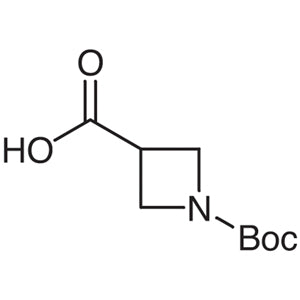
1-(tert-Butoxycarbonyl)azetidine-3-carboxylic Acid is a chemical compound widely used in organic synthesis reactions, particularly in the formation of heterocyclic structures. This compound plays a crucial role in laboratories where the synthesis of complex molecules is required. It serves as a key building block in the development of various chemical compounds with applications in pharmacology and materials science. Its presence in laboratory settings enables researchers to create essential azetidine structures that are fundamental to many biological molecules.
The compound's tert-butoxycarbonyl (Boc) group provides chemical stability, making it a preferred choice for synthetic processes. This stability ensures that the compound remains intact during reactions, reducing the risk of unwanted side reactions. Its resistance to hydrolysis allows for extended shelf life and improved efficiency in chemical reactions. These properties make it a reliable and effective reagent for laboratory use, especially in applications requiring high stability and controlled reaction conditions.
In Indonesian laboratories, 1-(tert-Butoxycarbonyl)azetidine-3-carboxylic Acid is commonly used in organic chemistry research, particularly in the development of new compounds with potential medical or industrial applications. It is frequently found in studies related to drug synthesis, where its structural properties are essential for creating bioactive molecules. Its versatility and reliability make it a valuable tool for researchers in both academic and industrial settings.
TCI brochures (PDF)
- Amino Acids and Peptide Synthesis Reagents 2025-08-14 · p. 14
Related TCI products
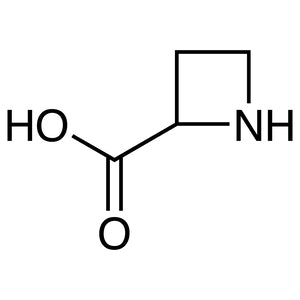
- TCI A3562 2517-04-6 Azetidine-2-carboxylic Acid
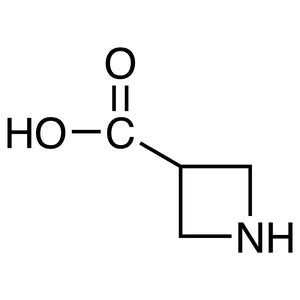
- TCI A1646 36476-78-5 Azetidine-3-carboxylic Acid
- TCI B4501 78879-20-6 (S)-2-(tert-Butoxycarbonyl)-1,2,3,4-tetrahydroisoquinoline-3-carboxylic Acid
- TCI B5350 68856-96-2 N-(tert-Butoxycarbonyl)-4-methoxy-D-phenylalanine
- TCI B5322 159622-10-3 (1R,2S)-1-[(tert-Butoxycarbonyl)amino]-2-vinylcyclopropanecarboxylic Acid
- TCI B5011 85466-66-6 N-(tert-Butoxycarbonyl)-N-methyl-D-phenylalanine
- Organic synthesis of heterocyclic compounds due to its ability to form stable azetidine structures.
- Development of pharmaceuticals where controlled reactivity and stability are essential.
- Research into new materials that require precise chemical building blocks for molecular design.
- Synthesis of bioactive molecules that rely on azetidine ring formation for biological activity.
- Investigation of chemical reactions that benefit from the Boc group's resistance to hydrolysis.
| Brand | TCI |
|---|---|
| CAS number | 142253-55-2 |
| Molecular formula | — |
| Purity | — |
| Category | Chemistry > Building Blocks > Heterocyclic Building Blocks |
| Pack sizes | Available in various quantities as per standard laboratory supply |
| Physical form | Solid (exact form may vary depending on supplier) |
| Storage | Store in a cool, dry place away from moisture and direct sunlight |
This compound should be stored in a cool, dry environment to maintain its chemical stability. It is recommended to keep it in a sealed container to prevent exposure to moisture and air. Proper ventilation is necessary when handling the material to minimize inhalation risks. The container should be made of a material compatible with the compound's chemical properties, such as glass or high-density polyethylene. Avoid contact with incompatible substances to prevent unintended reactions. Always follow standard laboratory safety protocols when working with this compound to ensure safe and effective use.
—
Product Categories
- Building BlocksHeterocyclic Building BlocksNon-Halogenated Heterocyclic Building Blocks
- Chemical BiologyPeptide ChemistryAmino Acid Derivatives [Peptide Chemistry]
- Chemical BiologyPeptide ChemistryUnnatural Amino Acid Derivatives
- Pharmaceutical Development and Drug Discovery Research ReagentsPeptide ChemistryAmino Acid Derivatives [Peptide Chemistry]
- Pharmaceutical Development and Drug Discovery Research ReagentsPeptide ChemistryUnnatural Amino Acid Derivatives
Produk Terkait
-
Azetidine-2-carboxylicAcid TCI A3562
Regular price From Rp 2.252.250,00Regular priceRp 1.590.750,00Sale price From Rp 2.252.250,00 -
Azetidine-3-carboxylicAcid TCI A1646
Regular price From Rp 1.220.100,00Regular priceRp 868.350,00Sale price From Rp 1.220.100,00 -
(S)-2-(tert-Butoxycarbonyl)-1,2,3,4-tetrahydroisoquinoline-3-carboxylicAcid TCI B4501
Regular price From Rp 1.351.350,00Regular priceRp 960.750,00Sale price From Rp 1.351.350,00 -
N-(tert-Butoxycarbonyl)-4-methoxy-D-phenylalanine TCI B5350
Regular price From Rp 1.723.050,00Regular priceRp 1.220.100,00Sale price From Rp 1.723.050,00 -
(1R,2S)-1-[(tert-Butoxycarbonyl)amino]-2-vinylcyclopropanecarboxylicAcid TCI B5322
Regular price From Rp 689.850,00Regular priceRp 497.700,00Sale price From Rp 689.850,00 -
N-(tert-Butoxycarbonyl)-N-methyl-D-phenylalanine TCI B5011
Regular price From Rp 1.643.250,00Regular priceRp 1.164.450,00Sale price From Rp 1.643.250,00 -
N-(tert-Butoxycarbonyl)-4-trifluoromethyl-L-phenylalanine TCI B4369
Regular price Rp 6.306.300,00Regular priceRp 4.425.750,00Sale price Rp 6.306.300,00