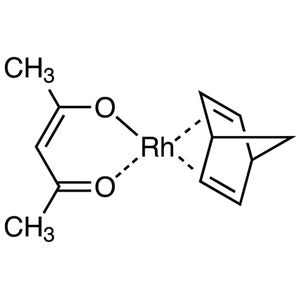
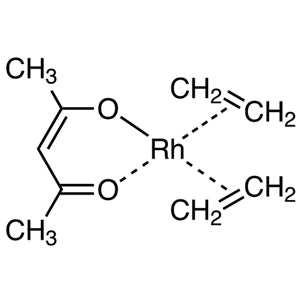
This complex chemical compound is a chiral catalyst used in asymmetric synthesis to accelerate chemical reactions and produce molecules with a specific spatial structure. It is designed to selectively favor one enantiomer over another, making it essential for applications requiring high stereochemical control. Its role in the laboratory is to facilitate reactions that demand precise molecular orientation, such as hydrogenation, oxidation, and cross-coupling processes. This compound is particularly valuable in the development of pharmaceuticals and organic chemicals where stereochemistry plays a critical role in biological activity.
The compound’s effectiveness stems from its complex molecular structure and its ability to function as a chiral ligand bound to a rhodium complex. This unique composition allows it to interact specifically with substrates, enhancing reaction efficiency and selectivity. Its stability under various reaction conditions ensures reliable performance in laboratory settings, making it a preferred choice for chemists working on intricate synthetic pathways. The compound’s ability to maintain its chiral integrity during reactions is a key factor in its widespread use.
In Indonesian laboratories, this material is commonly utilized in research and development projects focused on pharmaceuticals, fine chemicals, and specialty compounds. Its application is especially relevant in industries that require high precision and control over molecular structure. The compound is a go-to option for scientists aiming to achieve specific stereochemical outcomes in their synthetic processes.
Advantages (TCI brochure)
- Converts terminal alkenes into optically active 1,2-diols
- Catalyzes cross-coupling of alkynes in the formation of stereoselective ene-ynes
TCI brochures (PDF)
- Pincer-type Chiral Rhodium Complex Catalyst 2024-08-07 · p. 1
- Asymmetric Synthesis 2026-03-18 · p. 2
Related TCI products
- TCI B4549 819050-89-0 Bis[rhodium(alpha,alpha,alpha',alpha'-tetramethyl-1,3-benzenedipropionic Acid)]
- TCI B3961 35138-22-8 Bis(1,5-cyclooctadiene)rhodium(I) Tetrafluoroborate
- TCI B2091 36620-11-8 Bis[eta-(2,5-norbornadiene)]rhodium(I) Tetrafluoroborate
- TCI B1692 13938-94-8 Carbonylbis(triphenylphosphine)rhodium(I) Chloride
- TCI B1045 12092-47-6 Chloro(1,5-cyclooctadiene)rhodium(I) Dimer
- TCI A2761 32354-50-0 (Acetylacetonato)(norbornadiene)rhodium(I)
- Asymmetric hydrogenation reactions benefit from this compound’s ability to selectively produce desired enantiomers, ensuring high stereochemical purity in pharmaceutical synthesis.
- Oxidation reactions in organic chemistry rely on its chiral ligand structure to guide substrate interactions, enhancing reaction specificity and yield.
- Cross-coupling reactions require precise control over reaction pathways, and this catalyst provides the necessary selectivity for efficient bond formation.
- Chiral ligand-based catalytic systems utilize its complex structure to modulate reaction mechanisms, enabling the synthesis of complex molecules with defined stereochemistry.
- Pharmaceutical compound development leverages its selectivity to produce active pharmaceutical ingredients with the required stereoconfiguration for biological activity.
From the TCI brochure
- Asymmetric diboration of terminal alkenes and conversion to optically active 1,2-diols
- Stereoselective cross-coupling of alkynes
| Brand | TCI |
|---|---|
| CAS number | 929896-28-6 |
| Molecular formula | — |
| Purity | — |
| Category | Chemistry > Asymmetric Synthesis > Chiral Catalysts, Chiral Ligands, Chiral Reagents |
| Pack sizes | — |
| Physical form | — |
| Storage | Store in a cool, dry place away from moisture and light |
Data from the TCI brochure
| Kemasan | 10 mg |
|---|---|
| Loading katalis | 1 mol% (THF, 60 °C, 1 h (diborasi)) |
| Loading katalis | 1 mol% (H2 (1 atm), toluene, 100 °C, 4 h (kopling silang)) |
Source: TCI brochure RR032 (2024-08-07)
This compound should be stored in a cool, dry environment to maintain its chemical stability and catalytic activity. It is recommended to use airtight containers to prevent exposure to moisture and air, which may affect its performance. Due to its complex molecular structure, it is important to handle it with care to avoid contamination or degradation. In laboratory settings, it should be kept in a designated storage area that is accessible only to authorized personnel. Proper labeling and documentation are essential to ensure safe handling and usage. Always follow standard laboratory safety protocols when working with this material.
References cited in the TCI brochure
- Jun-ichi Ito. Asymmetric Catalysis Mediated by Optically Active Bis(oxazolinyl)phenyl Metal Complexes Journal of Synthetic Organic Chemistry, Japan, 2013. doi:10.5059/yukigoseikyokaishi.71.791
- Kenji Toribatake. Asymmetric Diboration of Terminal Alkenes with a Rhodium Catalyst and Subsequent Oxidation: Enantioselective Synthesis of Optically Active 1,2‐Diols Angewandte Chemie International Edition, 2013. doi:10.1002/anie.201305181
- Jun-ichi Ito. Cross-Coupling of Alkynes Catalyzed by Phebox−Rhodium Acetate Complexes Organometallics, 2007. doi:10.1021/om700742t
Produk Terkait
-
Bis[rhodium(alpha,alpha,alpha',alpha'-tetramethyl-1,3-benzenedipropionicAcid)] TCI B4549
Regular price Rp 2.464.350,00Regular priceRp 1.738.800,00Sale price Rp 2.464.350,00 -
Bis(1,5-cyclooctadiene)rhodium(I)Tetrafluoroborate TCI B3961
Regular price From Rp 2.411.850,00Regular priceRp 1.702.050,00Sale price From Rp 2.411.850,00 -
Bis[eta-(2,5-norbornadiene)]rhodium(I)Tetrafluoroborate TCI B2091
Regular price Rp 2.702.700,00Regular priceRp 1.905.750,00Sale price Rp 2.702.700,00 -
Carbonylbis(triphenylphosphine)rhodium(I)Chloride TCI B1692
Regular price Rp 10.414.950,00Regular priceRp 7.298.550,00Sale price Rp 10.414.950,00 -
Chloro(1,5-cyclooctadiene)rhodium(I)Dimer TCI B1045
Regular price From Rp 2.942.100,00Regular priceRp 2.072.700,00Sale price From Rp 2.942.100,00 -
(Acetylacetonato)(norbornadiene)rhodium(I) TCI A2761
Regular price From Rp 3.472.350,00Regular priceRp 2.443.350,00Sale price From Rp 3.472.350,00 -
Acetylacetonatobis(ethylene)rhodium(I) TCI A2100
Regular price Rp 5.380.200,00Regular priceRp 3.777.900,00Sale price Rp 5.380.200,00 -
Tris(triphenylphosphine)rhodium(I)Chloride TCI T0931
Regular price Rp 5.485.200,00Regular priceRp 3.851.400,00Sale price Rp 5.485.200,00