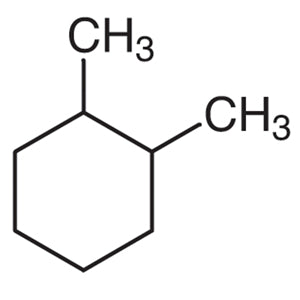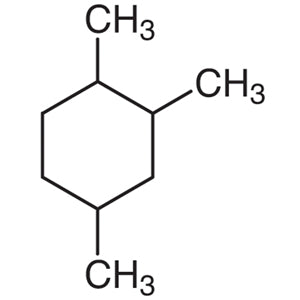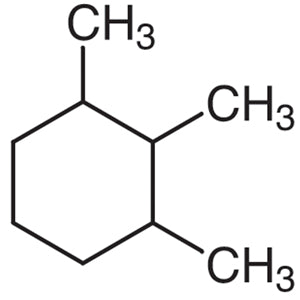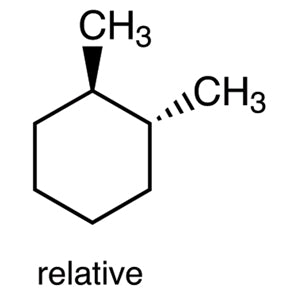
Trans-1,2-Dimethylcyclohexane is an organic compound widely used as a foundational building block in the synthesis of complex chemical structures. It belongs to the class of non-heterocyclic compounds, making it a versatile reagent in various chemical reactions. Its unique trans configuration of two methyl groups on a cyclohexane ring provides specific stereochemical properties that are essential in creating targeted molecular structures. This compound plays a critical role in organic chemistry by enabling the formation of specific functional groups and stereochemistry, which are vital in drug development and material science.
The compound is known for its stable chemical properties and controlled reactivity, making it a preferred choice for researchers. Its non-polar nature and volatility allow for efficient evaporation and separation during chemical processes, enhancing the precision of experimental outcomes. Additionally, its lack of heterocyclic components ensures that it does not interfere with other complex structures, making it ideal for reactions that require simplicity and purity. These characteristics make it a reliable and consistent reagent in laboratory settings.
In Indonesian laboratories, Trans-1,2-Dimethylcyclohexane is commonly used in both educational and research environments. It is integral to teaching organic chemistry concepts and is frequently employed in research projects aimed at synthesizing new compounds. Its availability and reliability have made it a staple in many academic and industrial laboratories across Indonesia, supporting both basic and advanced chemical investigations.
Related TCI products
- TCI D1054 2207-03-6 trans-1,3-Dimethylcyclohexane
- TCI D0700 589-90-2 1,4-Dimethylcyclohexane (cis- and trans- mixture)
- TCI D0699 591-21-9 1,3-Dimethylcyclohexane (cis- and trans- mixture)
- TCI D0698 583-57-3 1,2-Dimethylcyclohexane (cis- and trans- mixture)
- TCI D0271 2207-04-7 trans-1,4-Dimethylcyclohexane
- TCI T0827 3073-66-3 1,1,3-Trimethylcyclohexane
- Organic synthesis reactions benefit from Trans-1,2-Dimethylcyclohexane due to its stable structure and predictable reactivity, allowing for precise control over reaction outcomes.
- It is ideal for stereochemistry studies as its trans configuration enables the investigation of spatial arrangements in complex molecules.
- In educational settings, it serves as a key teaching tool for understanding cycloalkane structures and substitution patterns in organic chemistry.
- Its non-polar nature makes it suitable for solvent applications where non-polar solvation is required in chemical separations and extractions.
- It supports the development of new materials by providing a base for the synthesis of polymers and other functional compounds with specific structural requirements.
| Brand | TCI |
|---|---|
| CAS number | 6876-23-9 |
| Molecular formula | — |
| Purity | — |
| Category | Chemistry > Building Blocks > Non-Heterocyclic Building Blocks |
| Pack sizes | Available in various quantities as per standard chemical supply practices |
| Physical form | Liquid |
| Storage | Store in a cool, dry place away from direct sunlight and incompatible materials |
Trans-1,2-Dimethylcyclohexane should be stored in a cool, dry environment, away from direct sunlight and sources of heat. It is recommended to use airtight, non-reactive containers such as glass or high-density polyethylene to prevent contamination and evaporation. Due to its volatility, it should be handled in a well-ventilated area to minimize exposure. Always ensure that the container is properly sealed when not in use. Avoid contact with incompatible substances such as strong oxidizers or acids. In laboratory settings, it is essential to follow standard safety protocols, including the use of personal protective equipment when handling this compound.
—
Produk Terkait
-
trans-1,3-Dimethylcyclohexane TCI D1054
Regular price Rp 3.949.050,00Regular price -
1,4-Dimethylcyclohexane(cis-andtrans-mixture) TCI D0700
Regular price From Rp 1.298.850,00Regular price -
1,3-Dimethylcyclohexane(cis-andtrans-mixture) TCI D0699
Regular price From Rp 1.458.450,00Regular price -
1,2-Dimethylcyclohexane(cis-andtrans-mixture) TCI D0698
Regular price From Rp 848.400,00Regular price -
trans-1,4-Dimethylcyclohexane TCI D0271
Regular price From Rp 1.618.050,00Regular price -
1,1,3-Trimethylcyclohexane TCI T0827
Regular price Rp 5.830.650,00Regular price -
1,2,4-Trimethylcyclohexane(mixtureofstereoisomers) TCI T0825
Regular price From Rp 1.776.600,00Regular price -
1,2,3-Trimethylcyclohexane TCI T0824
Regular price Rp 3.100.650,00Regular price