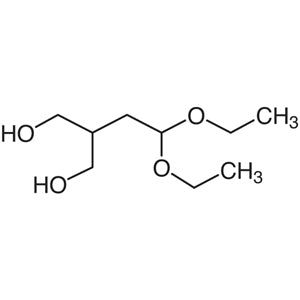
2-(2,2-Diethoxyethyl)-1,3-propanediol is a chemical compound widely used as a foundational building block in organic synthesis. Its role in the laboratory is crucial for constructing complex molecules through various chemical reactions. This compound is particularly valued for its ability to participate in high-reactivity processes and form bonds with multiple functional groups. As a versatile reagent, it supports the development of new compounds and modifications of existing ones, making it an essential component in organic chemistry research.
The unique properties of 2-(2,2-Diethoxyethyl)-1,3-propanediol, such as its molecular structure and reactivity, make it a preferred choice for researchers. The presence of ethoxy groups enhances its reactivity, allowing it to engage in substitution and coupling reactions effectively. These characteristics provide flexibility in chemical synthesis, enabling scientists to tailor reactions to specific needs. Its adaptability and reactivity make it a reliable and efficient tool in the laboratory, especially for those working on complex molecular designs.
In Indonesian laboratories, this compound is extensively used in organic chemistry research. It plays a vital role in the development of new compounds and the modification of existing ones. Its ability to be integrated into various molecular structures makes it a key ingredient in numerous research projects. Researchers in Indonesia rely on this compound for its versatility and effectiveness in chemical synthesis processes.
- Organic synthesis projects benefit from this compound due to its reactivity and ability to form complex molecular structures.
- It is ideal for substitution reactions because of its ethoxy groups, which enhance chemical versatility.
- Coupling reactions are supported by its molecular structure, allowing it to link different functional groups efficiently.
- It is commonly used in the development of new chemical compounds, providing a flexible building block for innovation.
- Modification of existing compounds is facilitated by its reactivity, making it a valuable tool in chemical research.
| Brand | TCI |
|---|---|
| CAS number | 55387-85-4 |
| Molecular formula | — |
| Purity | — |
| Category | Chemistry > Building Blocks > Non-Heterocyclic Building Blocks |
| Pack sizes | Available in standard laboratory quantities |
| Physical form | Liquid |
| Storage | Store in a cool, dry place away from light and incompatible materials |
This compound should be stored in a cool, dry environment, away from direct sunlight and incompatible substances. It is recommended to use sealed containers to prevent exposure to air and moisture. Proper ventilation is essential when handling the material to minimize inhalation risks. Laboratory personnel should wear appropriate personal protective equipment, including gloves and safety goggles, to ensure safe handling. The compound should not be stored near flammable materials or strong oxidizers. Regular monitoring of storage conditions is advised to maintain its integrity and ensure safe usage.
—
Produk Terkait
-
2-Bromo-2-nitro-1,3-propanediol TCI B1247
Regular price From Rp 1.008.000,00Regular price -
2-Butyl-2-ethyl-1,3-propanediol TCI B0922
Regular price From Rp 477.750,00Regular price -
3-Phenoxy-1,2-propanediol TCI P1335
Regular price From Rp 3.287.550,00Regular price -
2-Phenyl-1,3-propanediol TCI P1249
Regular price From Rp 1.485.750,00Regular price -
1,3-Propanediol TCI P0486
Regular price From Rp 477.750,00Regular price -
2-Methylene-1,3-propanediol TCI M2473
Regular price From Rp 1.060.500,00Regular price -
2-Methyl-1,3-propanediol TCI M1114
Regular price From Rp 557.550,00Regular price -
2-Methyl-2-nitro-1,3-propanediol TCI M0639
Regular price From Rp 2.121.000,00Regular price