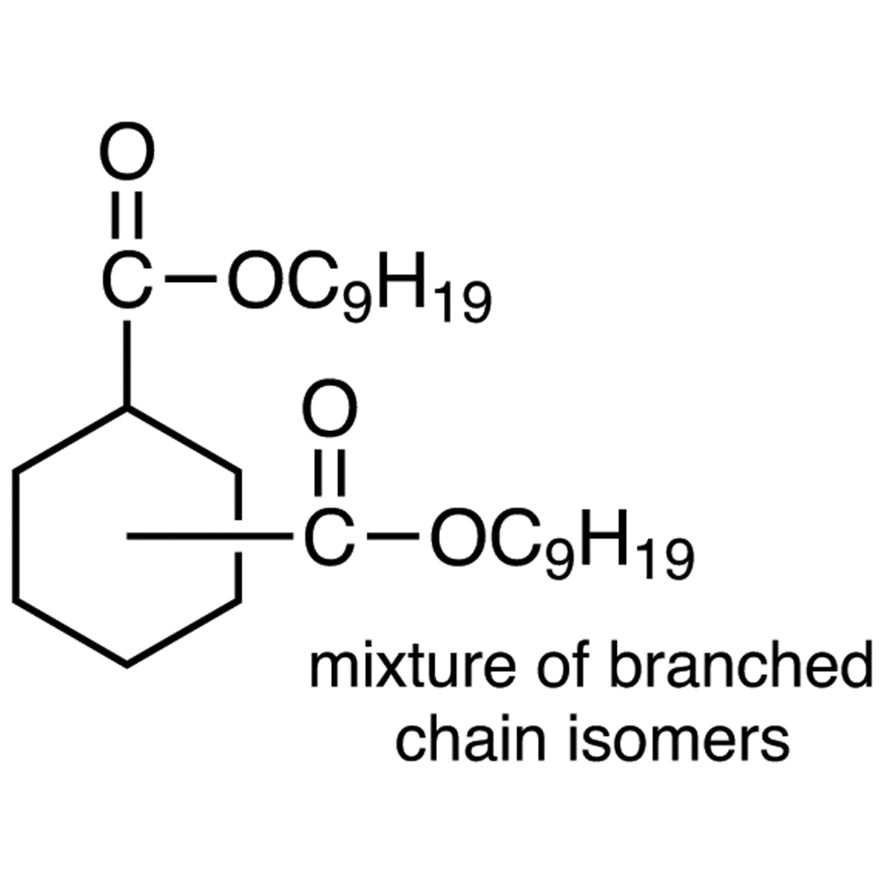
Diisononyl Cyclohexanedicarboxylate is the diisononyl ester of cyclohexanedicarboxylic acid, supplied as a mixture of branched chain isomers, and is widely known as a non-phthalate plasticizer. In the laboratory its function is that of a polymer additive incorporated into resin matrices, particularly polyvinyl chloride, in order to lower the glass transition temperature and to improve the flexibility, softness, and processability of the material. Because the aromatic phthalate framework is replaced by a saturated cyclohexane ring, this compound becomes an important research option whenever a formulation needs to be steered away from conventional phthalate plasticizers.
The property that makes this material attractive is the combination of good compatibility with PVC resin and its physical character as a viscous liquid with low volatility. The branched isononyl chains provide freedom of movement to the polymer chains so that the softening effect is achieved, while the cycloaliphatic ester structure delivers adequate stability during mixing and heating. This balance between plasticizing efficiency and thermal behaviour during compounding is what allows the compound to be evaluated as a direct working alternative within resin formulations, rather than only as a structural curiosity.
Packaging in millilitre units indicates that the substance is handled as a liquid, so it is easily pipetted and measured with volumetric glassware. In Indonesian laboratories this makes the material convenient for polymer formulation work carried out at bench scale, where small measured volumes are added to resin batches for trial compounding, screening, and comparative study. Handling as a liquid also suits routine academic and industrial research settings where accurate small-volume dispensing is the normal working method.
- PVC softening studies — added into polyvinyl chloride matrices to lower the glass transition temperature and to raise the flexibility and softness of the finished resin.
- Non-phthalate formulation research — used when a formulation must be directed away from conventional phthalate plasticizers, since the aromatic ring is replaced by a saturated cyclohexane ring.
- Polymer processability trials — incorporated as a polymer additive to improve the processing behaviour of resin systems during mixing and heating operations at the bench.
- Plasticizer compatibility evaluation — its good compatibility with PVC resin makes it suitable for comparative screening of plasticizer–resin pairings in polymer additive research.
- Low-volatility additive testing — the viscous liquid character with low volatility supports formulation work where the additive must remain in the matrix during thermal processing.
| Brand | TCI |
|---|---|
| CAS number | 508181-38-2 |
| Molecular formula | — |
| Purity | — |
| Category | Materials Science > Polymer/Macromolecule Reagents > Polymer Additives |
| Pack sizes | supplied in millilitre units, handled and dispensed as a liquid |
| Physical form | viscous liquid, low volatility; mixture of branched chain isomers |
| Storage | — |
- Catalogue reference: TCI D3754
Store the container tightly closed in a cool, dry, and well-ventilated area, away from direct sunlight, heat sources, and incompatible materials. Keep the product in its original supplier container or in clean, chemically resistant glassware that is clearly labelled. Because the material is a viscous liquid, dispense it with pipettes or volumetric glassware suited to viscous samples, and allow adequate time for complete transfer. Handle in a fume hood or well-ventilated laboratory space, wearing safety glasses, a laboratory coat, and chemically resistant gloves. Avoid skin and eye contact, close the container immediately after use, and consult the manufacturer safety data sheet before first handling and before disposal.
—
Produk Terkait
-
Bicyclo[2.2.2]octane-1,4-dicarboxylicAcid TCI B5595
Regular price Rp 4.957.050,00Regular price -
Bicyclo[2.2.2]octane-2,3,5,6-tetracarboxylic2,3:5,6-Dianhydride TCI B6198
Regular price From Rp 2.995.650,00Regular price -
Bicyclo[1.1.1]pentane-1,3-dicarboxylicAcid TCI B6522
Regular price Rp 4.797.450,00Regular price -
(+)-CamphoricAcid TCI C0012
Regular price From Rp 1.220.100,00Regular price -
cis-1,2-CyclohexanedicarboxylicAcid TCI C0458
Regular price From Rp 1.008.000,00Regular price -
trans-1,2-CyclohexanedicarboxylicAcid TCI C0474
Regular price From Rp 2.199.750,00Regular price -
trans-1,4-CyclohexanedicarboxylicAcid TCI C0475
Regular price From Rp 1.881.600,00Regular price -
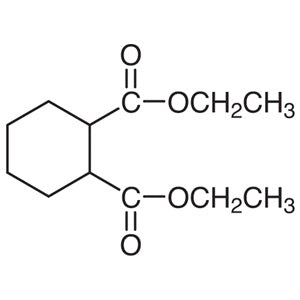
Diethylcis-1,2-Cyclohexanedicarboxylate(containsDiethyltrans-1,2-Cyclohexanedicarboxylate) TCI C0476
Regular price From Rp 1.749.300,00Regular price
![Bicyclo[2.2.2]octane-1,4-dicarboxylic Acid (CAS 711-02-4) - TCI B5595 - AMI Scientific](http://amiscientific.com/cdn/shop/files/TCI2510B5595.jpg?v=1767092548&width=533)
![Bicyclo[2.2.2]octane-2,3,5,6-tetracarboxylic 2,3:5,6-Dianhydride (CAS 2754-40-7) - TCI B6198 - AMI Scientific](http://amiscientific.com/cdn/shop/files/TCI2510B6198.jpg?v=1768816002&width=533)
![Bicyclo[1.1.1]pentane-1,3-dicarboxylic Acid (CAS 56842-95-6) - TCI B6522 - AMI Scientific](http://amiscientific.com/cdn/shop/files/TCI2510B6522.jpg?v=1767093799&width=533)