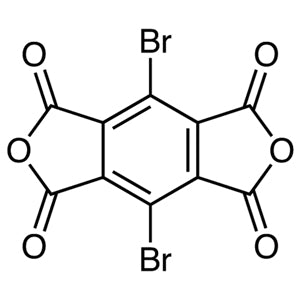
Dibromopyromellitic Dianhydride (DBPDA) is a chemical compound widely used in laboratory settings as a foundational building block for the synthesis of complex molecules. It plays a crucial role in organic chemistry and material science, serving as a versatile reagent for creating polymers and advanced chemical structures. Its unique molecular structure allows it to participate in a variety of chemical reactions, making it an essential tool for researchers working on innovative material development and chemical synthesis.
DBPDA is prized for its highly reactive anhydride group, which enables it to readily form bonds with various functional groups. This reactivity, combined with its chemical stability, makes it ideal for applications requiring both precision and reliability. Its ability to maintain structural integrity under different reaction conditions further enhances its appeal in synthetic chemistry. The compound’s versatility is evident in its use across multiple scientific disciplines, from polymer science to electrochemical research.
In Indonesian laboratories, DBPDA is commonly used by researchers and academic institutions engaged in organic chemistry, material science, and polymer technology. Its role in developing advanced materials with superior mechanical and thermal properties makes it a valuable resource for both educational and industrial research. The compound’s widespread application in these fields underscores its importance as a key chemical building block in modern scientific research.
- Organic synthesis: DBPDA is used for creating complex organic molecules due to its reactive anhydride group and structural versatility.
- Polymer development: It serves as a building block for synthesizing high-performance polymers with enhanced mechanical properties.
- Composite material research: Its ability to form stable chemical bonds makes it suitable for developing advanced composite materials.
- Electrochemical applications: DBPDA is employed in the synthesis of compounds used in electrochemical systems due to its chemical stability and reactivity.
- Material science experiments: It is widely utilized in studies involving the creation of materials with specific thermal and mechanical characteristics.
| Brand | TCI |
|---|---|
| CAS number | 24848-78-0 |
| Molecular formula | — |
| Purity | — |
| Category | Chemistry > Building Blocks > Non-Heterocyclic Building Blocks |
| Pack sizes | Available in various quantities as per standard supplier offerings |
| Physical form | Solid |
| Storage | Store in a cool, dry place away from moisture and direct sunlight |
DBPDA should be stored in a cool, dry environment, away from moisture and direct sunlight to maintain its chemical integrity. It is recommended to use airtight containers made of materials that are chemically inert to prevent any unwanted reactions. Due to its reactivity, it should be handled with care in a well-ventilated laboratory setting. Proper personal protective equipment, such as gloves and safety goggles, should be worn during handling to ensure safety. The compound should not be exposed to incompatible substances, and all storage areas should be clearly labeled for easy identification and safe access. Regular monitoring of storage conditions is essential to ensure the compound remains stable and usable for research purposes.
—
Produk Terkait
-
2-Bromonaphthalene-1,4,5,8-tetracarboxylic1,8:4,5-Dianhydride TCI B5756
Regular price From Rp 5.904.150,00Regular price -
[1,1'-Biphenyl]-3,4',5-tricarboxylicAcid TCI B5795
Regular price Rp 6.995.100,00Regular price -
[1,1'-Biphenyl]-3,3',4,4'-tetracarboxylicAcid TCI B6179
Regular price Rp 4.988.550,00Regular price -
2,5-Bis(trifluoromethyl)terephthalicAcid TCI B6503
Regular price From Rp 3.512.250,00Regular price -
Propane-2,2-diylbis(4,1-phenylene)Bis(1,3-dioxo-1,3-dihydroisobenzofuran-5-carboxylate) TCI B6612
Regular price From Rp 3.335.850,00Regular price -
4,4'-(Perfluoropropane-2,2-diyl)dibenzoylChloride TCI B6873
Regular price From Rp 3.600.450,00Regular price -
[1,1'-Biphenyl]-3,3'-dicarboxylicAcid TCI B7024
Regular price From Rp 1.417.500,00Regular price -
TrimelliticAnhydride TCI C0046
Regular price From Rp 562.800,00Regular price

![[1,1'-Biphenyl]-3,4',5-tricarboxylic Acid (CAS 677010-20-7) - TCI B5795 - AMI Scientific](http://amiscientific.com/cdn/shop/files/TCI2510B5795.jpg?v=1767092758&width=533)
![[1,1'-Biphenyl]-3,3',4,4'-tetracarboxylic Acid (CAS 22803-05-0) - TCI B6179 - AMI Scientific](http://amiscientific.com/cdn/shop/files/TCI2510B6179.jpg?v=1767093266&width=533)


![[1,1'-Biphenyl]-3,3'-dicarboxylic Acid (CAS 612-87-3) - TCI B7024 - AMI Scientific](http://amiscientific.com/cdn/shop/files/TCI2510B7024.jpg?v=1767094487&width=533)