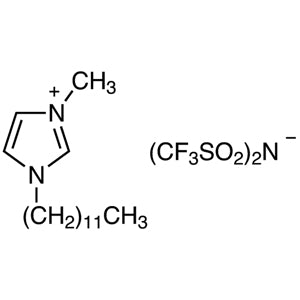
TCI D5694 1-Dodecyl-3-methylimidazolium Bis(trifluoromethanesulfonyl)imide (CAS 404001-48-5) is an ionic liquid built from an imidazolium cation carrying a long dodecyl alkyl chain paired with a bis(trifluoromethanesulfonyl)imide anion, commonly abbreviated NTf2 or TFSI. Ionic liquids are salts that melt at low temperatures, so they exist as liquids without any added solvent. In the laboratory, this material serves as a non-volatile alternative solvent, a reaction medium, an electrolyte, and an extraction phase, and TCI classifies it under specialty synthesis for ionic liquids because its use is more specific than that of conventional organic solvents.
The combination of a long dodecyl chain with the TFSI anion gives this compound its distinctive character and is the main reason researchers select it. The TFSI anion is known for being strongly hydrophobic, thermally and electrochemically stable, and weakly ion-coordinating, so the resulting liquid has a relatively low viscosity for an ionic liquid. The long alkyl chain on the cation adds amphiphilic character, improves the solubility of non-polar compounds, and promotes the formation of aggregated structures or mesophases. The outcome is a liquid that is essentially non-volatile and not readily flammable.
In Indonesian laboratories, this ionic liquid is typically used in university research groups, materials and electrochemistry laboratories, and institutional research centres working on green solvents, separation science, and electrolyte development. Because it does not evaporate under ambient conditions, it suits work where solvent loss must be avoided, including long reaction runs and repeated extraction cycles. It is normally purchased in small research quantities, handled on the bench or in a glovebox, and reused across experiments rather than consumed like a bulk organic solvent.
Related TCI products
- TCI V0145 1013027-27-4 1-Vinylimidazole Bis(trifluoromethanesulfonyl)imide
- TCI B5421 1312310-16-9 3,3'-(Butane-1,4-diyl)bis(1-vinyl-3-imidazolium) Bis(trifluoromethanesulfonyl)imide
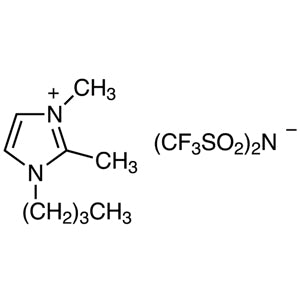
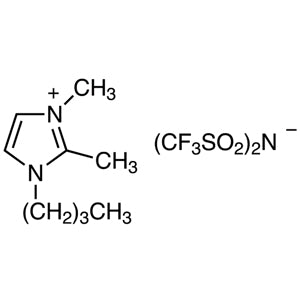
- TCI B3159 350493-08-2 1-Butyl-2,3-dimethylimidazolium Bis(trifluoromethanesulfonyl)imide
- TCI B2477 174899-83-3 1-Butyl-3-methylimidazolium Bis(trifluoromethanesulfonyl)imide
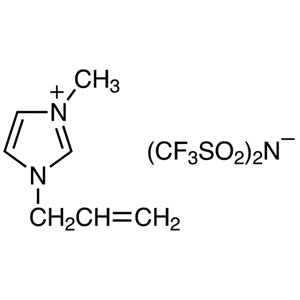
- TCI A3210 655249-87-9 1-Allyl-3-methylimidazolium Bis(trifluoromethanesulfonyl)imide
- TCI M3210 353239-08-4 1-Methylimidazole Bis(trifluoromethanesulfonyl)imide
- Non-volatile reaction medium — replaces conventional organic solvents in syntheses where evaporation, solvent loss, or vapour exposure must be minimised during extended heating or long reaction times.
- Electrolyte formulation and electrochemical studies — the TFSI anion offers thermal and electrochemical stability with weak ion interaction, supporting electrochemical windows required in electrolyte and device research.
- Liquid–liquid extraction and separation — its strongly hydrophobic character allows it to form a distinct phase against aqueous media for partitioning and recovery of target solutes.
- Dissolution of non-polar substrates — the long dodecyl chain improves solubility of non-polar compounds that dissolve poorly in shorter-chain, more polar ionic liquids used in laboratory work.
- Self-assembly and mesophase research — the amphiphilic dodecyl chain drives formation of aggregated structures and mesophases, making it useful for studies on ordered ionic liquid systems.
| Brand | TCI (Tokyo Chemical Industry) |
|---|---|
| CAS number | 404001-48-5 |
| Molecular formula | — |
| Purity | — |
| Category | Chemistry > Specialty Synthesis > Ionic Liquids [Specialty Synthesis] |
| Pack sizes | available in research-scale packaging as listed by TCI for this catalogue number (D5694) |
| Physical form | ionic liquid — liquid at low temperature without added solvent |
| Storage | keep tightly closed in a cool, dry place, protected from moisture |
Store the container tightly closed in a cool, dry, well-ventilated area away from heat sources and direct sunlight. Because the TFSI anion is hydrophobic but the material can still pick up atmospheric moisture, keep the bottle sealed between uses and, where water content matters, transfer under dry nitrogen or in a glovebox. Use the original TCI container or clean, dry glass vessels with chemically compatible closures; avoid contamination from residual solvents or metal spatulas. Handle in a fume hood with nitrile gloves, safety glasses, and a laboratory coat, and consult the manufacturer's Safety Data Sheet before use. Ionic liquids are non-volatile, so spills remain on surfaces — wipe promptly and dispose of residues as halogenated chemical waste according to institutional procedures.
—
Produk Terkait
-
1-VinylimidazoleBis(trifluoromethanesulfonyl)imide TCI V0145
Regular price Rp 2.757.300,00Regular price -
3,3'-(Butane-1,4-diyl)bis(1-vinyl-3-imidazolium)Bis(trifluoromethanesulfonyl)imide TCI B5421
Regular price Rp 2.386.650,00Regular price -
1-Butyl-2,3-dimethylimidazoliumBis(trifluoromethanesulfonyl)imide TCI B3159
Regular price From Rp 1.378.650,00Regular price -
1-Butyl-3-methylimidazoliumBis(trifluoromethanesulfonyl)imide TCI B2477
Regular price From Rp 1.298.850,00Regular price -
1-Allyl-3-methylimidazoliumBis(trifluoromethanesulfonyl)imide TCI A3210
Regular price From Rp 2.041.200,00Regular price -
1-MethylimidazoleBis(trifluoromethanesulfonyl)imide TCI M3210
Regular price From Rp 1.881.600,00Regular price -
1-Methyl-3-(4-sulfobutyl)imidazoliumBis(trifluoromethanesulfonyl)imide TCI M3119
Regular price From Rp 1.565.550,00Regular price -
1-Methyl-3-propylimidazoliumBis(trifluoromethanesulfonyl)imide TCI M3059
Regular price From Rp 1.485.750,00Regular price