TCI D5870 4,7-Dimethoxy-1,10-phenanthroline is a bidentate heterocyclic ligand from the phenanthroline family, carrying two methoxy groups at the 4 and 7 positions. The 1,10-phenanthroline framework consists of three fused aromatic rings in which the two nitrogen atoms sit adjacent to one another, locked into a rigid planar geometry. That arrangement makes the molecule a classic chelating clamp for transition metal ions. In the laboratory, the compound serves primarily as a supporting ligand in transition metal catalysis, as a complex-forming reagent, and as a starting material for preparing metal complexes whose electronic and photophysical behaviour is to be tuned in a deliberate, directed manner.
The properties that lead researchers to select this ligand are the combination of a rigid backbone and donor character reinforced by the methoxy groups. The two methoxy substituents release electron density into the aromatic system, so both nitrogen atoms become stronger Lewis bases than those of unsubstituted phenanthroline. Binding to the metal centre is therefore tighter, and the resulting complexes are generally more stable and more electron-rich. That same electron donation shifts the redox potential of the metal centre and alters the absorption and emission characteristics of the complex, which is precisely the handle chemists want when a system must be tuned rather than merely assembled.
In Indonesian laboratories, this building block is typically used in university research groups, institutional chemistry laboratories, and industrial R&D units working on coordination chemistry, homogeneous catalysis, and photoactive materials. It is generally handled in small quantities during synthetic route development and ligand screening, where a well-defined, reproducible chelating agent is required. Because it is supplied as a characterised reagent from an established catalogue source, it fits routine synthetic work without the need for in-house ligand preparation.
TCI brochures (PDF)
- Ligands 2025-12-01 · p. 14
Related TCI products
- Transition metal catalysis — the rigid bidentate N,N-donor set holds the metal centre in a defined coordination geometry, giving reproducible catalytic behaviour across repeated runs of the same reaction.
- Metal complex synthesis — the compound acts as a starting material for preparing structurally defined complexes whose electronic properties can be adjusted through the electron-donating methoxy substituents at positions 4 and 7.
- Complexation reagent work — the adjacent nitrogen atoms chelate transition metal ions strongly, making the ligand suitable for forming and isolating stable coordination compounds in solution-phase chemistry.
- Photophysical materials research — electron donation into the aromatic system shifts absorption and emission characteristics of the resulting complexes, supporting studies where tuned optical response is the experimental target.
- Redox chemistry studies — the enhanced Lewis basicity of the nitrogen donors shifts the redox potential of the bound metal centre, allowing systematic investigation of electron-rich metal systems.
| Brand | TCI |
|---|---|
| CAS number | 92149-07-0 |
| Molecular formula | — |
| Purity | — |
| Category | Chemistry > Building Blocks > Heterocyclic Building Blocks |
| Pack sizes | available in standard catalogue pack sizes; please confirm the current options when ordering |
| Physical form | — |
| Storage | store according to the manufacturer's instructions stated on the product label and Safety Data Sheet |
- Chemical name: 4,7-Dimethoxy-1,10-phenanthroline
- Product code: D5870
Store the product in its original tightly closed container in a cool, dry, well-ventilated place, away from direct sunlight, moisture, and incompatible materials. Glass containers with secure closures are appropriate for transfer and short-term working quantities. Handle the material in a fume hood, wearing a laboratory coat, safety goggles, and suitable chemical-resistant gloves. Avoid generating dust, avoid inhalation and skin or eye contact, and keep containers closed when not in active use. Always consult the manufacturer's Safety Data Sheet before first use, and follow the storage temperature and handling conditions stated there. Dispose of residues and contaminated materials in accordance with applicable laboratory waste regulations.
—
Product Categories
Produk Terkait
-
5-Amino-1,10-phenanthroline TCI A2977
Regular price Rp 3.738.000,00Regular price -
3,4,7,8-Tetramethyl-1,10-phenanthroline TCI T0847
Regular price Rp 2.147.250,00Regular priceRp 1.517.250,00Sale price Rp 2.147.250,00 -
1,7-Phenanthroline TCI P3288
Regular price Rp 1.618.050,00Regular priceRp 1.146.600,00Sale price Rp 1.618.050,00 -
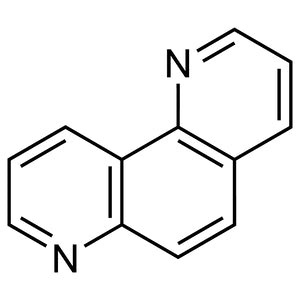
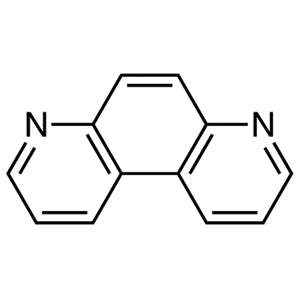
4,7-Phenanthroline TCI P2684
Regular price Rp 2.518.950,00Regular priceRp 1.776.600,00Sale price Rp 2.518.950,00 -
1,10-Phenanthroline-5,6-dione TCI P1973
Regular price Rp 3.472.350,00Regular priceRp 2.443.350,00Sale price Rp 3.472.350,00 -
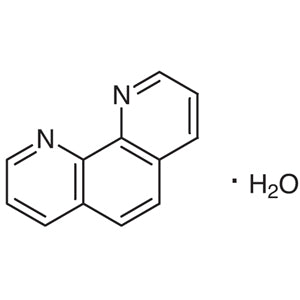
1,10-PhenanthrolineMonohydrate TCI P0879
Regular price Rp 1.510.950,00Regular priceRp 1.072.050,00Sale price Rp 1.510.950,00 -
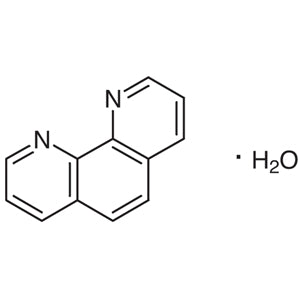
1,10-PhenanthrolineMonohydrate TCI P0221
Regular price Rp 557.550,00Regular priceRp 405.300,00Sale price Rp 557.550,00 -
1,10-PhenanthrolineHydrochlorideMonohydrate TCI P0081
Regular price Rp 1.696.800,00Regular priceRp 1.202.250,00Sale price Rp 1.696.800,00