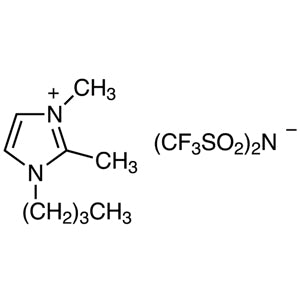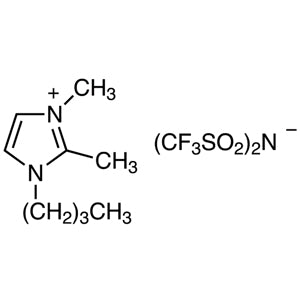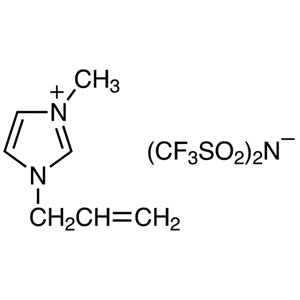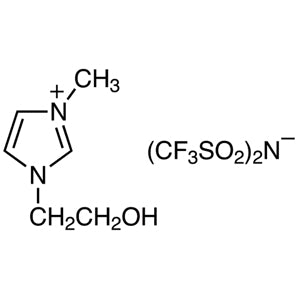
1-(2-Hydroxyethyl)-3-methylimidazolium Bis(trifluoromethanesulfonyl)imide is a specialized ionic liquid used in complex chemical reactions within laboratory settings. As a member of the ionic liquid family, it serves as a versatile medium for various synthetic processes. Its unique molecular structure consists of a cation and an anion, offering stability and reactivity in diverse chemical environments. This compound is widely utilized in organic synthesis due to its ability to dissolve a wide range of substances, making it an essential tool for researchers working on advanced chemical reactions.
The properties of this ionic liquid make it a preferred choice for laboratory use. It is non-volatile and non-flammable, ensuring a safe working environment. Its high boiling point allows for reactions to proceed under controlled conditions without the risk of evaporation. Additionally, the low viscosity of this material facilitates easy mixing and handling, which is crucial in laboratory procedures. The absence of water in its composition prevents unwanted side reactions and corrosion, enhancing its reliability in chemical experiments.
In Indonesian laboratories, this ionic liquid is commonly used in research focused on organic synthesis and chemical catalysis. Its stability and versatility make it a go-to material for scientists and researchers aiming to achieve precise and reproducible results. Its non-toxic nature further supports its use in both academic and industrial research settings across Indonesia.
TCI brochures (PDF)
- Ionic Liquids 2026-06-08 · p. 8
Related TCI products
- TCI V0145 1013027-27-4 1-Vinylimidazole Bis(trifluoromethanesulfonyl)imide
- TCI B5421 1312310-16-9 3,3'-(Butane-1,4-diyl)bis(1-vinyl-3-imidazolium) Bis(trifluoromethanesulfonyl)imide
- TCI B3159 350493-08-2 1-Butyl-2,3-dimethylimidazolium Bis(trifluoromethanesulfonyl)imide
- TCI B2477 174899-83-3 1-Butyl-3-methylimidazolium Bis(trifluoromethanesulfonyl)imide
- TCI A3210 655249-87-9 1-Allyl-3-methylimidazolium Bis(trifluoromethanesulfonyl)imide
- TCI M3210 353239-08-4 1-Methylimidazole Bis(trifluoromethanesulfonyl)imide
- Organic synthesis reactions benefit from this ionic liquid due to its ability to dissolve a wide range of organic compounds and its non-volatile nature, ensuring stable reaction conditions.
- Green chemistry initiatives often incorporate this material as a sustainable alternative to traditional solvents, reducing environmental impact while maintaining reaction efficiency.
- Catalytic processes in chemical synthesis utilize this ionic liquid as a reaction medium, enhancing reaction rates and selectivity without the need for additional catalysts.
- Analytical chemistry applications use this compound as a solvent for sample preparation, offering high solubility and minimal interference with analytical techniques.
- Electrochemical studies employ this ionic liquid due to its high ionic conductivity and thermal stability, making it suitable for use in batteries and fuel cells research.
| Brand | TCI |
|---|---|
| CAS number | 174899-86-6 |
| Molecular formula | — |
| Purity | — |
| Category | Chemistry > Specialty Synthesis > Ionic Liquids |
| Pack sizes | Available in various quantities as per supplier specifications |
| Physical form | Liquid |
| Storage | Store in a cool, dry place away from direct sunlight and incompatible materials |
This ionic liquid should be stored in a cool, dry environment to maintain its stability and prevent degradation. It is recommended to use sealed, non-reactive containers such as glass or high-density polyethylene to avoid contamination and chemical interactions. Due to its non-volatile nature, it does not require refrigeration but should be kept away from heat sources. General laboratory precautions include wearing appropriate personal protective equipment when handling, as well as ensuring proper ventilation in the workspace. Its non-toxic and non-flammable properties contribute to its safe handling and storage in laboratory settings.
—
Produk Terkait
-
1-VinylimidazoleBis(trifluoromethanesulfonyl)imide TCI V0145
Regular price Rp 2.757.300,00Regular price -
3,3'-(Butane-1,4-diyl)bis(1-vinyl-3-imidazolium)Bis(trifluoromethanesulfonyl)imide TCI B5421
Regular price Rp 2.386.650,00Regular price -
1-Butyl-2,3-dimethylimidazoliumBis(trifluoromethanesulfonyl)imide TCI B3159
Regular price From Rp 1.378.650,00Regular price -
1-Butyl-3-methylimidazoliumBis(trifluoromethanesulfonyl)imide TCI B2477
Regular price From Rp 1.298.850,00Regular price -
1-Allyl-3-methylimidazoliumBis(trifluoromethanesulfonyl)imide TCI A3210
Regular price From Rp 2.041.200,00Regular price -
1-MethylimidazoleBis(trifluoromethanesulfonyl)imide TCI M3210
Regular price From Rp 1.881.600,00Regular price -
1-Methyl-3-(4-sulfobutyl)imidazoliumBis(trifluoromethanesulfonyl)imide TCI M3119
Regular price From Rp 1.565.550,00Regular price -
1-Methyl-3-propylimidazoliumBis(trifluoromethanesulfonyl)imide TCI M3059
Regular price From Rp 1.485.750,00Regular price