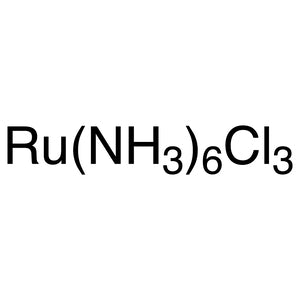
Hexaammineruthenium(III) chloride is a ruthenium coordination compound in which six ammonia ligands surround the central metal, supplied as a water-soluble chloride salt. This reagent occupies a distinctive position in inorganic chemistry and electrochemistry laboratories because it behaves as an outer-sphere redox couple whose response is highly predictable. Many researchers use it as a standard probe for assessing electrode surface quality and calculating electrochemically active surface area, and it also serves as a precursor for the synthesis of other, more elaborate ruthenium complexes in catalysis research.
The characteristic that makes this compound so widely chosen is the excellent reversibility of its electron transfer between the Ru(III) and Ru(II) oxidation states, which proceeds without any significant ligand rearrangement. This property yields clean, easily interpreted cyclic voltammograms, making the compound a suitable benchmark when comparing different electrode materials. Its solubility in aqueous media further simplifies the preparation of electrolyte solutions without recourse to organic solvents. In addition, its cationic charge allows the compound to interact electrostatically with negatively charged biomolecules, extending its usefulness beyond purely inorganic systems.
In Indonesian laboratories, this reagent is typically encountered in university and institutional research groups working on electrochemistry, materials characterization, and inorganic synthesis. It is commonly used during electrode calibration and validation work before experimental data are collected, and in coordination chemistry studies where a well-understood ruthenium starting material is required. Because it is handled as a defined reagent in aqueous solution, it fits readily into the routine analytical workflows of teaching and research facilities.
TCI brochures (PDF)
- Metallic Salts 2025-11-06 · p. 4
- Transition Metal Catalysts 2026-04-10 · p. 8
- Electrochemically active surface area determination — its predictable outer-sphere diffusion behaviour allows reliable calculation of the true working area of an electrode.
- Electrode quality assessment and validation — the clean, reversible voltammetric response quickly reveals surface contamination, passivation, or inconsistent polishing of an electrode.
- Benchmarking of electrode materials — because its electron transfer requires no ligand rearrangement, it provides a neutral reference point for comparing different electrode substrates.
- Precursor for ruthenium complex synthesis — the hexaammine framework serves as a convenient starting material for preparing more elaborate ruthenium coordination compounds in catalysis research.
- Interaction studies with charged biomolecules — its cationic character allows electrostatic association with negatively charged biomolecules, supporting investigations at the interface of inorganic and biological chemistry.
| Brand | TCI |
|---|---|
| CAS number | 14282-91-8 |
| Molecular formula | — |
| Purity | — |
| Category | Chemistry > Catalysis and Inorganic Chemistry > Transition Elements [Catalysis and Inorganic Chemistry] |
| Pack sizes | available in standard TCI research-scale packaging; please confirm the currently offered sizes when ordering |
| Physical form | chloride salt, soluble in water |
| Storage | keep in a tightly closed container in a cool, dry place protected from moisture |
- Product code: H1881
Store the compound in its original tightly closed container in a cool, dry, well-ventilated area, away from moisture and direct sunlight. Amber glass or the manufacturer's supplied packaging is suitable for keeping the material dry and protected from light; reseal promptly after each use to limit exposure to atmospheric humidity. Handle the solid in a fume hood or a well-ventilated weighing area, and wear a laboratory coat, chemical-resistant gloves, and safety goggles when weighing or preparing solutions. Avoid generating dust, avoid contact with skin and eyes, and wash hands thoroughly after handling. Prepare aqueous solutions using clean glassware and label them clearly with contents and date. Consult the manufacturer's safety data sheet before first use, and dispose of residues and spent solutions through the laboratory's designated chemical waste stream in accordance with local regulations.
—
Produk Terkait
-
Ruthenium(III)ChlorideHydrate TCI R0074
Regular price From Rp 1.618.050,00Regular price -
Platinum(IV)Chloride TCI P3140
Regular price From Rp 2.279.550,00Regular price -
Platinum(II)Chloride TCI P1920
Regular price Rp 4.479.300,00Regular price -
Palladium(II)Chloride TCI P1489
Regular price From Rp 3.075.450,00Regular price -
Osmium(III)Chloride TCI O0651
Regular price From Rp 2.359.350,00Regular price -
Nickel(II)ChlorideHexahydrate TCI N0851
Regular price From Rp 505.050,00Regular price -
Nickel(II)ChlorideAnhydrous TCI N0850
Regular price From Rp 610.050,00Regular price -
Manganese(II)ChlorideTetrahydrate TCI M2095
Regular price From Rp 505.050,00Regular price