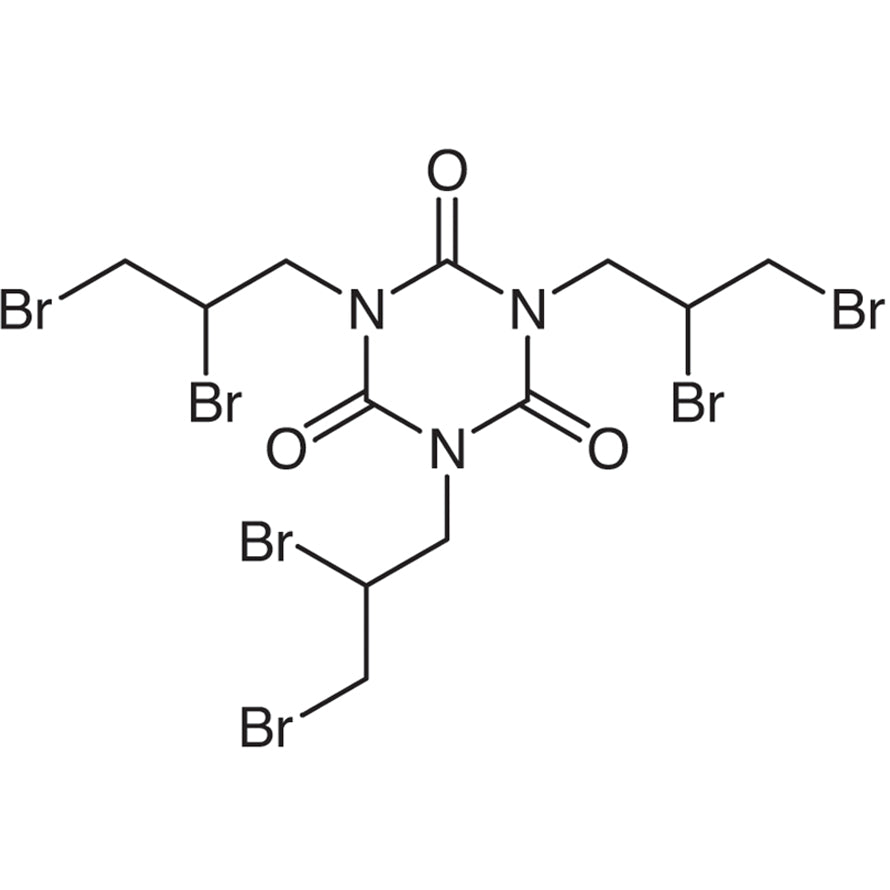
Tris(2,3-dibromopropyl) Isocyanurate is a chemical compound widely used in scientific applications related to polymers and macromolecules. It functions as a polymer additive, playing a crucial role in modifying the properties of polymer materials. This compound is particularly valued for its ability to enhance the stability and performance of polymer-based materials. Its unique chemical structure allows it to interact effectively with various types of polymers, making it a versatile tool in material science research. In Indonesian laboratories, it is commonly used in the development of polymer-based products that require specific functional properties.
The compound's chemical stability and controlled reactivity make it a preferred choice for researchers seeking to manipulate polymer characteristics. Its ability to act as an antioxidant and UV stabilizer is especially important in applications where polymer degradation is a concern. These properties make it suitable for use in both academic and industrial research settings. The compound’s versatility extends to its application in different polymer modification techniques, contributing to the development of advanced materials with tailored properties.
In Indonesian laboratories, Tris(2,3-dibromopropyl) Isocyanurate is widely used in polymer research, particularly in the fields of packaging, electronics, and construction materials. It is also found in studies related to polymer degradation and environmental impact, which are important research areas in many Indonesian scientific institutions. Its availability in various packaging formats ensures ease of use across different experimental scales.
- Polymer Modification: This compound is ideal for modifying polymer properties to enhance stability and performance, especially in materials requiring antioxidant or UV protection.
- Anti-Oxidant Additive Development: Its role as an antioxidant makes it suitable for research focused on preventing polymer degradation during storage or use.
- UV Stabilizer Formulation: It is used in the formulation of UV stabilizers for polymer materials, which is critical in industries like packaging and electronics.
- Environmental Degradation Studies: Its application in studying polymer degradation helps researchers understand the environmental impact of polymer materials.
- Material Science Research: It is a key component in the development of advanced materials with specific functional properties for various industrial applications.
| Brand | TCI |
|---|---|
| CAS number | 52434-90-9 |
| Molecular formula | — |
| Purity | — |
| Category | Materials Science > Polymer/Macromolecule Reagents > Polymer Additives |
| Pack sizes | Available in various packaging formats to suit different experimental scales |
| Physical form | Solid (exact form may vary depending on packaging) |
| Storage | Store in a cool, dry place away from direct sunlight |
Tris(2,3-dibromopropyl) Isocyanurate should be stored in a cool, dry environment to maintain its chemical stability. It is recommended to keep it in a sealed container to prevent moisture absorption and contamination. The compound is generally non-hazardous under normal conditions but should be handled with care to avoid direct contact with skin or inhalation of vapors. It is advisable to store it away from incompatible substances such as strong acids or bases. Proper labeling and storage conditions help ensure safety and maintain the integrity of the material during laboratory use. Always follow standard laboratory safety protocols when handling and storing chemical compounds.
—
Produk Terkait
-
TCI B5774 5,10-Bis(4,4,5,5-tetramethyl-1,3,2-dioxaborolan-2-yl)naphtho[1,2-c:5,6-c']bis([1,2,5]oxadiazole)
Regular price Rp 10.255.350,00Regular price -
Dihydroiodide TCI B6569
Regular price From Rp 1.936.200,00Regular price -
Trifluoromethanesulfonate TCI B7003
Regular price From Rp 1.936.200,00Regular price
![5,10-Bis(4,4,5,5-tetramethyl-1,3,2-dioxaborolan-2-yl)naphtho[1,2-c:5,6-c']bis([1,2,5]oxadiazole) - TCI B5774 - AMI Scientific](http://amiscientific.com/cdn/shop/files/TCI2510B5774.jpg?v=1769180228&width=533)