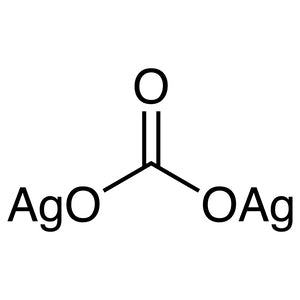
Silver(I) Carbonate (Ag₂CO₃) is a chemical compound widely used in laboratory settings, particularly in the fields of catalysis and inorganic chemistry. It plays a crucial role in various chemical reactions, especially those involving transition metals. This compound is commonly employed as a reagent in the synthesis of both organic and inorganic compounds. Its ability to form precipitates and generate complex ions makes it an essential tool for qualitative and quantitative analysis. In the laboratory, Silver(I) Carbonate is also used for the preparation of standard solutions, which are fundamental in analytical chemistry.
The chemical properties of Silver(I) Carbonate make it a preferred choice for many applications. It exhibits a stable chemical nature with controlled reactivity, which ensures consistent results in experiments. Its low solubility in water facilitates precipitation and separation processes, making it ideal for reactions requiring precise control over ion concentration. Additionally, Silver(I) Carbonate acts as a source of argentate ions, which are vital in certain analytical procedures. These characteristics contribute to its reliability and versatility in various laboratory tasks.
In Indonesian laboratories, Silver(I) Carbonate is frequently used in research and educational settings. It is a common reagent in both academic and industrial laboratories, supporting a wide range of chemical investigations. Its stability and predictable behavior make it a trusted material for students and researchers alike. The compound's applications are broad, ranging from basic chemical experiments to more advanced analytical techniques. Its availability through suppliers like AMI Scientific ensures that it is accessible for use in local laboratories.
- Qualitative and quantitative analysis due to its ability to form precipitates and generate argentate ions.
- Synthesis of organic and inorganic compounds as a reagent in various chemical reactions.
- Preparation of standard solutions for accurate analytical measurements in laboratory settings.
- Precipitation reactions where controlled ion concentration is required for effective separation.
- Research applications in catalysis and inorganic chemistry involving transition metals.
| Brand | TCI |
|---|---|
| CAS number | 534-16-7 |
| Molecular formula | — |
| Purity | — |
| Category | Chemistry > Catalysis and Inorganic Chemistry > Transition Elements |
| Pack sizes | Available in various quantities as per supplier specifications |
| Physical form | Solid powder |
| Storage | Store in a cool, dry place away from moisture and direct sunlight |
Silver(I) Carbonate should be stored in a cool, dry place, away from moisture and direct sunlight to maintain its chemical stability. It is recommended to use airtight containers to prevent exposure to humidity, which can affect its solubility and reactivity. Due to its low solubility, it is important to handle the compound with care to avoid contamination. In laboratory settings, it should be stored separately from strong acids to prevent unwanted reactions. Proper labeling and safe storage practices are essential to ensure the safety of laboratory personnel and the integrity of the compound.
—
Produk Terkait
-
TCI B5774 5,10-Bis(4,4,5,5-tetramethyl-1,3,2-dioxaborolan-2-yl)naphtho[1,2-c:5,6-c']bis([1,2,5]oxadiazole)
Regular price Rp 10.255.350,00Regular price -
Dihydroiodide TCI B6569
Regular price From Rp 1.936.200,00Regular price -
Trifluoromethanesulfonate TCI B7003
Regular price From Rp 1.936.200,00Regular price
![5,10-Bis(4,4,5,5-tetramethyl-1,3,2-dioxaborolan-2-yl)naphtho[1,2-c:5,6-c']bis([1,2,5]oxadiazole) - TCI B5774 - AMI Scientific](http://amiscientific.com/cdn/shop/files/TCI2510B5774.jpg?v=1769180228&width=533)