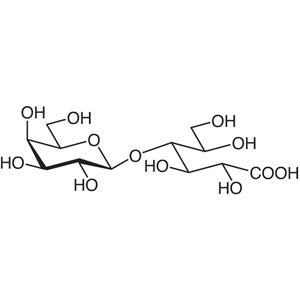
Lactobionic Acid (TCI L0005, CAS 96-82-2) is a chemical compound composed of a mixture of its acid form and lactone form. It plays a vital role in laboratory settings, particularly in chemical biology and glycoscience research. This compound is widely used as a building block for the synthesis of various organic molecules and as an active ingredient in biological activity assays. Its versatility makes it an essential tool for researchers exploring molecular interactions and metabolic pathways.
Lactobionic Acid is known for its chemical stability and solubility in water, which enhances its usability in a wide range of chemical reactions. These properties make it a preferred choice for laboratory applications where consistency and reliability are crucial. Its non-toxic and environmentally friendly nature further supports its use in high-standard laboratory environments. The availability in various packaging options also allows researchers to select the most suitable form for their specific experimental needs.
In Indonesian laboratories, Lactobionic Acid is commonly used in academic and research institutions focused on chemical biology and glycoscience. Its application spans across both basic and applied research, contributing to the advancement of scientific knowledge in the region. The compound's adaptability to different physical forms, such as solid and liquid, adds to its flexibility for diverse experimental setups.
- Chemical synthesis of carbohydrates and glycosides due to its structural versatility and reactivity.
- Biological activity testing as a key component in assays evaluating enzyme inhibition and substrate interactions.
- Metabolic pathway studies to understand how carbohydrates are processed in biological systems.
- Molecular interaction research to explore how Lactobionic Acid binds with proteins and other biomolecules.
- Educational purposes in teaching laboratories for demonstrating chemical reactions and analytical techniques.
| Brand | TCI |
|---|---|
| CAS number | 96-82-2 |
| Molecular formula | — |
| Purity | — |
| Category | Chemistry > Chemical Biology > Glycoscience |
| Pack sizes | Available in various sizes to suit different experimental needs |
| Physical form | Mixture of acid form and lactone form |
| Storage | Store in a cool, dry place away from direct sunlight |
Lactobionic Acid should be stored in a cool, dry place, away from direct sunlight and sources of heat. It is recommended to use airtight containers to prevent moisture absorption and maintain its chemical integrity. As it is non-toxic and environmentally friendly, it poses minimal risk during handling, but standard laboratory safety protocols should still be followed. Proper labeling of containers is essential to ensure safe handling and prevent accidental exposure. Researchers should avoid inhaling large quantities of the compound and ensure adequate ventilation when working with it. Regular monitoring of storage conditions will help maintain the compound’s stability and effectiveness for laboratory use.
—
Produk Terkait
-
CalciumLactobionate TCI L0006
Regular price Rp 1.829.100,00Regular price -
D-(+)-MelibioseMonohydrate TCI M0050
Regular price From Rp 505.050,00Regular price -
Lactulose TCI L0140
Regular price Rp 2.016.000,00Regular price -
D-(+)-LactoseMonohydrate TCI L0008
Regular price Rp 584.850,00Regular price -
Galactinol TCI G0298
Regular price From Rp 2.491.650,00Regular price -
N-Acetyllactosamine TCI A3636
Regular price Rp 7.234.500,00Regular price -
AMOR TCI M3044
Regular price Rp 11.580.450,00Regular price -
DipotassiumGlycyrrhizinate TCI G0270
Regular price Rp 1.590.750,00Regular price