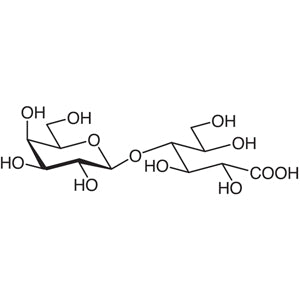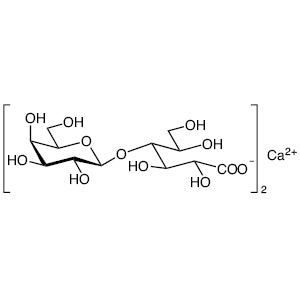
Calcium Lactobionate is the calcium salt of lactobionic acid, supplied as a solid and classified within the glycoscience reagent group. The compound brings together two elements that are equally interesting to researchers: an oxidised sugar backbone rich in hydroxyl groups, and a calcium ion that plays an important role in many biological processes as well as in food systems. In the laboratory it serves as a soluble and easy-to-handle calcium source, as a comparison material in studies of lactobionate salts, and as a model component in research on mineral fortification and cation–carbohydrate interactions.
The main reason researchers select Calcium Lactobionate is its good solubility in water compared with many inorganic calcium salts, which makes it straightforward to prepare test solutions without the precipitation problems that disrupt experimental work. The lactobionate anion acts as a mild chelating ligand that keeps the calcium ion dispersed in solution, while the neutral taste and organoleptic character of the material make it an attractive choice in functional food research. The hygroscopic nature of the material needs to be taken into account, although this same property is useful in water-retention studies.
Its stability in the solid form makes storage and repeated weighing straightforward, which matters in Indonesian laboratories where materials are often held for extended periods between experiments. Research groups in universities, food technology departments, and analytical service laboratories use this reagent when a well-defined calcium source is required for solution work. The solid presentation allows the material to be dispensed in small quantities as needed, supporting both method development and routine comparative studies.
TCI brochures (PDF)
- Soluble calcium source preparation — the good aqueous solubility of this salt allows calcium-containing test solutions to be made up without the precipitation issues common to inorganic calcium salts.
- Reference material in lactobionate salt studies — as a defined calcium salt of lactobionic acid, it serves as a comparison point when different lactobionate salts are evaluated side by side.
- Mineral fortification research — the combination of a bioavailable-style calcium ion with a carbohydrate-derived anion makes it a useful model component in studies of fortifying systems.
- Cation–carbohydrate interaction studies — the hydroxyl-rich oxidised sugar backbone paired with a bound calcium ion provides a direct model for examining how cations associate with carbohydrate structures.
- Functional food and water-retention investigations — its neutral organoleptic character and hygroscopic behaviour make it suitable for work examining moisture binding in formulated food systems.
| Brand | TCI |
|---|---|
| CAS number | 5001-51-4 |
| Molecular formula | — |
| Purity | — |
| Category | Chemistry > Chemical Biology > Glycoscience |
| Pack sizes | available in standard TCI research pack sizes; please refer to the ordering options on this page |
| Physical form | solid |
| Storage | store as a solid in a tightly closed container, protected from moisture |
- Product code: L0006
Store Calcium Lactobionate in its original tightly closed container, kept in a cool, dry place away from moisture. Because the material is hygroscopic, containers should be resealed promptly after each use and the bottle allowed to reach room temperature before opening to reduce condensation on the solid. Use clean, dry spatulas and dry glassware when weighing, and prepare solutions with appropriate laboratory-grade water. Handle the material in a well-ventilated area, wear standard personal protective equipment including gloves, safety glasses, and a laboratory coat, and avoid generating dust during transfer. Keep the container clearly labelled and dispose of residues according to applicable institutional and local waste-handling procedures.
—
Product Categories
Produk Terkait
-
LactobionicAcid(mixtureofAcidformandLactoneform) TCI L0005
Regular price From Rp 1.485.750,00Regular price -
D-(+)-MelibioseMonohydrate TCI M0050
Regular price From Rp 505.050,00Regular price -
Lactulose TCI L0140
Regular price Rp 2.016.000,00Regular price -
D-(+)-LactoseMonohydrate TCI L0008
Regular price Rp 584.850,00Regular price -
Galactinol TCI G0298
Regular price From Rp 2.491.650,00Regular price -
N-Acetyllactosamine TCI A3636
Regular price Rp 7.234.500,00Regular price -
AMOR TCI M3044
Regular price Rp 11.580.450,00Regular price -
DipotassiumGlycyrrhizinate TCI G0270
Regular price Rp 1.590.750,00Regular price