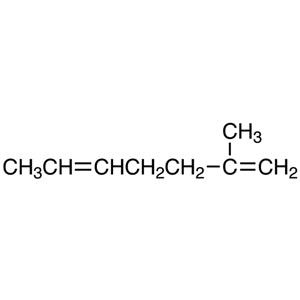
TCI M0316 2-Methyl-1,5-heptadiene, bearing CAS number 6766-54-7, is a hydrocarbon that carries two carbon-carbon double bonds within a single molecule and is supplied as a mixture of cis and trans isomers. The presence of two separate unsaturated groups makes this compound a considerably more versatile non-heterocyclic building block than an ordinary alkene, because researchers can engage either one or both of the double bonds across a synthetic sequence. TCI offers the material in a 5 mL pack size suited to research work and to the preparation of intermediate compounds in the laboratory.
The principal advantage of this diene lies in the difference in character between its two double bonds. One sits at the end of the chain as a relatively exposed vinyl group, while the other lies within the chain in a different steric environment. That distinction opens the door to selective reactions, in which one double bond is modified while the other is left intact and reserved for a later stage of the synthesis. A skeleton carrying two double bonds also makes this compound an attractive candidate for cyclization reactions and for ring-closing metathesis, two approaches widely used in the construction of cyclic structures in modern organic chemistry.
Research laboratories in Indonesia typically draw on a building block of this kind during exploratory synthesis, where a small, well-defined diene is needed to assemble a more elaborate carbon framework. The 5 mL presentation matches the scale of academic and institutional work, in which reactions are run on a research rather than production footing. It fits naturally into the workflow of university chemistry departments and research institutes engaged in preparing intermediates and investigating new synthetic routes.
Related TCI products
- TCI H0551 1541-23-7 1,5-Heptadiene (cis- and trans- mixture)
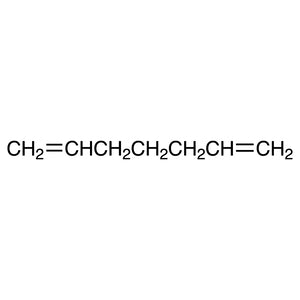
- TCI H0564 3070-53-9 1,6-Heptadiene
- TCI P1841 504-60-9 1,3-Pentadiene (cis- and trans- mixture) (stabilized with TBC)
- TCI P0495 637-50-3 beta-Methylstyrene (cis- and trans- mixture) (stabilized with TBC)
- TCI P0064 109-68-2 2-Pentene (cis- and trans- mixture)
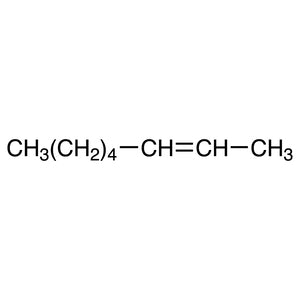
- TCI O0042 111-67-1 2-Octene (cis- and trans- mixture)
- Selective functionalization studies: the two double bonds differ in steric environment, so one can be reacted while the other is deliberately preserved for a subsequent transformation step.
- Ring-closing metathesis: the molecule carries two separate unsaturated sites within one chain, making it a natural substrate for closing a ring between them.
- Cyclization reactions: a diene skeleton of this type supports the construction of cyclic structures, a common objective in modern organic synthesis programs.
- Preparation of synthetic intermediates: as a non-heterocyclic building block, it serves as a compact starting fragment for assembling larger and more elaborate carbon frameworks.
- General alkene chemistry research: the terminal vinyl group provides a relatively accessible, less hindered reaction site useful for studying addition and related transformations of unsaturated systems.
| Brand | TCI |
|---|---|
| CAS number | 6766-54-7 |
| Molecular formula | — |
| Purity | — |
| Category | Chemistry > Building Blocks > Non-Heterocyclic Building Blocks |
| Pack sizes | 5 mL |
| Physical form | — |
| Storage | keep in a cool, well-ventilated place in the tightly closed original container |
- Isomeric composition: supplied as a mixture of cis and trans isomers
Store the material in a cool, well-ventilated area, keeping the container tightly closed and away from heat, open flame, and sources of ignition. The original supplier container is the preferred vessel; if transfer is required, use clean glassware compatible with hydrocarbon liquids and label it clearly. Handle in a fume hood, and wear safety glasses, gloves, and a laboratory coat. Avoid inhalation of vapors and contact with skin or eyes, and keep the compound separate from strong oxidizing agents. Consult the manufacturer's safety data sheet before first use.
—
Produk Terkait
-
1,5-Heptadiene(cis-andtrans-mixture) TCI H0551
Regular price Rp 3.658.200,00Regular price -
1,6-Heptadiene TCI H0564
Regular price From Rp 2.571.450,00Regular price -
1,3-Pentadiene(cis-andtrans-mixture)(stabilizedwithTBC) TCI P1841
Regular price Rp 10.229.100,00Regular price -
beta-Methylstyrene(cis-andtrans-mixture)(stabilizedwithTBC) TCI P0495
Regular price Rp 4.771.200,00Regular price -
2-Pentene(cis-andtrans-mixture) TCI P0064
Regular price From Rp 1.035.300,00Regular price -
2-Octene(cis-andtrans-mixture) TCI O0042
Regular price From Rp 1.220.100,00Regular price -
3-Methyl-3-heptene(cis-andtrans-mixture) TCI M0991
Regular price From Rp 3.763.200,00Regular price -
4-Methyl-2-pentene(cis-andtrans-mixture) TCI M0395
Regular price From Rp 1.988.700,00Regular price