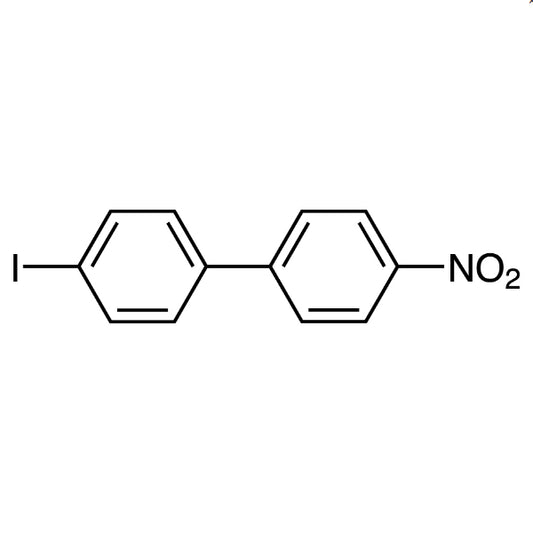
4-Methoxy-4'-nitrobiphenyl is an organic compound widely used in laboratory research focused on nonlinear optical materials. This compound plays a crucial role in the development and testing of advanced optical materials, particularly in the field of photonic science. Its unique molecular structure enables specific interactions with light, making it a valuable tool for studying optical properties and responses in organic-based systems. In laboratory settings, it is frequently employed to analyze the behavior of light and the optical characteristics of materials, supporting innovation in optical technologies.
The compound's key properties include high efficiency in light absorption and emission, as well as chemical stability and reactivity. The presence of nitro and methoxy groups contributes to its structural stability and tunable optical properties. These characteristics allow researchers to modify its molecular structure for various applications, enhancing its versatility in optical research. Its ability to respond precisely to light stimuli makes it a preferred choice for experiments requiring accurate optical performance.
In Indonesian laboratories, 4-Methoxy-4'-nitrobiphenyl is commonly used in optical material research and fundamental studies in physics and chemistry. It is a key component in experiments aimed at developing new optical devices and understanding the behavior of nonlinear optical materials. Its use supports both academic and industrial research, contributing to advancements in modern optical technologies.
Related TCI products
- Nonlinear Optical Material Testing – This compound is ideal for evaluating the optical response and nonlinear properties of materials, supporting research in photonic applications.
- Organic Photonic Research – Its molecular structure enables detailed studies of light-matter interactions, making it suitable for organic-based optical material development.
- Optical Device Development – The compound’s tunable optical properties are used in the design and testing of advanced optical components and devices.
- Spectroscopic Analysis – Its unique absorption and emission characteristics make it useful in spectroscopic studies to analyze light behavior in different environments.
- Material Characterization – It is employed to assess the optical and chemical stability of materials under various experimental conditions.
| Brand | TCI |
|---|---|
| CAS number | 2143-90-0 |
| Molecular formula | — |
| Purity | — |
| Category | Materials Science > Photonic Materials and Optical Materials > Organic Non-Linear Optical (NLO) Materials |
| Pack sizes | — |
| Physical form | — |
| Storage | Store in a cool, dry place away from light and moisture |
This compound should be stored in a cool, dry place, away from direct light and moisture to maintain its chemical stability. It is recommended to use airtight containers to prevent exposure to air and humidity, which could affect its optical properties. Laboratory personnel should handle the compound with care, using appropriate personal protective equipment such as gloves and safety goggles. Due to its chemical nature, it should be kept in a secure location to prevent accidental spills or contamination. Proper ventilation is also advised when working with this material to ensure a safe laboratory environment.
—
Produk Terkait
-
4-Methoxy-3-nitrobiphenyl TCI M1166
Regular price From Rp 903.000,00Regular price -
4-Hydroxy-4'-nitrobiphenyl TCI H0747
Regular price From Rp 1.803.900,00Regular price -
4'-Nitrobiphenyl-4-carboxaldehyde TCI N0967
Regular price From Rp 3.710.700,00Regular price -
4-Hydroxy-3-nitrobiphenyl TCI N0560
Regular price From Rp 2.757.300,00Regular price -
4-Iodo-4'-nitrobiphenyl TCI I0537
Regular price From Rp 2.809.800,00Regular price -
4-Hydroxy-2'-nitrobiphenyl TCI H0753
Regular price From Rp 3.155.250,00Regular price -
4,4'-Dibromo-2-nitrobiphenyl TCI D5189
Regular price From Rp 1.326.150,00Regular price -
2,4-Dichloro-4'-nitrobiphenylEther TCI D3912
Regular price Rp 6.943.650,00Regular price