

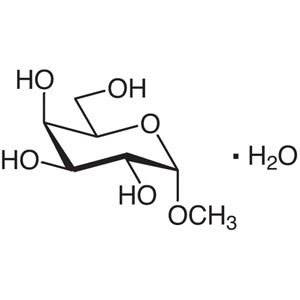
TCI M1047 Methyl alpha-D-Galactopyranoside Monohydrate is the methyl glycoside of D-galactose supplied in its monohydrate form, with the anomeric configuration locked in the alpha orientation. The compound is an important reagent in glycoscience, the branch of research concerned with the role of carbohydrates in biological systems. In the laboratory it serves as a model ligand, an enzyme assay substrate, and a reference compound in the many experiments that involve the recognition of sugars by proteins. Because the anomeric group is already methylated, the compound does not undergo mutarotation the way free galactose does, giving researchers a far more clearly defined test system to work with.
The principal properties that make this material a preferred choice are the stability of the alpha configuration at the anomeric centre and the availability of four free hydroxyl groups that can be modified selectively. That configurational stability matters because many lectins and glycosidase enzymes are highly specific for the anomeric configuration of their substrate, so a reagent that cannot interconvert removes an important source of ambiguity from binding and kinetic data. The compound also dissolves readily in water, which makes it straightforward to prepare as a stock solution for biochemical assays. The monohydrate is a stable crystalline solid that is easy to weigh out accurately.
In Indonesian laboratories this reagent is typically used in university and institutional research groups working on carbohydrate chemistry, protein–sugar interactions, and enzyme characterisation. It is handled as a standard fine chemical on the analytical bench: weighed out on a balance, dissolved in aqueous buffer, and used to prepare working solutions for assays and binding studies. Its defined anomeric form and good water solubility make it convenient for teaching laboratories and research groups alike, where reproducible and clearly defined test systems are needed.
TCI brochures (PDF)
Related TCI products
- TCI N0492 7493-95-0 4-Nitrophenyl alpha-D-Galactopyranoside [Substrate for alpha-D-Galactosidase]
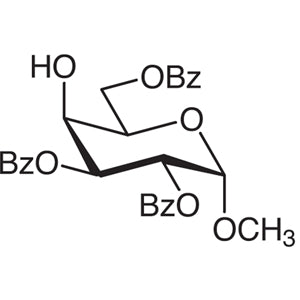
- TCI M1933 3601-36-3 Methyl 2,3,6-Tri-O-benzoyl-alpha-D-galactopyranoside
- TCI B3470 97753-82-7 5-Bromo-3-indolyl beta-D-Galactopyranoside [for Biochemical Research]
- TCI B3201 7240-90-6 5-Bromo-4-chloro-3-indolyl beta-D-Galactopyranoside [for Biochemical Research]
- TCI P2078 183875-28-7 Phenyl 2-O-Acetyl-3,4,6-tri-O-benzyl-1-thio-beta-D-galactopyranoside
- TCI P1326 2818-58-8 Phenyl beta-D-Galactopyranoside
- Lectin binding studies — the locked alpha configuration provides a defined ligand for probing how galactose-recognising proteins discriminate between anomeric forms, removing mutarotation as a variable.
- Glycosidase enzyme assays — serves as a well-defined substrate for enzymes that act on alpha-galactosidic linkages, allowing activity to be measured against a stable and unambiguous starting material.
- Reference and comparison compound — used alongside test samples in carbohydrate experiments so that results obtained from unknown or modified sugars can be interpreted against a known glycoside standard.
- Selective chemical modification and synthesis — the four free hydroxyl groups permit selective derivatisation, making the molecule a convenient starting scaffold for preparing modified galactoside structures in the laboratory.
- Aqueous stock solution preparation for biochemical work — the compound's good water solubility allows accurate stock solutions to be made up quickly for routine binding, inhibition, and enzyme kinetics experiments.
| Brand | TCI |
|---|---|
| CAS number | 34004-14-3 |
| Molecular formula | — |
| Purity | — |
| Category | Chemistry > Chemical Biology > Glycoscience |
| Pack sizes | — |
| Physical form | stable crystalline solid (monohydrate) |
| Storage | store in a cool, dry place in a tightly closed container; refer to the manufacturer's label and safety data sheet for the exact recommended conditions |
- Catalogue Code: M1047
Store the container tightly closed in a cool, dry, well-ventilated area, away from direct sunlight, heat sources, and moisture, since the material is supplied as a defined monohydrate and unnecessary exposure to humid air should be avoided. Keep the reagent in its original supplier container or transfer it to a clean, dry, chemically compatible bottle that is clearly labelled with the product name and CAS number. Handle the solid on a clean balance area or in a fume hood while wearing a laboratory coat, safety glasses, and suitable gloves, and avoid generating or inhaling dust. Use clean, dry spatulas to prevent contaminating the bulk material, close the container immediately after weighing, and consult the manufacturer's safety data sheet before first use and before disposal.
—
Product Categories
Produk Terkait
-
4-Nitrophenylalpha-D-Galactopyranoside[Substrateforalpha-D-Galactosidase] TCI N0492
Regular price Rp 1.298.850,00Regular price -
Methyl2,3,6-Tri-O-benzoyl-alpha-D-galactopyranoside TCI M1933
Regular price From Rp 1.749.300,00Regular price -
5-Bromo-3-indolylbeta-D-Galactopyranoside[forBiochemicalResearch] TCI B3470
Regular price From Rp 743.400,00Regular price -
5-Bromo-4-chloro-3-indolylbeta-D-Galactopyranoside[forBiochemicalResearch] TCI B3201
Regular price From Rp 1.326.150,00Regular price -
Phenyl2-O-Acetyl-3,4,6-tri-O-benzyl-1-thio-beta-D-galactopyranoside TCI P2078
Regular price Rp 10.229.100,00Regular price -
Phenylbeta-D-Galactopyranoside TCI P1326
Regular price From Rp 3.207.750,00Regular price -
4-Nitrophenylbeta-D-Galactopyranoside[Substrateforbeta-Galactosidase] TCI N0616
Regular price From Rp 1.961.400,00Regular price -
2-Nitrophenylbeta-D-Galactopyranoside[Substrateforbeta-D-Galactosidase] TCI N0418
Regular price From Rp 848.400,00Regular price
![7493-95-0 4-Nitrophenyl alpha-D-Galactopyranoside [Substrate for alpha-D-Galactosidase] - AMI Scientific](http://amiscientific.com/cdn/shop/files/TCI2510N0492.jpg?v=1767129934&width=533)
![97753-82-7 5-Bromo-3-indolyl beta-D-Galactopyranoside [for Biochemical Research] - AMI Scientific](http://amiscientific.com/cdn/shop/files/TCI2510B3470.jpg?v=1768193597&width=533)
![7240-90-6 5-Bromo-4-chloro-3-indolyl beta-D-Galactopyranoside [for Biochemical Research] - AMI Scientific](http://amiscientific.com/cdn/shop/files/TCI2510B3201.jpg?v=1768193511&width=533)


![3150-24-1 4-Nitrophenyl beta-D-Galactopyranoside [Substrate for beta-Galactosidase] - AMI Scientific](http://amiscientific.com/cdn/shop/files/TCI2510N0616.jpg?v=1767130131&width=533)
![369-07-3 2-Nitrophenyl beta-D-Galactopyranoside [Substrate for beta-D-Galactosidase] - AMI Scientific](http://amiscientific.com/cdn/shop/files/TCI2510N0418.jpg?v=1767129806&width=533)