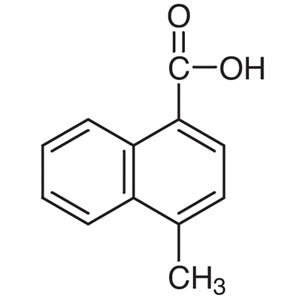
4-Methyl-1-naphthoic Acid is a chemical compound widely used as a building block in various chemical reactions, particularly in the synthesis of complex molecules. It plays a crucial role in laboratory settings by serving as a versatile reagent that can participate in multiple reaction pathways. This compound is commonly employed in organic chemistry research, where its ability to form stable intermediates makes it an essential tool for chemists. Its presence in scientific applications extends to the development of pharmaceuticals and organic materials, making it a fundamental component in many experimental processes.
The compound is valued for its stable molecular structure and relatively high reactivity, which allows it to interact effectively with a range of functional groups. Its solubility in organic solvents enhances its usability in diverse chemical processes, simplifying both preparation and reaction conditions. These properties make it a preferred choice for researchers aiming to achieve controlled and efficient chemical transformations. The compound’s versatility also supports its application in both academic and industrial research environments.
In Indonesian laboratories, 4-Methyl-1-naphthoic Acid is extensively used in organic chemistry research, particularly in educational institutions and research centers. It is a key reagent in the study of both heterocyclic and non-heterocyclic compounds, contributing to the development of new chemical technologies. Its role in chemical education and innovation underscores its importance in the scientific community, especially in the context of local research and development efforts.
Related TCI products
- Organic synthesis applications benefit from this compound’s ability to form stable intermediates and participate in multiple reaction pathways.
- Pharmaceutical research utilizes it as a building block for the synthesis of complex drug molecules and bioactive compounds.
- Academic research in chemistry relies on its versatility for teaching and experimental purposes in both undergraduate and graduate studies.
- Industrial chemical development incorporates it in the production of organic materials and specialty chemicals.
- Analytical chemistry applications leverage its solubility and reactivity for use in chromatographic and spectroscopic analyses.
| Brand | TCI |
|---|---|
| CAS number | 4488-40-8 |
| Molecular formula | — |
| Purity | — |
| Category | Chemistry > Building Blocks > Non-Heterocyclic Building Blocks |
| Pack sizes | Available in various quantities as per standard laboratory supply |
| Physical form | Solid |
| Storage | Store in a cool, dry place away from direct sunlight and moisture |
This compound should be stored in a cool, dry environment to maintain its stability and prevent degradation. It is recommended to use airtight containers to protect it from moisture and air exposure. Due to its chemical nature, it should be kept away from incompatible substances such as strong bases or oxidizing agents. Proper labeling of storage containers is essential for safety and traceability. In laboratory settings, personal protective equipment such as gloves and safety goggles should be worn when handling this material to ensure safe usage and minimize potential risks.
—
Produk Terkait
-
4-Bromo-1-naphthoicAcid TCI B4949
Regular price From Rp 769.650,00Regular price -
6-Bromo-2-naphthoicAcid TCI B3823
Regular price From Rp 1.431.150,00Regular price -
4-Bromo-3-hydroxy-2-naphthoicAcid TCI B3229
Regular price From Rp 2.174.550,00Regular price -
7-Bromo-3-hydroxy-2-naphthoicAcid TCI B3180
Regular price From Rp 769.650,00Regular price -
1-Bromo-2-naphthoicAcid TCI B1617
Regular price Rp 610.050,00Regular price -
6-Acetoxy-2-naphthoicAcid TCI A0970
Regular price From Rp 1.644.300,00Regular price -
2-NaphthoicAcid TCI N0025
Regular price From Rp 743.400,00Regular price -
1-NaphthoicAcid TCI N0024
Regular price Rp 1.326.150,00Regular price