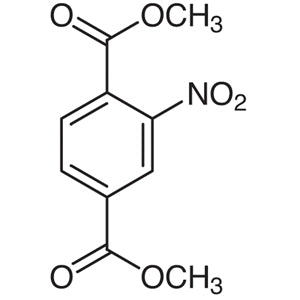
Dimethyl Nitroterephthalate (DMNT), with CAS number 5292-45-5, is a chemical compound widely utilized in organic synthesis reactions. It serves as a key building block in the development of heterocyclic compounds and terpenoid derivatives. Its molecular structure enables it to participate in various chemical transformations, making it an essential reagent for synthetic chemists. In laboratory settings, DMNT is frequently employed in electrophilic substitution reactions and molecular coupling processes. Its versatility supports the creation of complex organic molecules, contributing to research in pharmaceuticals, materials science, and chemical engineering.
DMNT is valued for its chemical stability under controlled conditions, although it is sensitive to moisture and air exposure. This sensitivity necessitates careful handling and storage, which aligns with standard laboratory practices. Its solubility in organic solvents such as ethyl acetate and chloroform enhances its utility in purification and reaction processes. These properties make DMNT a reliable and effective reagent for researchers aiming to achieve precise chemical outcomes. Its availability and performance in controlled environments further solidify its role in modern chemical research.
In Indonesian laboratories, DMNT is commonly used in organic chemistry research at universities and research institutions. Its application spans across various projects involving compound synthesis and structural modifications. The compound's reliability and compatibility with standard laboratory procedures make it a preferred choice for both academic and industrial research. Its consistent performance and ease of use contribute to its popularity among chemists in Indonesia.
- Organic synthesis reactions benefit from DMNT's role in creating complex molecular structures through electrophilic substitution processes.
- Molecular coupling applications utilize DMNT's ability to facilitate the formation of new chemical bonds in synthetic pathways.
- Heterocyclic compound development relies on DMNT as a building block for constructing ring-based molecular frameworks.
- Terpenoid derivative synthesis leverages DMNT's structural characteristics to produce bioactive compounds with diverse applications.
- Purification and separation processes take advantage of DMNT's solubility in organic solvents, aiding in efficient compound isolation.
| Brand | TCI |
|---|---|
| CAS number | 5292-45-5 |
| Molecular formula | — |
| Purity | — |
| Category | Chemistry > Building Blocks > Non-Heterocyclic Building Blocks |
| Pack sizes | Available in standard laboratory quantities |
| Physical form | Solid |
| Storage | Requires dry, cool, and airtight conditions |
DMNT should be stored in a dry, cool environment to prevent moisture absorption and degradation. It is recommended to use airtight containers made of glass or high-density polyethylene to maintain its chemical integrity. Laboratory personnel should handle DMNT with care, ensuring proper ventilation and protective gear to minimize exposure. Due to its sensitivity to air and humidity, it is best stored in a controlled laboratory setting with consistent temperature and humidity levels. Regular monitoring of storage conditions is essential to ensure the compound remains viable for use in chemical reactions. Proper labeling and safe handling practices are crucial to maintaining safety and effectiveness in laboratory operations.
—
Produk Terkait
-
2-HydroxyethylMethylTerephthalate TCI T1679
Regular price From Rp 1.803.900,00Regular price -
Bis(2-hydroxyethyl)Terephthalate TCI B3429
Regular price From Rp 928.200,00Regular price -
DisodiumTerephthalate TCI T1097
Regular price From Rp 1.510.950,00Regular price -
DimethylTerephthalate TCI T0015
Regular price From Rp 505.050,00Regular price -
DiethylTerephthalate TCI T0014
Regular price From Rp 1.881.600,00Regular price -
DibutylTerephthalate TCI D6074
Regular price Rp 2.227.050,00Regular price -
DiphenylTerephthalate TCI D5995
Regular price From Rp 2.094.750,00Regular price -
NitroterephthalicAcid TCI N0272
Regular price From Rp 1.590.750,00Regular price