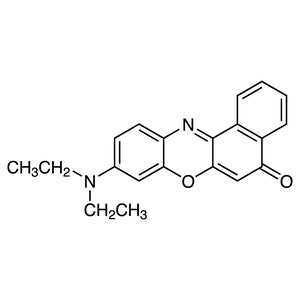
Nile Red from TCI is a lipophilic fluorescent dye from the benzophenoxazone family. It is well known in cell biology, microbiology and materials science. Its main uses are staining neutral lipids, such as lipid droplets inside cells, and detecting hydrophobic environments. TCI classifies it as an oil dye for research and experimental use. In the laboratory, Nile Red is a key tool for quickly visualising and measuring lipid content by fluorescence microscopy, flow cytometry or spectrofluorometry. Researchers who need a fast, reliable way to show where lipids sit in a sample often choose it as their first stain.
The biggest advantage of Nile Red is that it is solvatochromic. The colour and intensity of its fluorescence change sharply with the polarity of its surroundings. In aqueous environments its fluorescence is weak. In lipid-rich or hydrophobic environments the fluorescence rises steeply and the emission wavelength shifts. Because the dye "switches on" in hydrophobic environments, background staining stays low and contrast stays high, often without complicated washing steps. Nile Red also dissolves well in many organic solvents and passes easily through cell membranes. Together, these properties make it a practical choice for staining both live and fixed samples.
In Indonesia, Nile Red is highly relevant to research groups in universities, government research institutes and industrial laboratories. Microbiology and biotechnology teams use it to screen microalgae and oleaginous microorganisms for lipid accumulation, which supports bioenergy and biofuel research. Cell biology and biomedical laboratories use it to study lipid droplets and lipid metabolism. Materials science and polymer laboratories use its polarity sensitivity to probe hydrophobic domains. Because the method is simple, it suits teaching laboratories as well as advanced research facilities across the country.
- Lipid droplet staining in cells: Nile Red selectively highlights neutral lipids such as lipid droplets, giving clear, high-contrast fluorescence images for studies of cellular lipid storage and metabolism.
- Microalgae and microbial lipid screening: Its strong fluorescence in lipid-rich environments allows rapid screening of microalgae and oleaginous microbes for lipid accumulation, which supports bioenergy and biofuel research programmes.
- Flow cytometry analysis: Nile Red passes easily through cell membranes and gives low background signal, so researchers can quickly measure lipid content in large cell populations by flow cytometry.
- Spectrofluorometric lipid quantification: Because its fluorescence rises sharply in hydrophobic media, Nile Red supports quick relative measurement of lipid content in suspensions and extracts using spectrofluorometry.
- Probing hydrophobic environments in materials: Its solvatochromic response to environmental polarity makes Nile Red useful for detecting and characterising hydrophobic domains in polymers, micelles and other materials science systems.
| Brand | TCI (product code N0659) |
|---|---|
| CAS number | 7385-67-3 |
| Molecular formula | — |
| Purity | — |
| Category | Chemistry > Stains and Dyes (for Research and Experimental Use) > Oil Dyes (for Research and Experimental Use) |
| Pack sizes | please see the pack options on the product listing |
| Physical form | solid dye; see the TCI product documentation for full details |
| Storage | keep tightly closed and protected from light; follow the TCI label and Safety Data Sheet |
Store Nile Red in its original, tightly closed container in a cool, dry and dark place, away from direct light and sources of heat. Fluorescent dyes can be sensitive to light, so prepared stock solutions are best kept in amber glass vials or containers wrapped in foil. Always follow the storage conditions on the TCI label and in the Safety Data Sheet. Handle the dye in a well-ventilated area and wear standard personal protective equipment, including a laboratory coat, gloves and safety glasses. Avoid skin contact, eye contact and inhaling dust. Take care when working with the organic solvents used to prepare solutions, and dispose of waste according to local laboratory and environmental regulations. This product is for research and experimental use only.
—
Produk Terkait
-
TCI B5774 5,10-Bis(4,4,5,5-tetramethyl-1,3,2-dioxaborolan-2-yl)naphtho[1,2-c:5,6-c']bis([1,2,5]oxadiazole)
Regular price Rp 10.255.350,00Regular price -
Dihydroiodide TCI B6569
Regular price From Rp 1.936.200,00Regular price -
Trifluoromethanesulfonate TCI B7003
Regular price From Rp 1.936.200,00Regular price
![5,10-Bis(4,4,5,5-tetramethyl-1,3,2-dioxaborolan-2-yl)naphtho[1,2-c:5,6-c']bis([1,2,5]oxadiazole) - TCI B5774 - AMI Scientific](http://amiscientific.com/cdn/shop/files/TCI2510B5774.jpg?v=1769180228&width=533)