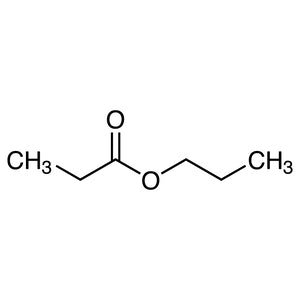
Propyl Propionate (TCI P0511), with CAS number 106-36-5, is a chemical compound widely used in laboratory settings for its versatility in organic synthesis. As an ester derived from propanol and propionic acid, it serves as a fundamental building block in the creation of more complex chemical structures. Its role in the laboratory is critical, particularly in the development of pharmaceutical compounds and organic molecules. This compound is essential for researchers aiming to explore chemical reactions and synthesize new materials.
Propyl Propionate is valued for its chemical stability and reactivity, making it a preferred choice in various synthetic processes. Its simple yet flexible molecular structure allows it to participate in a range of reactions, including esterification and hydrolysis. This adaptability enables chemists to manipulate its properties for different applications. Additionally, its compatibility with a wide array of reagents enhances its utility in laboratory experiments. These characteristics make it an indispensable tool in both academic and industrial research environments.
In Indonesian laboratories, Propyl Propionate is commonly used in pharmaceutical and organic chemistry research. It plays a key role in the synthesis of compounds requiring ester functionalities. Its reliability and ease of manipulation make it a go-to material for researchers working on drug development, chemical analysis, and material science. The compound's consistent performance supports a wide range of experimental needs, contributing to the advancement of scientific research in the region.
TCI brochures (PDF)
- Lipids 2025-12-17 · p. 12
- Organic synthesis in pharmaceutical research due to its role in esterification reactions and compound development.
- Chemical analysis applications where ester functionalities are required for sample preparation and reagent compatibility.
- Drug development projects that rely on building blocks for the synthesis of complex molecules and active pharmaceutical ingredients.
- Material science experiments involving the creation of polymers and other chemical structures through controlled reactions.
- Teaching and research in academic institutions focused on organic chemistry and chemical engineering curricula.
| Brand | TCI |
|---|---|
| CAS number | 106-36-5 |
| Molecular formula | — |
| Purity | — |
| Category | Chemistry > Building Blocks > Non-Heterocyclic Building Blocks |
| Pack sizes | Available in standard laboratory quantities |
| Physical form | Liquid |
| Storage | Store in a cool, dry place away from direct sunlight |
Propyl Propionate should be stored in a cool, dry environment to maintain its chemical stability. It is recommended to keep it in a sealed container to prevent exposure to air and moisture. Due to its reactivity, it should be handled in a well-ventilated area, preferably with appropriate personal protective equipment. Avoid contact with strong acids or bases to prevent unwanted chemical reactions. Regular monitoring of storage conditions is essential to ensure the compound remains in optimal condition for use in laboratory experiments. Proper labeling and secure storage are also important to prevent accidental exposure or misuse.
—
Produk Terkait
-
tert-ButylPropionate TCI B3327
Regular price From Rp 2.094.750,00Regular price -
2-PhenylethylPropionate TCI P1823
Regular price Rp 689.850,00Regular price -
SodiumPropionate TCI P0512
Regular price From Rp 610.050,00Regular price -
PotassiumPropionate TCI P0510
Regular price From Rp 769.650,00Regular price -
PhenylPropionate TCI P0509
Regular price From Rp 1.749.300,00Regular price -
MethylPropionate TCI P0508
Regular price From Rp 505.050,00Regular price -
IsopropylPropionate TCI P0507
Regular price From Rp 689.850,00Regular price -
IsobutylPropionate TCI P0506
Regular price From Rp 505.050,00Regular price