

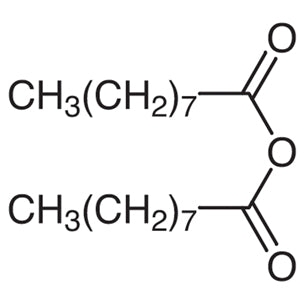
Nonanoic Anhydride (TCI P0957), with CAS number 1680-36-0, is a chemical compound widely used in organic synthesis within laboratory settings. As an anhydride, it plays a crucial role in the formation of esters and amides, making it a valuable reagent for chemists. This compound is commonly employed in the development of complex organic molecules, particularly in research involving functional group transformations and molecular modifications. Its chemical reactivity and versatility make it a preferred choice for synthetic chemists seeking efficient and reliable reagents.
The reactivity of Nonanoic Anhydride is a key factor in its popularity. It is highly reactive towards water and organic materials, which allows it to participate in a wide range of chemical reactions. However, this reactivity also means it is prone to hydrolysis, necessitating careful handling and storage. Its ability to act as a primary reagent in the synthesis of complex structures is a major advantage, especially in environments where precision and control are essential. The compound’s stability under specific conditions further enhances its usability in various synthetic pathways.
In Indonesian laboratories, Nonanoic Anhydride is frequently used in organic chemistry research conducted by universities and research institutions. Its availability and effectiveness in producing desired chemical outcomes make it a go-to reagent for many researchers. It is particularly useful in applications requiring dry and uncontaminated conditions, ensuring consistent and reproducible results. Its role in advancing chemical synthesis in Indonesia underscores its importance in the scientific community.
- Organic synthesis of esters and amides due to its reactivity and ability to form stable intermediates.
- Functional group modification in complex molecule construction for pharmaceutical and materials research.
- Research in polymer chemistry for the development of new synthetic polymers and copolymers.
- Development of specialty chemicals for industrial applications requiring precise chemical transformations.
- Educational use in university laboratories for teaching advanced organic chemistry techniques and reaction mechanisms.
| Brand | TCI |
|---|---|
| CAS number | 1680-36-0 |
| Molecular formula | — |
| Purity | — |
| Category | Chemistry > Building Blocks > Non-Heterocyclic Building Blocks |
| Pack sizes | Available in various quantities as per standard laboratory supply formats |
| Physical form | Solid |
| Storage | Must be stored in a dry, cool, and well-ventilated area away from moisture and incompatible substances |
Nonanoic Anhydride should be stored in a dry, cool, and well-ventilated area to prevent hydrolysis and degradation. It is recommended to use airtight containers made of inert materials such as glass or polyethylene to minimize exposure to moisture and air. Due to its reactivity, it should be kept away from water, acids, and other reactive substances. In laboratory settings, it is essential to handle the compound in a fume hood to ensure proper ventilation and safety. Always use appropriate personal protective equipment, including gloves and safety goggles, when working with this material. Regular monitoring of storage conditions is advised to maintain the compound’s stability and effectiveness for use in chemical reactions.
—
Produk Terkait
-
NonanoicAcid TCI P0952
Regular price From Rp 477.750,00Regular price -
ValericAnhydride TCI V0006
Regular price From Rp 875.700,00Regular price -
3-BromophthalicAnhydride TCI B4061
Regular price From Rp 1.246.350,00Regular price -
Bicyclo[2.2.2]oct-5-ene-2,3-dicarboxylicAnhydride TCI B3038
Regular price Rp 3.605.700,00Regular price -
ButylsuccinicAnhydride TCI B2742
Regular price From Rp 5.274.150,00Regular price -
4-BromophthalicAnhydride TCI B1693
Regular price From Rp 2.386.650,00Regular price -
2-Buten-1-ylsuccinicAnhydride TCI B1613
Regular price From Rp 2.439.150,00Regular price -
BehenicAnhydride TCI B1531
Regular price From Rp 1.776.600,00Regular price


![6708-37-8 Bicyclo[2.2.2]oct-5-ene-2,3-dicarboxylic Anhydride - AMI Scientific](http://amiscientific.com/cdn/shop/files/TCI2510B3038.jpg?v=1767089273&width=533)


