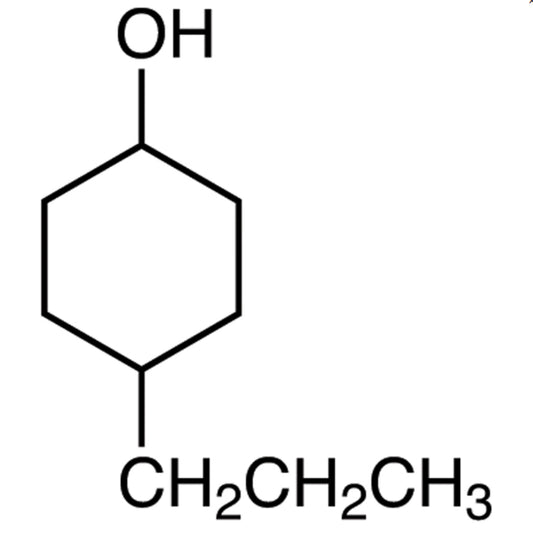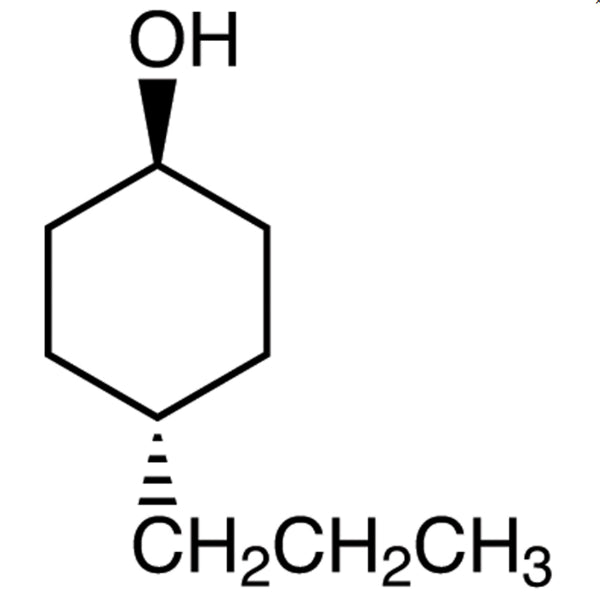
Trans-4-Propylcyclohexanol is an organic compound widely used in chemical reactions to construct complex molecular structures. As a cycloalkanol, it serves as a versatile building block in synthetic chemistry, enabling the development of a wide range of organic compounds. Its unique structure allows for various chemical transformations, including substitution, oxidation, and reduction, making it a valuable tool in laboratory settings. This compound is commonly found in chemical laboratories as a foundational material for research and development.
The chemical properties of trans-4-Propylcyclohexanol make it a preferred choice for synthetic chemists. It exhibits reactivity and flexibility, allowing it to participate in multiple reaction pathways. Its stability under controlled conditions ensures consistent results in experimental procedures. However, it is sensitive to temperature and humidity, requiring careful handling and storage. The solubility of this compound varies depending on the solvent used, which adds to its adaptability in different synthetic applications.
In Indonesian laboratories, trans-4-Propylcyclohexanol is utilized in organic chemistry research, particularly in the synthesis of complex compounds and the study of reactivity. It is also commonly used in educational settings to demonstrate molecular structures and reaction mechanisms. Its role in both research and teaching makes it an essential component in the chemical laboratory environment.
Related TCI products
- TCI P1874 52204-65-6 4-Propylcyclohexanol (cis- and trans- mixture)
- TCI P0770 90676-25-8 2-Propylcyclohexanol (cis- and trans- mixture)
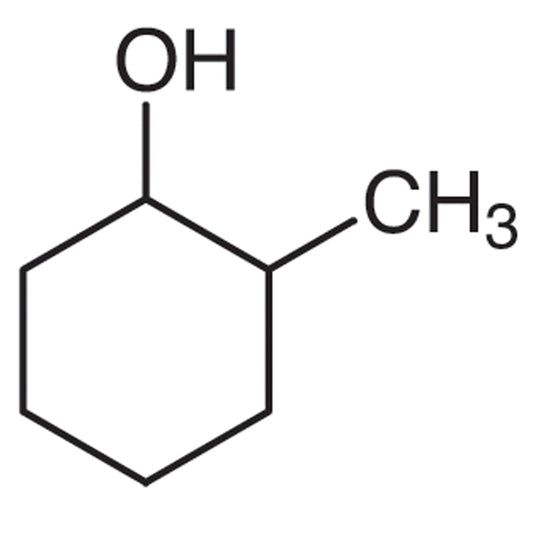
- TCI M0194 583-59-5 2-Methylcyclohexanol (cis- and trans- mixture)
- TCI P1174 2362-61-0 trans-2-Phenyl-1-cyclohexanol
- TCI M3152 81936-32-5 1-Methoxy-4-(trans-4-propylcyclohexyl)benzene
- TCI M0354 7731-29-5 trans-4-Methylcyclohexanol
- Organic synthesis of complex molecules benefits from the flexible structure of trans-4-Propylcyclohexanol, allowing for precise molecular modifications.
- It is ideal for studying reactivity and functional group transformations due to its chemical versatility and stability.
- In educational settings, it helps students understand molecular structures and reaction mechanisms through hands-on experimentation.
- Its solubility characteristics make it suitable for use in solvent-based reactions, enabling controlled chemical processes.
- It supports research into new compounds and materials by serving as a starting point for various synthetic pathways.
| Brand | TCI |
|---|---|
| CAS number | 77866-58-1 |
| Molecular formula | — |
| Purity | — |
| Category | Chemistry > Building Blocks > Non-Heterocyclic Building Blocks |
| Pack sizes | Available in various sizes as per supplier specifications |
| Physical form | Liquid |
| Storage | Store in a cool, dry place away from direct sunlight and moisture |
Trans-4-Propylcyclohexanol should be stored in a cool, dry environment to maintain its chemical stability. It is recommended to keep it in a tightly sealed container to prevent exposure to moisture and air. Due to its sensitivity to temperature and humidity, it should be stored away from heat sources and direct sunlight. Suitable containers for storage include glass or high-density polyethylene bottles. In laboratory settings, it is important to handle this compound with care, using appropriate personal protective equipment. Proper labeling and storage conditions ensure the safety and effectiveness of the material in chemical experiments.
—
Produk Terkait
-
4-Propylcyclohexanol(cis-andtrans-mixture) TCI P1874
Regular price From Rp 795.900,00Regular price -
2-Propylcyclohexanol(cis-andtrans-mixture) TCI P0770
Regular price From Rp 980.700,00Regular price -
2-Methylcyclohexanol(cis-andtrans-mixture) TCI M0194
Regular price From Rp 505.050,00Regular price -
trans-2-Phenyl-1-cyclohexanol TCI P1174
Regular price From Rp 2.411.850,00Regular price -
1-Methoxy-4-(trans-4-propylcyclohexyl)benzene TCI M3152
Regular price From Rp 689.850,00Regular price -
trans-4-Methylcyclohexanol TCI M0354
Regular price Rp 2.359.350,00Regular price -
cis-4-Methylcyclohexanol TCI M0353
Regular price From Rp 928.200,00Regular price -
trans-2-Methylcyclohexanol TCI M0352
Regular price Rp 4.108.650,00Regular price