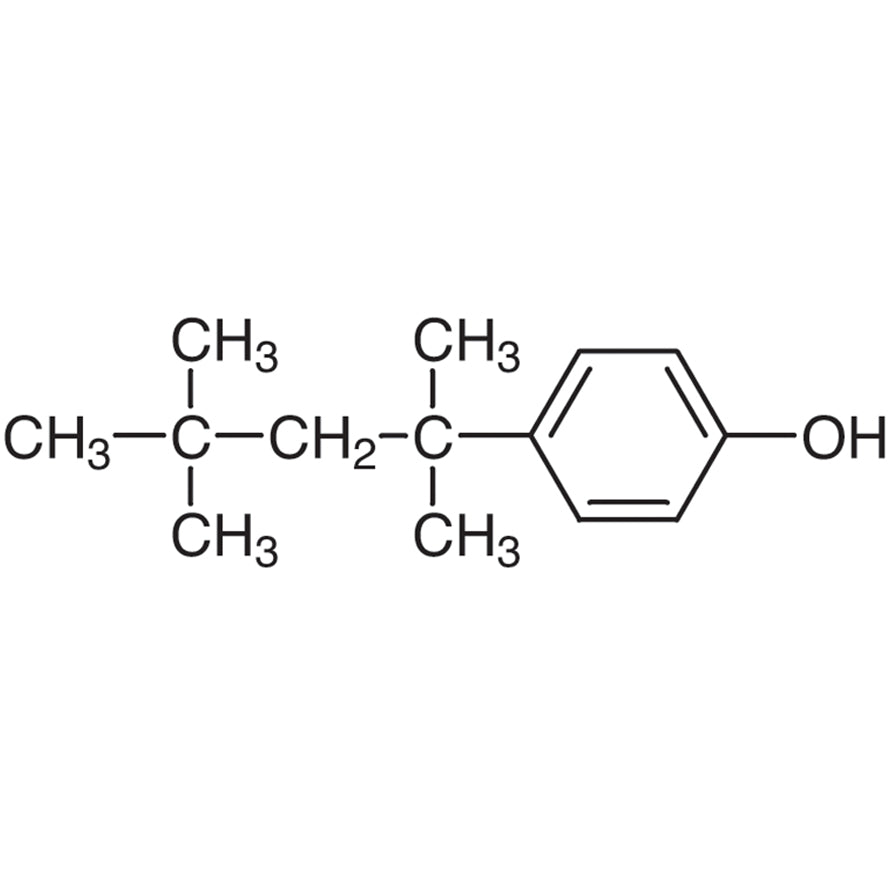
4-(1,1,3,3-Tetramethylbutyl)phenol from TCI is better known as 4-tert-octylphenol. It belongs to the alkylphenol family: a phenol ring that carries a branched octyl group at the para position. In the laboratory, this compound serves as a non-heterocyclic building block for synthesizing phenol derivatives, phenolic resins, and nonionic surfactant precursors. Octylphenol is also often used as a reference compound in environmental and toxicological studies. Alkylphenols are known contaminants monitored in water bodies, and they are also studied as endocrine-disrupting substances.
Researchers choose this material because its structure has two clearly different sides. The phenolic hydroxyl group is reactive, so it can be etherified, esterified, or condensed with formaldehyde. The bulky, branched tert-octyl chain gives the molecule strong hydrophobic character. Together, these two features make octylphenol useful for designing amphiphilic molecules such as ethoxylated surfactants. The branched group also creates steric hindrance, which affects solubility, compatibility with polymers, and how the compound behaves in the environment. TCI's consistent quality helps researchers get reproducible results from one batch to the next.
In Indonesian laboratories, this compound is used mainly in university organic chemistry research groups, polymer and materials science laboratories, and environmental testing facilities. Synthetic chemists use it as a starting material for phenol derivatives and resin studies. Analytical and environmental laboratories use it as a reference substance when developing methods to detect alkylphenol contaminants in water samples. Toxicology and endocrinology research teams also use it as a model compound when studying the effects of endocrine-disrupting chemicals.
Related TCI products
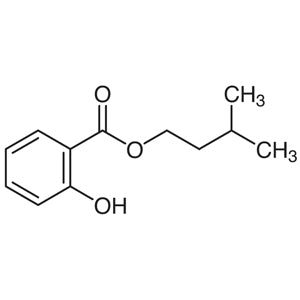
- TCI S0012 87-20-7 Isoamyl Salicylate (contains 2-Methylbutyl Salicylate)
- TCI H1546 172611-72-2 2-(1-Hydroxy-3-methylbutylidene)-5,5-dimethyl-1,3-cyclohexanedione
- TCI T3895 76115-06-5 4-(1,2,2-Triphenylvinyl)phenol
- TCI B4053 3035-94-7 4-(4-Bromophenylazo)phenol
- TCI B2772 2772-45-4 2,4-Bis(alpha,alpha-dimethylbenzyl)phenol
- TCI B2357 2496-21-1 4-(4-Butylphenylazo)phenol
- Synthesis of phenol derivatives: the reactive phenolic hydroxyl group can be etherified or esterified, so researchers can build a range of para-substituted phenol compounds from a single starting material.
- Phenolic resin research: the hydroxyl-bearing ring can be condensed with formaldehyde, while the bulky tert-octyl group changes how the resulting resin dissolves and how well it blends with polymers.
- Nonionic surfactant precursor development: the strongly hydrophobic branched chain combined with a reactive polar head makes the compound well suited to designing amphiphilic molecules such as ethoxylated surfactants.
- Environmental analysis reference: alkylphenols are contaminants monitored in water bodies, so this compound works as a reference substance when developing and validating detection methods for environmental samples.
- Endocrine disruption and toxicology studies: octylphenol is studied as an endocrine-disrupting compound, which makes it a relevant model substance for research into how alkylphenols affect biological systems.
| Brand | TCI (product code T0144) |
|---|---|
| CAS number | 140-66-9 |
| Molecular formula | — |
| Purity | — |
| Category | Chemistry > Building Blocks > Non-Heterocyclic Building Blocks |
| Pack sizes | see the available options on the product listing |
| Physical form | see the TCI label and Safety Data Sheet (SDS) |
| Storage | — |
- Synonym: 4-tert-Octylphenol
Store this compound in its original, tightly closed container in a cool, dry, well-ventilated area, away from direct sunlight, heat sources, and strong oxidizing agents. Follow the storage temperature on the TCI label and Safety Data Sheet. Because alkylphenols are studied as endocrine disruptors and monitored as environmental contaminants, handle the material carefully. Wear gloves, safety glasses, and a lab coat, and work in a fume hood or a well-ventilated area. Avoid skin and eye contact, and do not breathe in dust or vapors. Do not let the material or its waste enter drains or waterways. Dispose of residues according to local regulations for chemical waste.
—
Produk Terkait
-
IsoamylSalicylate(contains2-MethylbutylSalicylate) TCI S0012
Regular price From Rp 505.050,00Regular priceRp 352.800,00Sale price From Rp 505.050,00 -
2-(1-Hydroxy-3-methylbutylidene)-5,5-dimethyl-1,3-cyclohexanedione TCI H1546
Regular price From Rp 2.121.000,00Regular priceRp 1.482.600,00Sale price From Rp 2.121.000,00 -
4-(1,2,2-Triphenylvinyl)phenol TCI T3895
Regular price Rp 6.386.100,00Regular priceRp 4.481.400,00Sale price Rp 6.386.100,00 -
4-(4-Bromophenylazo)phenol TCI B4053
Regular price From Rp 3.392.550,00Regular priceRp 2.371.950,00Sale price From Rp 3.392.550,00 -
2,4-Bis(alpha,alpha-dimethylbenzyl)phenol TCI B2772
Regular price From Rp 582.750,00Regular priceRp 423.150,00Sale price From Rp 582.750,00 -
4-(4-Butylphenylazo)phenol TCI B2357
Regular price From Rp 2.677.500,00Regular priceRp 1.872.150,00Sale price From Rp 2.677.500,00 -
3-(Benzyloxy)phenol TCI B2070
Regular price From Rp 5.460.000,00Regular priceRp 3.833.550,00Sale price From Rp 5.460.000,00 -
2-(Benzyloxy)phenol TCI B1661
Regular price From Rp 2.677.500,00Regular priceRp 1.887.900,00Sale price From Rp 2.677.500,00