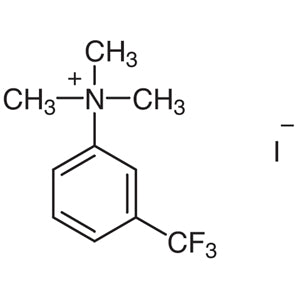
TCI T1036 is 3-(Trifluoromethyl)phenyltrimethylammonium Bromide, CAS number 262608-95-7, an aromatic quaternary ammonium salt. The cation consists of a phenyl ring carrying a trifluoromethyl group at the meta position, attached to a positively charged nitrogen atom bearing three methyl groups, while bromide serves as the counter-anion. In the TCI catalogue this material is grouped under synthetic reagents, so it is used as a specialized reagent or precursor in organic chemistry experiments where reactivity must be carefully controlled. In the laboratory it is typically a purpose-selected building block rather than a general-purpose chemical.
Aryl trimethylammonium salts are known because the trimethylammonium group can act as a leaving group in certain types of aromatic transformations, especially when the ring is electron-poor. The electron-withdrawing trifluoromethyl group makes this aromatic framework attractive to researchers studying nucleophilic aromatic substitution or reactions that involve cleavage of the carbon-nitrogen bond. Its ionic character also influences solubility, so solvent choice deserves careful thought when a reaction is being designed. Together, these features make it a considered option for focused synthetic work.
In Indonesian laboratories, specialized reagents such as this one are usually needed by research groups, university laboratories and development teams that carry out organic synthesis and explore new reaction pathways. Because it is a single-purpose reagent, it is normally procured in small quantities that match planned experiments. AMI Scientific supplies the TCI brand for laboratories that want a recognized manufacturer's product for their synthetic reagent needs. Researchers should consult the product documentation for details before planning work with this compound.
TCI brochures (PDF)
- Quaternary Ammonium Salts 2025-11-10 · p. 6
- Fluorination Reagents, Fluorinated Building Blocks 2026-03-18 · p. 38
Related TCI products
- TCI T1014 27389-57-7 3-(Trifluoromethyl)phenyltrimethylammonium Iodide
- TCI T0961 68254-41-1 3-(Trifluoromethyl)phenyltrimethylammonium Hydroxide (5% in Methanol) [for Transesterification of Glyceride]
- TCI B3970 1197922-04-5 (11bS)-2,6-Bis[bis[3,5-bis(trifluoromethyl)phenyl]hydroxymethyl]-3,5-dihydrospiro[4H-dinaphth[2,1-c:1',2'-e]azepine-4,4'-morpholinium] Bromide
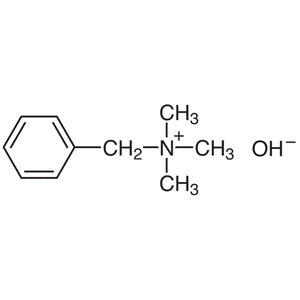
- TCI B1071 100-85-6 Benzyltrimethylammonium Hydroxide (40% in Water)
- TCI B1070 100-85-6 Benzyltrimethylammonium Hydroxide (10% in Water)
- TCI B0448 100-85-6 Benzyltrimethylammonium Hydroxide (40% in Methanol)
- Nucleophilic aromatic substitution studies: the trimethylammonium group can act as a leaving group on an electron-poor ring, so this salt suits researchers investigating how nucleophiles displace it from the aromatic framework.
- Carbon-nitrogen bond cleavage research: the quaternary ammonium attached to the aryl ring offers a defined substrate for experiments that examine how and under what conditions this bond is broken.
- Synthetic precursor in organic chemistry: as a catalogued synthetic reagent, it can serve as a starting material for building molecules that contain a meta-trifluoromethyl aromatic unit.
- Studies of electron-withdrawing group effects: the trifluoromethyl substituent at the meta position lets chemists compare how an electron-poor ring influences reactivity relative to other aryl ammonium salts.
- Solvent and solubility screening for ionic reagents: because the salt is ionic, it is a practical example for teams evaluating which solvents work best when planning reactions with quaternary ammonium compounds.
| Brand | TCI |
|---|---|
| CAS number | 262608-95-7 |
| Molecular formula | — |
| Purity | — |
| Category | Chemistry > Synthetic Reagents > Acids, Bases [Synthetic Reagents] |
| Pack sizes | please refer to the product listing or contact AMI Scientific for available sizes |
| Physical form | refer to the manufacturer's label and safety data sheet |
| Storage | — |
- Product code: T1036
Store the reagent according to the conditions printed on the manufacturer's label and safety data sheet, usually in a tightly closed container kept in a cool, dry and well-ventilated place away from direct sunlight and incompatible materials. Keep it in its original container, or in a clean, clearly labelled, chemically compatible one, and close it promptly after each use to limit exposure to moisture and air. As with all laboratory chemicals, wear suitable gloves, safety glasses and a laboratory coat, and handle the material in a fume hood or a well-ventilated area. Avoid generating dust, prevent skin and eye contact, wash hands after handling, and dispose of waste in line with your institution's chemical waste procedures.
—
Produk Terkait
-
3-(Trifluoromethyl)phenyltrimethylammoniumIodide TCI T1014
Regular price Rp 2.041.200,00Regular priceRp 1.442.700,00Sale price Rp 2.041.200,00 -
3-(Trifluoromethyl)phenyltrimethylammoniumHydroxide(5%inMethanol)[forTransesterificationofGlyceride] TCI T0961
Regular price From Rp 4.796.400,00Regular priceRp 3.369.450,00Sale price From Rp 4.796.400,00 -
(11bS)-2,6-Bis[bis[3,5-bis(trifluoromethyl)phenyl]hydroxymethyl]-3,5-dihydrospiro[4H-dinaphth[2,1-c:1',2'-e]azepine-4,4'-morpholinium]Bromide TCI B3970
Regular price Rp 7.234.500,00Regular priceRp 5.074.650,00Sale price Rp 7.234.500,00 -
BenzyltrimethylammoniumHydroxide(40%inWater) TCI B1071
Regular price From Rp 742.350,00Regular priceRp 534.450,00Sale price From Rp 742.350,00 -
BenzyltrimethylammoniumHydroxide(10%inWater) TCI B1070
Regular price From Rp 795.900,00Regular priceRp 572.250,00Sale price From Rp 795.900,00 -
BenzyltrimethylammoniumHydroxide(40%inMethanol) TCI B0448
Regular price From Rp 582.750,00Regular priceRp 423.150,00Sale price From Rp 582.750,00 -
BenzyltrimethylammoniumHydroxide(10%inWater) TCI B0428
Regular price Rp 1.087.800,00Regular priceRp 775.950,00Sale price Rp 1.087.800,00 -
HexadecyltrimethylammoniumHydroxide(10%inWater) TCI H1354
Regular price From Rp 1.538.250,00Regular priceRp 1.090.950,00Sale price From Rp 1.538.250,00