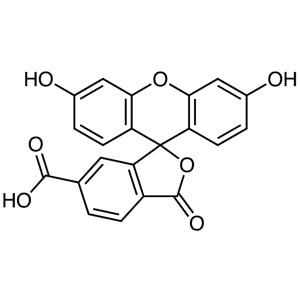
6-Aminofluorescein (isomer II), with CAS number 51649-83-3, is an organic compound widely used in biochemical and biomedical laboratory applications. This compound is known for its fluorescent properties, making it a valuable tool in molecular analysis and chemical reactions. Its ability to emit light under specific conditions allows it to serve as a ligand or marker in various experimental setups. In the laboratory, it plays a crucial role in supporting research related to proteins, enzymes, and molecular interactions. Its versatility and reliability make it an essential component for scientists working in life sciences.
The key properties that make 6-Aminofluorescein a preferred choice include its fluorescence characteristics and chemical stability. These features enable it to be used in fluorescence spectroscopy and molecular labeling techniques, where precise detection and quantification are required. Its stability ensures that it remains effective over extended periods, reducing the need for frequent replenishment. Additionally, its compatibility with a range of experimental conditions makes it adaptable to various research needs, enhancing its utility in both basic and applied research settings.
In Indonesian laboratories, 6-Aminofluorescein is commonly used in biomedical, biochemical, and diagnostic research. It is an integral part of studies focused on molecular detection and analysis methods. Its presence supports the development of innovative techniques for identifying and analyzing biological molecules, contributing to advancements in health sciences and biotechnology. The compound’s reliability and performance make it a trusted resource for researchers in Indonesia.
Advantages (TCI brochure)
- Green fluorescence
- Labeled to carboxy groups by amide bond formation using a coupling agent
TCI brochures (PDF)
- Iodinated Fluorescein for Various Applications 2024-11-22 · p. 2
- Fluorescent Labeling Dyes 2025-11-18 · p. 3
- Reagents for Biological Research 2025-03-11 · p. 5
Related TCI products
- TCI A0306 3326-34-9 5-Aminofluorescein (isomer I)
- TCI F0783 18861-78-4 Fluorescein 6-Isothiocyanate (isomer II)
- TCI F0810 75350-46-8 Fluorescein-5-maleimide (contains 2% N,N-Dimethylformamide at maximum)
- TCI C2479 92557-80-7 5-Carboxyfluorescein N-Succinimidyl Ester
- TCI C2478 3301-79-9 6-Carboxyfluorescein
- TCI C2477 76823-03-5 5-Carboxyfluorescein
- Fluorescence Spectroscopy: This item is ideal for fluorescence spectroscopy due to its ability to emit light under specific conditions, allowing for precise detection and analysis of molecular interactions.
- Molecular Labeling: It is widely used in molecular labeling techniques to tag and track biomolecules, facilitating their study in complex biological systems.
- Protein and Enzyme Studies: Its fluorescent properties make it a valuable tool for studying protein and enzyme interactions, enabling real-time monitoring of biochemical processes.
- Diagnostic Research: It supports diagnostic research by aiding in the development of sensitive and specific detection methods for various biomarkers.
- Biochemical Assays: Its stability and fluorescence characteristics make it suitable for use in a range of biochemical assays requiring accurate and reliable results.
From the TCI brochure
- Labeling of carboxy groups
| Brand | TCI |
|---|---|
| CAS number | 51649-83-3 |
| Molecular formula | — |
| Purity | — |
| Category | Life Science > Antibodies > Antibody Supplementary Products |
| Pack sizes | Available in various quantities as per supplier specifications |
| Physical form | Solid or powder, depending on the formulation |
| Storage | Store in a cool, dry place away from light |
Data from the TCI brochure
| λex,max | 494 nm |
|---|---|
| λem,max | 521 nm |
Source: TCI brochure LL039 (2025-11-18)
6-Aminofluorescein should be stored in a cool, dry place away from direct light to maintain its stability and fluorescence properties. It is recommended to use airtight containers to prevent moisture absorption, which could affect its performance. Laboratory personnel should handle the compound with care, using appropriate personal protective equipment such as gloves and safety goggles. It is important to ensure that the compound is stored in a secure location to prevent accidental exposure. Proper labeling of containers is essential for safe handling and to avoid contamination. Regular monitoring of storage conditions ensures the compound remains effective for research applications.
—
Product Categories
Produk Terkait
-
5-Aminofluorescein(isomerI) TCI A0306
Regular price Rp 4.056.150,00Regular priceRp 2.836.050,00Sale price Rp 4.056.150,00 -
Fluorescein6-Isothiocyanate(isomerII) TCI F0783
Regular price Rp 8.613.150,00Regular priceRp 6.022.800,00Sale price Rp 8.613.150,00 -
Fluorescein-5-maleimide(contains2%N,N-Dimethylformamideatmaximum) TCI F0810
Regular price Rp 5.565.000,00Regular priceRp 3.907.050,00Sale price Rp 5.565.000,00 -
5-CarboxyfluoresceinN-SuccinimidylEster TCI C2479
Regular price From Rp 5.962.950,00Regular priceRp 4.185.300,00Sale price From Rp 5.962.950,00 -
6-Carboxyfluorescein TCI C2478
Regular price Rp 4.611.600,00Regular priceRp 3.224.550,00Sale price Rp 4.611.600,00 -
5-Carboxyfluorescein TCI C2477
Regular price Rp 3.207.750,00Regular priceRp 2.242.800,00Sale price Rp 3.207.750,00 -
ATBTA-Eu3+ TCI A2083
Regular price Rp 2.702.700,00Regular priceRp 1.905.750,00Sale price Rp 2.702.700,00 -
Sodium5-(2-Aminoethylamino)-1-naphthalenesulfonate TCI S0891
Regular price Rp 2.041.200,00Regular priceRp 1.442.700,00Sale price Rp 2.041.200,00