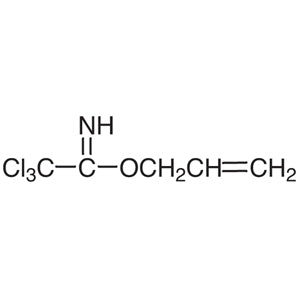
Allyl 2,2,2-Trichloroacetimidate is a chemical compound widely used as a building block in the synthesis of complex organic molecules. This reagent plays a crucial role in laboratory settings, particularly in organic chemistry research, where it is employed to construct intricate molecular structures. Its unique chemical structure enables it to participate in highly specific chemical reactions, especially in coupling reactions with various functional groups. This makes it an essential component for chemists aiming to develop new compounds, pharmaceuticals, and materials.
The compound is favored for its reactivity and specificity, which allow for precise control over reaction outcomes. It exhibits stability under certain conditions, making it suitable for reactions that require controlled environments. Additionally, its solubility in organic solvents such as ethyl acetate and chloroform enhances its usability in laboratory processes. These properties make it a reliable choice for both academic and industrial research.
In Indonesian laboratories, Allyl 2,2,2-Trichloroacetimidate is commonly used in organic chemistry research, especially in institutions focused on drug development and material science. Its versatility and effectiveness in various synthetic pathways have made it a staple in many research projects. The compound is particularly valuable for its ability to facilitate the formation of complex molecular architectures, supporting advancements in chemical synthesis and innovation.
TCI brochures (PDF)
- Protecting Agents 2025-03-25 · p. 10
- Organic synthesis of heterocyclic compounds due to its ability to form stable intermediates in coupling reactions.
- Development of pharmaceuticals through its role in constructing complex molecular frameworks with high specificity.
- Preparation of functionalized organic molecules by reacting with various functional groups under controlled conditions.
- Research in material science for the synthesis of polymers and advanced chemical materials.
- Analytical chemistry applications where precise chemical reactions are required for compound characterization.
| Brand | TCI |
|---|---|
| CAS number | 51479-73-3 |
| Molecular formula | — |
| Purity | — |
| Category | Chemistry > Building Blocks > Non-Heterocyclic Building Blocks |
| Pack sizes | Available in standard laboratory quantities as per supplier specifications |
| Physical form | Liquid or solid, depending on formulation and packaging |
| Storage | Store in a cool, dry place away from moisture and direct sunlight |
Allyl 2,2,2-Trichloroacetimidate should be stored in a cool, dry environment to maintain its chemical stability. It is recommended to keep the compound in a sealed container to prevent exposure to moisture and air. Due to its reactivity, it should be handled in a well-ventilated laboratory setting, using appropriate personal protective equipment such as gloves and safety goggles. Avoid contact with strong bases, alkali metals, and organic solvents that may trigger unwanted reactions. The compound is best stored in glass or polyethylene containers to ensure compatibility and prevent degradation. Always follow standard laboratory safety protocols when working with this reagent to ensure safe and effective use.
—
Produk Terkait
-
tert-Butyl2,2,2-Trichloroacetimidate TCI B1496
Regular price From Rp 1.776.600,00Regular priceRp 1.257.900,00Sale price From Rp 1.776.600,00 -
Benzyl2,2,2-Trichloroacetimidate TCI B1483
Regular price Rp 3.285.450,00Regular priceRp 2.313.150,00Sale price Rp 3.285.450,00 -
4-Methoxybenzyl2,2,2-Trichloroacetimidate TCI M2016
Regular price From Rp 2.835.000,00Regular priceRp 1.998.150,00Sale price From Rp 2.835.000,00 -
3'-Amino-4'-chloroacetophenone TCI A3026
Regular price From Rp 610.050,00Regular priceRp 442.050,00Sale price From Rp 610.050,00 -
AllylBromide TCI B0643
Regular price From Rp 557.550,00Regular priceRp 389.550,00Sale price From Rp 557.550,00