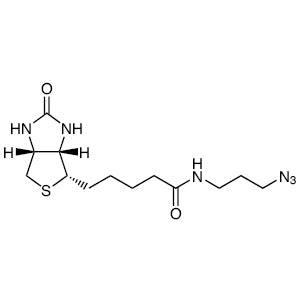
N-(3-Azidopropyl)biotinamide is a chemical compound widely used in biochemical and molecular applications within laboratory settings. This compound contains an azido group (–N₃), which is highly reactive and plays a crucial role in various synthetic processes. Its biotinamide moiety allows it to bind to proteins or other molecules through the well-known biotin-avidin interaction, making it a versatile tool in bioconjugation and labeling techniques. As a building block, it is essential for the synthesis of complex molecules, especially in biomedical and pharmacological research.
The compound’s chemical stability under specific conditions and the high reactivity of its azido group make it a preferred choice for many researchers. It is particularly well-suited for click chemistry reactions, such as azido-alkin reactions, which enable efficient and specific molecular construction. These properties allow for rapid and reliable synthesis of functionalized molecules, which are critical in drug development and diagnostic applications. Its reliability and efficiency in chemical reactions contribute to its widespread use in modern laboratory practices.
In Indonesian laboratories, N-(3-Azidopropyl)biotinamide is a key component in biochemistry, pharmacology, and biotechnology research. It is frequently used in the development of pharmaceuticals, molecular diagnostics, and protein modification studies. Its relevance in these fields makes it an essential reagent for both academic and industrial research institutions in Indonesia.
TCI brochures (PDF)
- Bio-Orthogonal Non-Canonical Amino Acid Tagging (BONCAT) Related Reagents 2025-12-23 · p. 1
- Europium Fluorescent Labeling Reagent and Labeled Probes 2025-01-30 · p. 4
- Streptavidins and Related Reagents 2025-02-28 · p. 4
- Biotinylation Reagents and Avidins 2025-06-26 · p. 2
- Bioconjugation Reagents 2026-07-07 · p. 3
- Click Chemistry 2026-09-08 · p. 8
Related TCI products
- TCI A3420 908007-17-0 N-(3-Azidopropyl)biotinamide (2mg*5)
- TCI A2523 875770-34-6 Biotin-PEG3-Azide
- TCI B5546 1309649-57-7 Biotin-PEG4-Azide
- TCI P2471 112247-65-1 N-[2-(2-Pyridyldithio)ethyl]biotinamide
- TCI B3694 1585236-34-5 (2S,3S,5R,6R)-5,6-Bis(azidomethyl)-2,3-dimethoxy-2,3-dimethyl-1,4-dioxane
- TCI A2474 1392500-07-0 2-Azido-1,3-bis[(2,2-dimethyl-1,3-dioxan-5-yl)oxy]propane
- Molecular conjugation and labeling due to its biotinamide group for specific protein binding.
- Synthesis of complex molecules in pharmaceutical research through click chemistry reactions.
- Development of diagnostic tools and assays requiring high specificity and sensitivity.
- Protein modification and functionalization in biotechnology applications.
- Bioconjugation studies for targeted drug delivery and imaging techniques.
| Brand | TCI |
|---|---|
| CAS number | 908007-17-0 |
| Molecular formula | — |
| Purity | — |
| Category | Chemistry > Building Blocks > Non-Heterocyclic Building Blocks |
| Pack sizes | Available in various quantities as per standard laboratory supply |
| Physical form | Solid (as per standard product description) |
| Storage | Store in a cool, dry place away from light and moisture |
N-(3-Azidopropyl)biotinamide should be stored in a cool, dry environment, away from direct light and moisture to maintain its chemical stability. It is recommended to use airtight containers to prevent exposure to air and moisture, which may affect its reactivity. Due to the presence of an azido group, it is important to handle the compound with care to avoid any potential hazards associated with reactive chemical groups. Standard laboratory safety protocols should be followed, including the use of personal protective equipment such as gloves and safety goggles. The compound should not be stored near incompatible materials, and proper ventilation should be ensured in the workspace to minimize any risk of exposure.
—
Product Categories
- Building BlocksNon-Heterocyclic Building BlocksNitrogen Compounds [Non-Heterocyclic Building Blocks]
- Chemical BiologyConjugation Chemistry/Click ChemistryAzides [Conjugation Chemistry/Click Chemistry]
- Chemical BiologyConjugation Chemistry/Click ChemistryBiotin Azides/Alkynes [Conjugation Chemistry/Click Chemistry]
- Chemical BiologyBioconjugationBiotins and Streptavidins
- Biochemicals and ReagentsBioconjugationBiotins and Streptavidins
- Pharmaceutical Development and Drug Discovery ResearchBioconjugationBiotins and Streptavidins
- Pharmaceutical Development and Drug Discovery ResearchConjugation Chemistry/Click ChemistryAzides [Conjugation Chemistry/Click Chemistry]
- Pharmaceutical Development and Drug Discovery ResearchConjugation Chemistry/Click ChemistryBiotin Azides/Alkynes [Conjugation Chemistry/Click Chemistry]
Produk Terkait
-
N-(3-Azidopropyl)biotinamide(2mg*5) TCI A3420
Regular price Rp 4.636.800,00Regular priceRp 3.258.150,00Sale price Rp 4.636.800,00 -
Biotin-PEG3-Azide TCI A2523
Regular price Rp 4.373.250,00Regular priceRp 3.073.350,00Sale price Rp 4.373.250,00 -
Biotin-PEG4-Azide TCI B5546
Regular price Rp 7.949.550,00Regular priceRp 5.574.450,00Sale price Rp 7.949.550,00 -
N-[2-(2-Pyridyldithio)ethyl]biotinamide TCI P2471
Regular price From Rp 1.458.450,00Regular priceRp 1.035.300,00Sale price From Rp 1.458.450,00 -
(2S,3S,5R,6R)-5,6-Bis(azidomethyl)-2,3-dimethoxy-2,3-dimethyl-1,4-dioxane TCI B3694
Regular price Rp 1.908.900,00Regular priceRp 1.350.300,00Sale price Rp 1.908.900,00 -
2-Azido-1,3-bis[(2,2-dimethyl-1,3-dioxan-5-yl)oxy]propane TCI A2474
Regular price Rp 4.796.400,00Regular priceRp 3.369.450,00Sale price Rp 4.796.400,00 -
6-BiotinamidohexanoicAcid TCI B2433
Regular price Rp 3.365.250,00Regular priceRp 2.368.800,00Sale price Rp 3.365.250,00 -
N-SuccinimidylN-[6-(Biotinamido)hexanoyl]-6-aminohexanoate TCI S0956
Regular price From Rp 3.815.700,00Regular priceRp 2.683.800,00Sale price From Rp 3.815.700,00