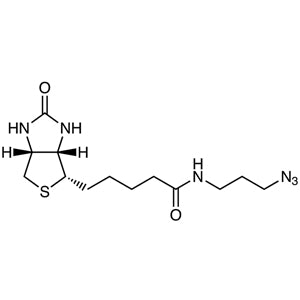
N-(3-Azidopropyl)biotinamide is a chemical compound widely used in biochemical and molecular conjugation applications. This reagent plays a crucial role in laboratory settings where the formation of stable and specific molecular bonds is required. It is commonly employed in click chemistry and conjugation reactions to link target molecules with biotin, proteins, or antigens. Its utility spans across various research fields, including biochemistry, diagnostics, and drug development. The compound is essential for creating efficient and reliable molecular linkages that are fundamental to many experimental protocols.
The compound's key properties include chemical stability and the ability to participate in rapid, efficient click reactions. These characteristics make it a preferred choice for researchers seeking precision and reliability in their experiments. Its structure allows for high specificity and reproducibility, ensuring consistent results in laboratory applications. The compound's performance in click chemistry reactions is well-documented, making it a trusted component in advanced biochemical research. Its reliability and efficiency contribute to its widespread use in both academic and industrial research environments.
In Indonesian laboratories, N-(3-Azidopropyl)biotinamide is frequently used in biochemical research, diagnostic testing, and drug development projects. It is a vital reagent in molecular conjugation processes, supporting the development of biosensors, protein analysis, and molecular interaction studies. Its role in enabling precise and efficient chemical bonding makes it an essential tool for researchers working on complex biochemical and molecular applications.
TCI brochures (PDF)
- Pre-weighed Bioconjugation Reagents 2025-06-26 · p. 1
- Streptavidins and Related Reagents 2025-02-28 · p. 3
- Biotinylation Reagents and Avidins 2025-06-26 · p. 2
- Bioconjugation Reagents 2026-07-07 · p. 3
- Reagents for Biological Research 2025-03-11 · p. 16
Related TCI products
- TCI A2524 908007-17-0 N-(3-Azidopropyl)biotinamide
- TCI P2471 112247-65-1 N-[2-(2-Pyridyldithio)ethyl]biotinamide
- TCI A2523 875770-34-6 Biotin-PEG3-Azide
- TCI B5546 1309649-57-7 Biotin-PEG4-Azide
- TCI B2433 72040-64-3 6-Biotinamidohexanoic Acid
- TCI S0956 89889-52-1 N-Succinimidyl N-[6-(Biotinamido)hexanoyl]-6-aminohexanoate
- Molecular conjugation in biosensor development due to its ability to form stable and specific bonds between target molecules and biotin.
- Protein labeling and modification in biochemical research as it enables efficient and selective attachment to protein structures.
- Diagnostic assay development where precise molecular interactions are required for accurate detection and analysis.
- Click chemistry applications in drug discovery and synthesis due to its rapid and efficient reaction properties.
- Molecular interaction studies for understanding biological processes and designing targeted therapies.
| Brand | TCI |
|---|---|
| CAS number | 908007-17-0 |
| Molecular formula | — |
| Purity | — |
| Category | Chemistry > Chemical Biology > Conjugation Chemistry/Click Chemistry |
| Pack sizes | 2mg*5 |
| Physical form | Solid |
| Storage | Store at 2-8°C in a dry, cool place away from light |
N-(3-Azidopropyl)biotinamide should be stored at 2-8°C in a dry, cool environment to maintain its chemical stability and activity. It is recommended to use airtight containers to prevent moisture exposure, which could affect its performance. The compound should be kept away from light and potential contaminants to preserve its integrity. In laboratory settings, it is important to handle the material with care, using appropriate personal protective equipment such as gloves and safety goggles. Proper labeling of storage containers is essential to ensure safe handling and prevent accidental exposure. Regular monitoring of storage conditions ensures the compound remains suitable for use in research applications.
—
Product Categories
- Biochemicals and ReagentsBioconjugationBiotins and Streptavidins
- Pharmaceutical Development and Drug Discovery ResearchBioconjugationBiotins and Streptavidins
- Pharmaceutical Development and Drug Discovery ResearchConjugation Chemistry/Click ChemistryBiotin Azides/Alkynes [Conjugation Chemistry/Click Chemistry]
Produk Terkait
-
N-(3-Azidopropyl)biotinamide TCI A2524
Regular price Rp 10.069.500,00Regular priceRp 7.057.050,00Sale price Rp 10.069.500,00 -
N-[2-(2-Pyridyldithio)ethyl]biotinamide TCI P2471
Regular price From Rp 1.458.450,00Regular priceRp 1.035.300,00Sale price From Rp 1.458.450,00 -
Biotin-PEG3-Azide TCI A2523
Regular price Rp 4.373.250,00Regular priceRp 3.073.350,00Sale price Rp 4.373.250,00 -
Biotin-PEG4-Azide TCI B5546
Regular price Rp 7.949.550,00Regular priceRp 5.574.450,00Sale price Rp 7.949.550,00 -
6-BiotinamidohexanoicAcid TCI B2433
Regular price Rp 3.365.250,00Regular priceRp 2.368.800,00Sale price Rp 3.365.250,00 -
N-SuccinimidylN-[6-(Biotinamido)hexanoyl]-6-aminohexanoate TCI S0956
Regular price From Rp 3.815.700,00Regular priceRp 2.683.800,00Sale price From Rp 3.815.700,00 -
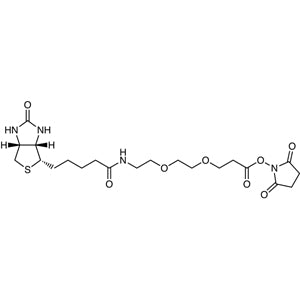
N-Succinimidyl9-(Biotinamido)-4,7-dioxanonanoate TCI S0955
Regular price From Rp 3.419.850,00Regular priceRp 2.406.600,00Sale price From Rp 3.419.850,00 -
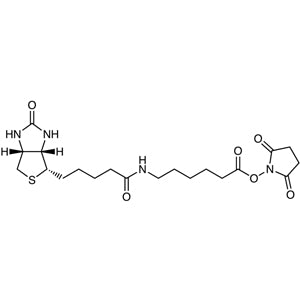
N-Succinimidyl6-Biotinamidohexanoate TCI S0490
Regular price From Rp 1.431.150,00Regular priceRp 1.016.400,00Sale price From Rp 1.431.150,00