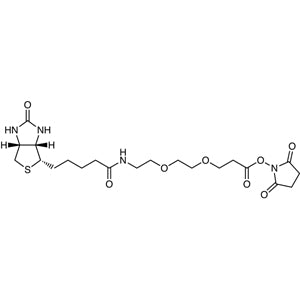
N-Succinimidyl 6-Biotinamidohexanoate (SBH), also known as TCI S0490 72040-63-2, is a chemical compound widely used in bioconjugation applications within laboratory settings. It serves as a key reagent for attaching biotin to various biomolecules such as proteins, nucleic acids, and other functional groups. This compound plays a critical role in molecular biology and biochemical research by enabling the creation of biotinylated molecules with high specificity and efficiency. Its utility spans multiple experimental techniques, making it an essential tool for scientists working in biotechnology and life sciences.
SBH is preferred due to its high reactivity towards amino groups and its chemical stability under controlled conditions. The compound’s ability to form strong, covalent bonds with target molecules ensures reliable and reproducible results in experimental settings. Its high purity further enhances the accuracy of research outcomes, making it a trusted reagent in both academic and industrial laboratories. Additionally, SBH exhibits resistance to extreme environmental conditions, allowing for greater flexibility in experimental design and application.
In Indonesian laboratories, SBH is commonly used in biochemical and molecular biology research. It is a staple in institutions conducting studies related to biotinylation, immunodetection, and protein labeling. Its versatility and effectiveness make it a valuable resource for researchers aiming to develop and refine techniques such as ELISA, Western blot, and other biotin-based assays. Its consistent performance and reliability contribute to the advancement of scientific research in the region.
TCI brochures (PDF)
- Europium Fluorescent Labeling Reagent and Labeled Probes 2025-01-30 · p. 4
- Streptavidins and Related Reagents 2025-02-28 · p. 3
- Biotinylation Reagents and Avidins 2025-06-26 · p. 1
- Bioconjugation Reagents 2026-07-07 · p. 2
- Reagents for Biological Research 2025-03-11 · p. 15
Related TCI products
- TCI S0491 35013-72-0 N-Succinimidyl D-Biotinate
- TCI B2433 72040-64-3 6-Biotinamidohexanoic Acid
- TCI S0956 89889-52-1 N-Succinimidyl N-[6-(Biotinamido)hexanoyl]-6-aminohexanoate
- TCI S0955 596820-83-6 N-Succinimidyl 9-(Biotinamido)-4,7-dioxanonanoate
- TCI S0814 38862-24-7 N-Succinimidyl Acrylate
- TCI S0812 38862-25-8 N-Succinimidyl Methacrylate
- ELISA (Enzyme-Linked Immunosorbent Assay) utilizes SBH to biotinylate antibodies, enhancing signal detection and specificity in immunoassays.
- Western blot analysis benefits from SBH’s ability to conjugate biotin to proteins, enabling efficient detection through streptavidin-based systems.
- Biotinylation of proteins is a common application where SBH allows for the covalent attachment of biotin to amino groups, facilitating downstream purification and analysis.
- Molecular biology research often employs SBH to label nucleic acids, aiding in hybridization studies and gene expression analysis.
- Immunohistochemistry applications use SBH to biotinylate antibodies, improving the sensitivity and accuracy of tissue staining techniques.
| Brand | TCI |
|---|---|
| CAS number | 72040-63-2 |
| Molecular formula | — |
| Purity | — |
| Category | Chemistry > Chemical Biology > Bioconjugation |
| Pack sizes | Available in various quantities as per standard laboratory reagent packaging |
| Physical form | Solid powder |
| Storage | Store at room temperature, away from moisture and direct sunlight |
SBH should be stored in a cool, dry place, away from direct sunlight and sources of heat. It is recommended to use airtight containers to prevent moisture absorption, which could affect its chemical stability. In laboratory settings, it is important to handle SBH with appropriate personal protective equipment, such as gloves and safety goggles, to ensure safe handling. The compound should be kept in a well-ventilated area to minimize exposure to vapors. Due to its reactivity, it is advisable to avoid prolonged contact with skin or eyes. Proper storage and handling protocols help maintain the integrity and effectiveness of SBH in research applications.
—
Produk Terkait
-
N-SuccinimidylD-Biotinate TCI S0491
Regular price From Rp 2.013.900,00Regular priceRp 1.423.800,00Sale price From Rp 2.013.900,00 -
6-BiotinamidohexanoicAcid TCI B2433
Regular price Rp 3.365.250,00Regular priceRp 2.368.800,00Sale price Rp 3.365.250,00 -
N-SuccinimidylN-[6-(Biotinamido)hexanoyl]-6-aminohexanoate TCI S0956
Regular price From Rp 3.815.700,00Regular priceRp 2.683.800,00Sale price From Rp 3.815.700,00 -
N-Succinimidyl9-(Biotinamido)-4,7-dioxanonanoate TCI S0955
Regular price From Rp 3.419.850,00Regular priceRp 2.406.600,00Sale price From Rp 3.419.850,00 -
N-SuccinimidylAcrylate TCI S0814
Regular price From Rp 3.207.750,00Regular priceRp 2.258.550,00Sale price From Rp 3.207.750,00 -
N-SuccinimidylMethacrylate TCI S0812
Regular price From Rp 2.650.200,00Regular priceRp 1.869.000,00Sale price From Rp 2.650.200,00 -
Di(N-succinimidyl)Sebacate TCI D4019
Regular price From Rp 1.670.550,00Regular priceRp 1.183.350,00Sale price From Rp 1.670.550,00 -
Di(N-succinimidyl)Suberate TCI D3895
Regular price From Rp 2.809.800,00Regular priceRp 1.980.300,00Sale price From Rp 2.809.800,00