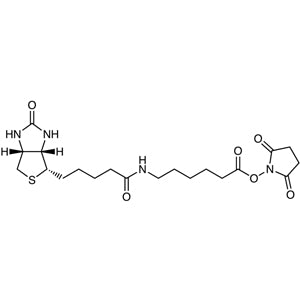
N-Succinimidyl 9-(Biotinamido)-4,7-dioxanonanoate is a chemical reagent widely used in bioconjugation applications to link biological molecules with biotin. This compound plays a crucial role in laboratories where molecular interactions need to be precisely controlled. It is commonly employed in biomedical and chemical biology research to modify proteins, peptides, or nucleic acids for specific binding with avidin or streptavidin. Its utility lies in its ability to facilitate targeted molecular modifications, making it an essential tool for advanced research.
The reagent's reactive and specific nature allows it to form stable covalent bonds with amino groups on proteins or other biomolecules. Its chemical structure ensures strong and durable conjugates, which are vital for applications requiring long-term stability and reliability. These properties make it a preferred choice for researchers aiming to achieve high precision in molecular modifications. The compound's effectiveness in creating specific and reliable connections is a key factor in its widespread use across various scientific disciplines.
In Indonesian laboratories, this reagent is extensively used in biomedical, pharmacological, and biotechnological research. It supports studies focused on drug development, molecular diagnostics, and biological modification. Its availability ensures that local research institutions can conduct advanced experiments requiring precise molecular interactions. The compound's role in enhancing research capabilities makes it a valuable asset for scientific innovation in Indonesia.
TCI brochures (PDF)
- Pre-Weighed Biotinylation Reagents 2025-03-25 · p. 2
- Europium Fluorescent Labeling Reagent and Labeled Probes 2025-01-30 · p. 4
- Streptavidins and Related Reagents 2025-02-28 · p. 3
- Biotinylation Reagents and Avidins 2025-06-26 · p. 1
- Protein and Biological Sample Preparation Reagents 2026-09-10 · p. 16
- Bioconjugation Reagents 2026-07-07 · p. 2
Related TCI products
- TCI S0956 89889-52-1 N-Succinimidyl N-[6-(Biotinamido)hexanoyl]-6-aminohexanoate
- TCI S0491 35013-72-0 N-Succinimidyl D-Biotinate
- TCI S0490 72040-63-2 N-Succinimidyl 6-Biotinamidohexanoate
- TCI S0814 38862-24-7 N-Succinimidyl Acrylate
- TCI S0812 38862-25-8 N-Succinimidyl Methacrylate
- TCI D4019 23024-29-5 Di(N-succinimidyl) Sebacate
- Bioconjugation Research: This reagent is ideal for creating stable biotinylated molecules, enabling specific binding with avidin or streptavidin for use in assays and labeling techniques.
- Protein Modification: It facilitates the covalent attachment of biotin to proteins, enhancing their detectability and functionality in various biochemical applications.
- Peptide Conjugation: The compound allows for the precise modification of peptides, making them suitable for use in diagnostic tools and therapeutic applications.
- Nucleic Acid Labeling: It enables the biotinylation of nucleic acids, supporting molecular biology experiments such as hybridization and detection methods.
- Drug Development: The reagent supports the creation of biotinylated drug candidates, aiding in the study of molecular interactions and therapeutic efficacy.
| Brand | TCI |
|---|---|
| CAS number | 596820-83-6 |
| Molecular formula | — |
| Purity | — |
| Category | Chemistry > Chemical Biology > Bioconjugation |
| Pack sizes | Available in various quantities as per supplier specifications |
| Physical form | Solid or powder, depending on the batch |
| Storage | Store in a cool, dry place away from light and moisture |
This reagent should be stored in a cool, dry environment, away from direct light and moisture to maintain its stability and effectiveness. It is recommended to use airtight containers to prevent exposure to humidity and contaminants. Due to its reactive nature, it should be handled with care, using appropriate personal protective equipment such as gloves and safety goggles. Proper ventilation is essential when working with this compound to minimize inhalation risks. It should not be disposed of in drains or landfills without following local regulations for chemical waste. Always follow standard laboratory safety protocols to ensure safe handling and storage.
—
Produk Terkait
-
N-SuccinimidylN-[6-(Biotinamido)hexanoyl]-6-aminohexanoate TCI S0956
Regular price From Rp 3.815.700,00Regular priceRp 2.683.800,00Sale price From Rp 3.815.700,00 -
N-SuccinimidylD-Biotinate TCI S0491
Regular price From Rp 2.013.900,00Regular priceRp 1.423.800,00Sale price From Rp 2.013.900,00 -
N-Succinimidyl6-Biotinamidohexanoate TCI S0490
Regular price From Rp 1.431.150,00Regular priceRp 1.016.400,00Sale price From Rp 1.431.150,00 -
N-SuccinimidylAcrylate TCI S0814
Regular price From Rp 3.207.750,00Regular priceRp 2.258.550,00Sale price From Rp 3.207.750,00 -
N-SuccinimidylMethacrylate TCI S0812
Regular price From Rp 2.650.200,00Regular priceRp 1.869.000,00Sale price From Rp 2.650.200,00 -
Di(N-succinimidyl)Sebacate TCI D4019
Regular price From Rp 1.670.550,00Regular priceRp 1.183.350,00Sale price From Rp 1.670.550,00 -
Di(N-succinimidyl)Suberate TCI D3895
Regular price From Rp 2.809.800,00Regular priceRp 1.980.300,00Sale price From Rp 2.809.800,00 -
Di(N-succinimidyl)Carbonate TCI D1662
Regular price From Rp 1.934.100,00Regular priceRp 1.368.150,00Sale price From Rp 1.934.100,00