


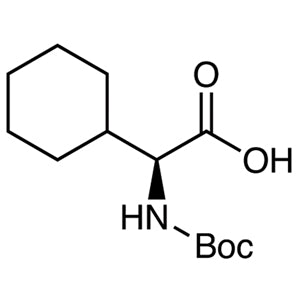
N-(tert-Butoxycarbonyl)-L-2-cyclohexylglycine is a chemical compound widely used in organic and biochemical research, particularly in peptide chemistry. This compound serves as a key building block in the synthesis of complex peptides, playing a critical role in the formation of peptide chains through controlled chemical reactions. Its presence in laboratories is essential for researchers working on protein structure and function, as well as in drug development. Due to its chemical stability and reactivity under specific conditions, it is a preferred choice for precise and reproducible chemical synthesis processes.
The compound's unique molecular structure allows it to interact effectively with various functional groups, making it versatile for a range of synthetic applications. Its stability under controlled laboratory conditions ensures consistent performance, while its reactivity enables efficient peptide coupling reactions. These properties make it an indispensable tool for scientists aiming to develop new pharmaceuticals or improve existing synthetic methods. Its utility extends to both academic and industrial research settings, where high precision and reliability are paramount.
In Indonesian laboratories, N-(tert-Butoxycarbonyl)-L-2-cyclohexylglycine is commonly used in biochemical and pharmaceutical research. It is a vital component in the development of new chemical products and the refinement of synthesis techniques. Researchers in Indonesia rely on this compound for its reliability and effectiveness in complex chemical reactions, supporting advancements in biotechnology and drug discovery. Its application is widespread across various scientific disciplines, contributing to the growth of chemical research in the region.
TCI brochures (PDF)
- Amino Acids and Peptide Synthesis Reagents 2025-08-14 · p. 14
Related TCI products
- TCI F1248 161321-36-4 N-[(9H-Fluoren-9-ylmethoxy)carbonyl]-L-cyclohexylglycine
- TCI B5350 68856-96-2 N-(tert-Butoxycarbonyl)-4-methoxy-D-phenylalanine
- TCI B5322 159622-10-3 (1R,2S)-1-[(tert-Butoxycarbonyl)amino]-2-vinylcyclopropanecarboxylic Acid
- TCI B5011 85466-66-6 N-(tert-Butoxycarbonyl)-N-methyl-D-phenylalanine
- TCI B4877 131724-45-3 N-(tert-Butoxycarbonyl)-4-cyano-L-phenylalanine
- TCI B4369 114873-07-3 N-(tert-Butoxycarbonyl)-4-trifluoromethyl-L-phenylalanine
- Peptide Synthesis: This compound is ideal for peptide synthesis due to its ability to form stable peptide bonds under controlled conditions, making it suitable for creating complex molecular structures.
- Drug Development: It is frequently used in the development of pharmaceuticals as a building block for synthesizing bioactive peptides that target specific receptors.
- Protein Structure Studies: Researchers use it to study the structural and functional properties of proteins, aiding in the understanding of molecular interactions.
- Biochemical Research: Its reactivity and stability make it a preferred choice for biochemical experiments involving functional group modifications and molecular interactions.
- Material Science Applications: It is utilized in the synthesis of novel materials, where precise chemical control is required to achieve desired properties.
| Brand | TCI |
|---|---|
| CAS number | 109183-71-3 |
| Molecular formula | — |
| Purity | — |
| Category | Chemistry > Chemical Biology > Peptide Chemistry |
| Pack sizes | Available in various quantities as per standard laboratory supply |
| Physical form | Solid |
| Storage | Store in a cool, dry place away from moisture and direct sunlight |
This compound should be stored in a cool, dry environment to maintain its chemical stability and prevent degradation. It is recommended to use airtight containers to protect it from moisture and contaminants. Due to its reactivity, it should be handled in a well-ventilated area, and appropriate personal protective equipment should be worn when working with it. Avoid exposure to heat and direct light, as these conditions can affect its integrity. Proper storage ensures that the compound remains effective for its intended applications in laboratory research.
—
Product Categories
- Chemical BiologyPeptide ChemistryAmino Acid Derivatives [Peptide Chemistry]
- Chemical BiologyPeptide ChemistryUnnatural Amino Acid Derivatives
- Pharmaceutical Development and Drug Discovery Research ReagentsPeptide ChemistryAmino Acid Derivatives [Peptide Chemistry]
- Pharmaceutical Development and Drug Discovery Research ReagentsPeptide ChemistryUnnatural Amino Acid Derivatives
Produk Terkait
-
N-[(9H-Fluoren-9-ylmethoxy)carbonyl]-L-cyclohexylglycine TCI F1248
Regular price From Rp 769.650,00Regular priceRp 553.350,00Sale price From Rp 769.650,00 -
N-(tert-Butoxycarbonyl)-4-methoxy-D-phenylalanine TCI B5350
Regular price From Rp 1.723.050,00Regular priceRp 1.220.100,00Sale price From Rp 1.723.050,00 -
(1R,2S)-1-[(tert-Butoxycarbonyl)amino]-2-vinylcyclopropanecarboxylicAcid TCI B5322
Regular price From Rp 689.850,00Regular priceRp 497.700,00Sale price From Rp 689.850,00 -
N-(tert-Butoxycarbonyl)-N-methyl-D-phenylalanine TCI B5011
Regular price From Rp 1.643.250,00Regular priceRp 1.164.450,00Sale price From Rp 1.643.250,00 -
N-(tert-Butoxycarbonyl)-4-cyano-L-phenylalanine TCI B4877
Regular price From Rp 2.518.950,00Regular priceRp 1.776.600,00Sale price From Rp 2.518.950,00 -
N-(tert-Butoxycarbonyl)-4-trifluoromethyl-L-phenylalanine TCI B4369
Regular price Rp 6.306.300,00Regular priceRp 4.425.750,00Sale price Rp 6.306.300,00 -
N-(tert-Butoxycarbonyl)-L-homophenylalanine TCI B4356
Regular price Rp 717.150,00Regular priceRp 516.600,00Sale price Rp 717.150,00 -
N-(tert-Butoxycarbonyl)-4-phenyl-L-phenylalanine TCI B4289
Regular price Rp 2.623.950,00Regular priceRp 1.850.100,00Sale price Rp 2.623.950,00


