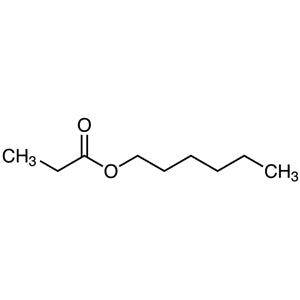
TCI H1330 with CAS number 2445-76-3 is Hexyl Propionate, an aliphatic ester formed from the combination of propionic acid and hexanol. The compound belongs to the medium-chain ester group, which is known for its characteristic fruity aroma, and for that reason it is widely studied in the context of flavor and fragrance chemistry. In the laboratory, this material serves as an analytical standard in aroma component analysis, as a comparison substance in research on volatile esters produced by fermentation, and as a solvent and starting material in organic chemistry experiments involving reactions at the ester group.
The characteristics that make this compound a preferred choice are its physical properties: it is a liquid at room temperature with moderate volatility and good solubility in organic solvents but low solubility in water. These properties make it highly suitable for analysis by gas chromatography, the principal technique used in the identification of aroma compounds. Its ester group is reactive toward hydrolysis, transesterification, reduction to the corresponding alcohol, and reactions with organometallic reagents, which makes it useful as a model substrate in studies of reaction mechanisms and in the testing of lipase enzyme activity.
In Indonesian laboratories, Hexyl Propionate is typically encountered in flavor and fragrance research, in fermentation studies where volatile esters are profiled, and in teaching and research work on organic reactions of the ester functional group. Because the material is a liquid, dispensing can be carried out volumetrically, which suits routine sample preparation for chromatographic work and small-scale synthetic experiments in both academic and industrial research settings.
TCI brochures (PDF)
- Lipids 2025-12-17 · p. 12
- Aroma component analysis — used as an analytical standard whose moderate volatility and clean chromatographic behavior make it well suited to identification and quantification by gas chromatography.
- Fermentation research on volatile esters — serves as a reference compound for comparison against esters generated during fermentation, supporting confident peak assignment in volatile profiling work.
- Flavor and fragrance chemistry studies — its characteristic fruity aroma, typical of medium-chain esters, makes it a relevant subject compound for sensory and compositional investigations.
- Organic synthesis experiments — functions as a starting material and solvent in reactions at the ester group, including hydrolysis, transesterification, reduction to alcohol, and organometallic reagent reactions.
- Enzyme activity testing and mechanism studies — acts as a model substrate for lipase activity assays and for investigations into the mechanisms of ester group transformations.
| Brand | TCI |
|---|---|
| CAS number | 2445-76-3 |
| Molecular formula | — |
| Purity | — |
| Category | Chemistry > Building Blocks > Non-Heterocyclic Building Blocks |
| Pack sizes | available in the standard laboratory pack sizes offered for this catalogue item |
| Physical form | liquid at room temperature, with moderate volatility |
| Storage | keep in a tightly closed container, away from heat and ignition sources |
Store Hexyl Propionate in a tightly closed container in a cool, well-ventilated area, away from heat, open flame, and other ignition sources, since the material is a volatile organic liquid. Glass bottles with chemically resistant closures are appropriate, and containers should be kept sealed when not in use to limit evaporative loss and preserve the integrity of the material for analytical work. Handle in a fume hood where practical, and use standard laboratory personal protective equipment including safety glasses, gloves, and a laboratory coat. Because the compound is a liquid, dispensing may be performed volumetrically using clean, dry glassware. Avoid contact with strong oxidizing agents and with moisture, as the ester group is susceptible to hydrolysis.
—
Produk Terkait
-
tert-ButylPropionate TCI B3327
Regular price From Rp 2.094.750,00Regular price -
2-PhenylethylPropionate TCI P1823
Regular price Rp 689.850,00Regular price -
SodiumPropionate TCI P0512
Regular price From Rp 610.050,00Regular price -
PropylPropionate TCI P0511
Regular price From Rp 505.050,00Regular price -
PotassiumPropionate TCI P0510
Regular price From Rp 769.650,00Regular price -
PhenylPropionate TCI P0509
Regular price From Rp 1.749.300,00Regular price -
MethylPropionate TCI P0508
Regular price From Rp 505.050,00Regular price -
IsopropylPropionate TCI P0507
Regular price From Rp 689.850,00Regular price