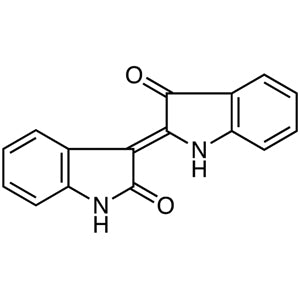
Indirubin is a chemical compound classified under the alkaloid category, widely utilized in life science research. It plays a crucial role in laboratories as a key reagent for various biochemical and chemical experiments. Its complex chemical structure makes it an essential component in the synthesis of other compounds and in conducting specific chemical reactions. Due to its stability and reactivity, Indirubin is also employed in studies related to biological activity, including pharmacological testing on cells and organisms. Its unique chemical properties enable it to interact with both organic and inorganic molecules, making it highly versatile in experimental settings.
The compound's high purity level ensures reliable and accurate experimental outcomes, which is vital for scientific research. Its ability to maintain stability under controlled conditions enhances its effectiveness in laboratory applications. Additionally, Indirubin's reactivity allows it to participate in a wide range of chemical processes, making it a preferred choice for researchers seeking precision and consistency in their experiments. These characteristics contribute to its widespread use in both academic and industrial research environments.
In Indonesian laboratories, Indirubin is commonly used in scientific research, particularly in biochemical and pharmaceutical studies. Its application spans across various research fields, including drug development and molecular biology. Researchers in Indonesia rely on Indirubin for its reliability and performance, ensuring that their experiments meet the required standards of accuracy and reproducibility. Its availability through trusted suppliers like AMI Scientific further supports its use in local research institutions and laboratories.
- Biochemical Synthesis: Indirubin is ideal for synthesizing complex organic compounds due to its reactivity and chemical stability.
- Pharmacological Testing: Its ability to interact with biological systems makes it suitable for testing drug effects on cells and tissues.
- Molecular Biology Research: Indirubin is used in experiments involving DNA and RNA interactions, owing to its unique chemical properties.
- Chemical Reaction Catalysts: The compound's reactivity allows it to act as a catalyst in various chemical reactions, enhancing reaction efficiency.
- Toxicology Studies: Indirubin is employed in assessing the toxicity of compounds on living organisms, providing valuable insights into biological responses.
| Brand | TCI |
|---|---|
| CAS number | 479-41-4 |
| Molecular formula | — |
| Purity | — |
| Category | Life Science > Biochemicals and Reagents > Alkaloids |
| Pack sizes | Available in various quantities as per supplier specifications |
| Physical form | Solid powder |
| Storage | Store in a cool, dry place away from light and moisture |
Indirubin should be stored in a cool, dry environment, away from direct sunlight and moisture to maintain its chemical integrity. It is recommended to keep the compound in airtight containers to prevent contamination and degradation. Due to its reactivity, it should be handled with care, using appropriate personal protective equipment such as gloves and safety goggles. Laboratory personnel should ensure proper ventilation when working with Indirubin to minimize exposure. Proper labeling of containers is essential for safe handling and to prevent accidental use. Regular monitoring of storage conditions ensures the compound remains in optimal condition for research applications.
—
Produk Terkait
-
TCI B5774 5,10-Bis(4,4,5,5-tetramethyl-1,3,2-dioxaborolan-2-yl)naphtho[1,2-c:5,6-c']bis([1,2,5]oxadiazole)
Regular price Rp 10.255.350,00Regular price -
Dihydroiodide TCI B6569
Regular price From Rp 1.936.200,00Regular price -
Trifluoromethanesulfonate TCI B7003
Regular price From Rp 1.936.200,00Regular price
![5,10-Bis(4,4,5,5-tetramethyl-1,3,2-dioxaborolan-2-yl)naphtho[1,2-c:5,6-c']bis([1,2,5]oxadiazole) - TCI B5774 - AMI Scientific](http://amiscientific.com/cdn/shop/files/TCI2510B5774.jpg?v=1769180228&width=533)