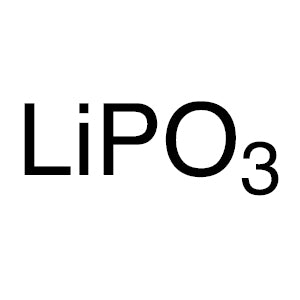
Lithium metaphosphate (LiPO₃) is an inorganic compound widely used in chemical reactions, particularly in catalysis and inorganic chemistry. It serves as a versatile reagent that can act as a catalyst, reactant, or auxiliary in the synthesis of complex compounds. Its stable crystalline structure allows it to participate in various chemical transformations efficiently. In laboratory settings, lithium metaphosphate is often employed to accelerate chemical reactions, improve process efficiency, or assist in precipitation and compound formation reactions. Its ability to function as an electron donor and its reactivity under different environmental conditions make it a valuable tool in chemical research.
Lithium metaphosphate is preferred due to its unique chemical properties, including its high reactivity and ability to act as a donor of electrons. Its solubility varies depending on the solvent used, offering flexibility in experimental design. This adaptability makes it suitable for a wide range of applications in both synthetic and analytical chemistry. The compound’s stability and reactivity also make it a reliable choice for use in controlled laboratory environments. Its chemical behavior under different conditions ensures that it can be tailored to meet the specific needs of various experimental setups.
In Indonesian laboratories, lithium metaphosphate is commonly used in chemical research, especially in catalysis and synthesis. It is a key component in studies involving the formation of new compounds and the optimization of chemical processes. Its role in supporting chemical reactions and enhancing laboratory efficiency makes it an essential material for researchers in the field of inorganic chemistry.
- Catalytic reactions benefit from lithium metaphosphate due to its ability to accelerate chemical transformations and improve reaction efficiency.
- Precipitation reactions often use lithium metaphosphate as an auxiliary to facilitate the formation of new compounds and control reaction outcomes.
- Inorganic synthesis applications rely on lithium metaphosphate for its reactivity and role in the creation of complex chemical structures.
- Analytical chemistry experiments utilize lithium metaphosphate to support various chemical processes and enhance the accuracy of results.
- Compound formation studies incorporate lithium metaphosphate to explore its reactivity and its role in the development of new materials.
| Brand | TCI |
|---|---|
| CAS number | 13762-75-9 |
| Molecular formula | — |
| Purity | — |
| Category | Chemistry > Catalysis and Inorganic Chemistry > Metallic Salts |
| Pack sizes | Available in standard laboratory quantities |
| Physical form | Solid |
| Storage | Store in a cool, dry place away from moisture and direct sunlight |
Lithium metaphosphate should be stored in a cool, dry place, away from moisture and direct sunlight to maintain its chemical stability. It is recommended to use airtight containers to prevent exposure to humidity, which may affect its reactivity. In laboratory settings, proper ventilation should be ensured when handling the compound to minimize inhalation risks. Avoid contact with skin and eyes, and use appropriate personal protective equipment such as gloves and safety goggles. The compound should be kept in a secure location to prevent accidental spills or contamination. Regular inspection of storage conditions is advised to ensure the material remains in optimal condition for use.
—
Produk Terkait
-
TCI B5774 5,10-Bis(4,4,5,5-tetramethyl-1,3,2-dioxaborolan-2-yl)naphtho[1,2-c:5,6-c']bis([1,2,5]oxadiazole)
Regular price Rp 10.255.350,00Regular price -
Dihydroiodide TCI B6569
Regular price From Rp 1.936.200,00Regular price -
Trifluoromethanesulfonate TCI B7003
Regular price From Rp 1.936.200,00Regular price
![5,10-Bis(4,4,5,5-tetramethyl-1,3,2-dioxaborolan-2-yl)naphtho[1,2-c:5,6-c']bis([1,2,5]oxadiazole) - TCI B5774 - AMI Scientific](http://amiscientific.com/cdn/shop/files/TCI2510B5774.jpg?v=1769180228&width=533)