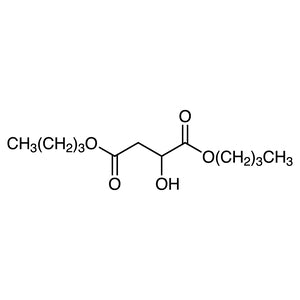
Dibutyl DL-Malate is a chemical compound widely used in laboratory settings for the synthesis of complex molecules. It serves as a fundamental building block in organic chemistry, offering a simple yet versatile molecular structure that supports various synthetic pathways. This compound is commonly utilized in chemical reactions where the introduction of specific functional groups is required. Its role as a donor of carbonyl groups makes it particularly valuable in substitution reactions and other synthetic processes.
The chemical properties of Dibutyl DL-Malate make it a preferred choice for laboratory use. It exhibits stability under normal conditions and demonstrates high reactivity, which is essential for successful chemical transformations. Its neutral chemical nature and resistance to degradation ensure consistent performance in experimental settings. Additionally, its solubility in organic solvents facilitates easy handling and integration into diverse chemical protocols. These characteristics contribute to its widespread adoption in both academic and industrial research environments.
In Indonesian laboratories, Dibutyl DL-Malate is extensively used in organic synthesis and chemical reactivity studies. It is a key component in the development of new compounds and is frequently employed in research focused on functional group manipulation. Its availability and reliability make it a staple in chemical laboratories across Indonesia, supporting both educational and applied research initiatives.
- Organic Synthesis: Dibutyl DL-Malate is ideal for synthesizing complex organic compounds due to its reactivity and ability to act as a carbonyl donor.
- Substitution Reactions: The compound is frequently used in substitution reactions where the introduction of specific functional groups is necessary.
- Chemical Reactivity Studies: Its stable yet reactive nature makes it suitable for studying chemical reactivity and reaction mechanisms.
- Functional Group Manipulation: It is a valuable tool in experiments that require precise control over functional group transformations.
- Solvent Compatibility: Its solubility in organic solvents allows it to be easily integrated into a wide range of synthetic procedures.
| Brand | TCI |
|---|---|
| CAS number | 6280-99-5 |
| Molecular formula | — |
| Purity | — |
| Category | Chemistry > Building Blocks > Non-Heterocyclic Building Blocks |
| Pack sizes | Available in standard laboratory quantities |
| Physical form | Solid or liquid, depending on the specific product variant |
| Storage | Store in a cool, dry place away from direct sunlight |
Dibutyl DL-Malate should be stored in a cool, dry environment to maintain its chemical stability. It is recommended to keep the compound in airtight containers to prevent moisture absorption and contamination. Due to its reactivity, it should be handled with care, using appropriate personal protective equipment such as gloves and safety goggles. Avoid exposure to heat or direct sunlight, as these conditions may affect its integrity. In laboratory settings, it is important to ensure proper ventilation when working with this compound to minimize any potential health risks. Always follow standard chemical safety protocols to ensure safe handling and storage practices.
—
Produk Terkait
-
DisodiumDL-Malate TCI M0026
Regular price From Rp 505.050,00Regular price -
DimethylDL-Malate TCI M0025
Regular price Rp 2.041.200,00Regular price -
DiethylDL-Malate TCI M0024
Regular price From Rp 1.035.300,00Regular price -
DibutylSebacate TCI S0023
Regular price From Rp 477.750,00Regular price -
DibutylPhthalate TCI P0292
Regular price From Rp 477.750,00Regular price -
DibutylOxalate TCI O0077
Regular price From Rp 584.850,00Regular price -
DibutylMalonate TCI M0540
Regular price From Rp 2.359.350,00Regular price -
DibutylMaleate TCI M0009
Regular price From Rp 477.750,00Regular price