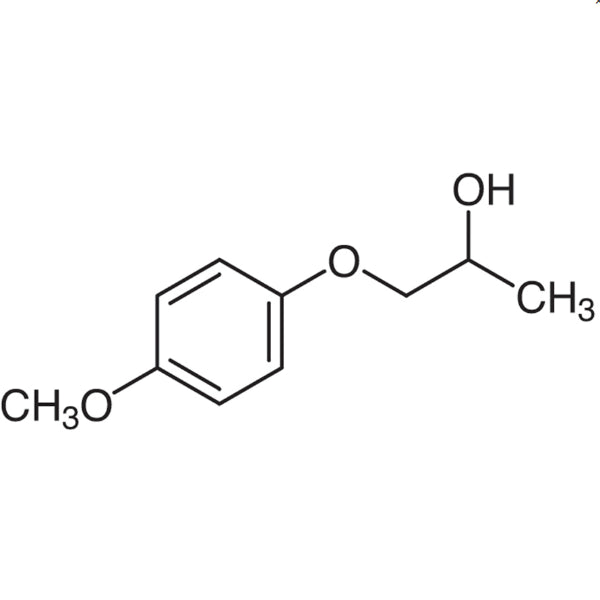
1-(4-Methoxyphenoxy)-2-propanol is a chemical compound widely used in organic laboratory reactions. It serves as a building block in the synthesis of complex molecules, particularly in the creation of heterocyclic compounds and aromatic structures. This compound plays a crucial role in facilitating the formation of more intricate chemical bonds during various synthetic processes. Its versatility makes it an essential reagent for chemists working on diverse research projects.
The compound’s reactivity and functional group characteristics make it a preferred choice for organic synthesis. It exhibits polarity due to the presence of a methoxy group on the aromatic ring, enabling solubility in organic solvents such as ethyl acetate and acetone. This solubility is vital for reactions requiring specific solvent interactions. Additionally, its stable molecular structure allows it to participate in a range of chemical reactions, including substitution and esterification, making it a reliable component in laboratory workflows.
In Indonesian laboratories, 1-(4-Methoxyphenoxy)-2-propanol is commonly used in organic chemistry research. It is particularly valuable in the development of pharmaceuticals, agrochemicals, and specialty chemicals. Its non-reactive nature under certain conditions also makes it suitable for use in a variety of experimental setups, supporting both academic and industrial research efforts.
Related TCI products
- TCI M1060 64120-49-6 1-(2-Methoxyphenoxy)-2-propanol
- TCI B5207 23116-94-1 1,5-Bis(2-hydroxyphenoxy)-3-oxapentane
- TCI B1485 5085-95-0 1,4-Bis(3-hydroxyphenoxy)benzene
- TCI B1484 126716-90-3 1,3-Bis(4-hydroxyphenoxy)benzene
- TCI B1479 104104-12-3 Bis[2-(4-methoxyphenoxy)ethyl] Ether
- TCI B1454 13118-91-7 1,3-Bis(4-methoxyphenoxy)benzene
- Organic synthesis of heterocyclic compounds due to its functional group versatility and reactivity.
- Esterification reactions where the hydroxyl group can be converted into ester functionalities.
- Substitution reactions involving aromatic rings due to the methoxy group's electron-donating effect.
- Solvent-compatible reactions requiring polar solvents such as ethyl acetate and acetone.
- Research in pharmaceutical and agrochemical development for compound modification and structural variation.
| Brand | TCI |
|---|---|
| CAS number | 42900-54-9 |
| Molecular formula | — |
| Purity | — |
| Category | Chemistry > Building Blocks > Non-Heterocyclic Building Blocks |
| Pack sizes | Available in standard laboratory quantities |
| Physical form | Liquid or crystalline, depending on the batch |
| Storage | Store in a cool, dry place away from direct sunlight |
This compound should be stored in a cool, dry environment, away from direct sunlight and sources of heat. It is recommended to use airtight containers to prevent exposure to moisture and air, which may affect its stability. Due to its reactivity, it should be handled in a well-ventilated area, with appropriate personal protective equipment such as gloves and safety goggles. Avoid contact with incompatible substances, and ensure proper disposal according to local regulations. Regular monitoring of storage conditions is advised to maintain the compound’s integrity and effectiveness in laboratory applications.
—
Produk Terkait
-
1-(2-Methoxyphenoxy)-2-propanol TCI M1060
Regular price From Rp 2.757.300,00Regular price -
1,5-Bis(2-hydroxyphenoxy)-3-oxapentane TCI B5207
Regular price Rp 1.618.050,00Regular price -
1,4-Bis(3-hydroxyphenoxy)benzene TCI B1485
Regular price Rp 3.578.400,00Regular price -
1,3-Bis(4-hydroxyphenoxy)benzene TCI B1484
Regular price From Rp 2.174.550,00Regular price -
Bis[2-(4-methoxyphenoxy)ethyl]Ether TCI B1479
Regular price Rp 1.298.850,00Regular price -
1,3-Bis(4-methoxyphenoxy)benzene TCI B1454
Regular price Rp 3.446.100,00Regular price -
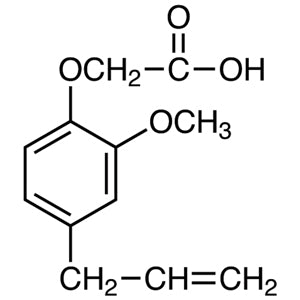
(4-Allyl-2-methoxyphenoxy)aceticAcid TCI A3037
Regular price From Rp 2.041.200,00Regular price -
2-(4-Methoxyphenoxy)propanoicAcid TCI M3883
Regular price From Rp 1.035.300,00Regular price


![104104-12-3 Bis[2-(4-methoxyphenoxy)ethyl] Ether - AMI Scientific](http://amiscientific.com/cdn/shop/files/TCI2510B1479.jpg?v=1769141601&width=533)