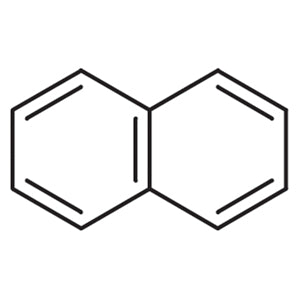
Naphthalene from TCI is the simplest polycyclic aromatic hydrocarbon. Its molecule is made of two fused benzene rings. It is widely known as a white crystalline solid with a characteristic odour, and it sublimes readily at room temperature. As a non-heterocyclic building block, naphthalene is the starting material for many important derivatives, including naphthalenesulfonic acids, naphthols, and other substituted naphthalene compounds. In the laboratory it is also a very popular material for basic practical work and serves as a reference compound in physical and analytical chemistry.
Several properties make naphthalene a preferred choice. It sublimes easily, it is simple to purify by recrystallization, and its thermal properties are well documented in the literature. This makes it ideal for teaching purification techniques and melting point determination. Its electron-rich aromatic system undergoes electrophilic substitution with regioselectivity that is well worth studying. Naphthalene can also be reduced, for example by Birch reduction. It is also used to prepare sodium naphthalenide, a strong single-electron reducing agent used in inorganic and organometallic synthesis.
In Indonesian laboratories, naphthalene is a familiar compound in university teaching laboratories, where students use it to practise sublimation, recrystallization, and melting point measurement. Research groups working in organic synthesis use it as a starting material for substituted naphthalene derivatives and to study aromatic substitution. Groups in inorganic and organometallic chemistry use it to prepare sodium naphthalenide. Analytical and physical chemistry laboratories keep it as a well-characterised reference compound for method checks and thermal studies.
- Purification teaching: naphthalene sublimes readily and is easy to recrystallize, so it works well for showing students sublimation and recrystallization techniques in basic practical sessions.
- Melting point determination: its thermal properties are well documented in the literature, which makes naphthalene a dependable compound for teaching and checking melting point measurement in the laboratory.
- Synthesis of naphthalene derivatives: as a non-heterocyclic building block, it is the starting material for naphthalenesulfonic acids, naphthols, and other substituted naphthalene compounds used in further research.
- Studies of electrophilic aromatic substitution: its electron-rich fused-ring system gives substitution products with interesting regioselectivity, which is useful for teaching and research in reaction mechanisms.
- Preparation of sodium naphthalenide: naphthalene is used to make this strong single-electron reducing agent, which is widely used in inorganic and organometallic synthesis, and the compound can also be studied through Birch reduction.
| Brand | TCI (product code N0885) |
|---|---|
| CAS number | 91-20-3 |
| Molecular formula | — |
| Purity | — |
| Category | Chemistry > Building Blocks > Non-Heterocyclic Building Blocks |
| Pack sizes | see the product page for available pack sizes |
| Physical form | white crystalline solid with a characteristic odour |
| Storage | keep tightly closed, because the material sublimes readily at room temperature |
Store naphthalene in a tightly sealed container in a cool, dry, well-ventilated place, away from heat sources, open flames, and strong oxidizing agents. Because it sublimes readily at room temperature, a well-closed glass or compatible chemical container helps prevent loss of material and stops vapour from building up in the storage area. Handle it in a fume hood or a well-ventilated area, and wear suitable gloves, safety glasses, and a lab coat. Avoid breathing dust or vapour and avoid contact with skin and eyes. Always read the supplier's Safety Data Sheet before use, and dispose of waste according to local regulations.
—
Produk Terkait
-
TCI B5774 5,10-Bis(4,4,5,5-tetramethyl-1,3,2-dioxaborolan-2-yl)naphtho[1,2-c:5,6-c']bis([1,2,5]oxadiazole)
Regular price Rp 10.255.350,00Regular price -
Dihydroiodide TCI B6569
Regular price From Rp 1.936.200,00Regular price -
Trifluoromethanesulfonate TCI B7003
Regular price From Rp 1.936.200,00Regular price
![5,10-Bis(4,4,5,5-tetramethyl-1,3,2-dioxaborolan-2-yl)naphtho[1,2-c:5,6-c']bis([1,2,5]oxadiazole) - TCI B5774 - AMI Scientific](http://amiscientific.com/cdn/shop/files/TCI2510B5774.jpg?v=1769180228&width=533)