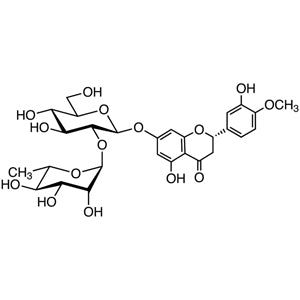
Neohesperidin is a flavonoid compound widely recognized for its role as a flavor enhancer and natural preservative. It is commonly used in chemical and biochemical research to study phenolic compounds and their antioxidant properties. As a derivative of hesperidin, Neohesperidin possesses a complex chemical structure, making it a valuable tool in the investigation of bioactive compounds. In laboratory settings, it is essential for analyzing the physical and chemical properties of natural products, contributing to the development of pharmaceuticals and food additives. Its stability under certain conditions and solubility in organic solvents make it a reliable material for precise scientific experiments.
Neohesperidin is preferred due to its chemical stability and solubility in various organic solvents, which allows for consistent performance in experimental conditions. Its resistance to degradation ensures long-term usability and simplifies storage requirements. These characteristics make it an ideal choice for high-precision research applications. Additionally, its unique chemical properties enable it to be used in studies related to biological effects and pharmacological activities, expanding its utility across multiple scientific disciplines. Its versatility supports a wide range of research objectives, from basic biochemical studies to applied product development.
In Indonesian laboratories, Neohesperidin is frequently utilized in pharmaceutical, nutritional, and biochemical research. It plays a crucial role in the development of natural products with potential health benefits. Its presence in research projects highlights its importance in advancing scientific knowledge and innovation within the local scientific community. As a key component in natural product research, it supports the exploration of bioactive compounds for both academic and industrial applications.
TCI brochures (PDF)
- Quorum Sensing Research Reagents 2024-10-17 · p. 2
- Biofilm Research Reagents 2024-06-21 · p. 2
- Polyphenols 2024-12-05 · p. 1
- Phytochemicals 2025-12-17 · p. 11
- Used in pharmaceutical research for the development of natural-based drug formulations due to its bioactive properties and stability.
- Applied in nutritional studies to investigate the antioxidant and health-promoting effects of flavonoids in food products.
- Utilized in biochemical experiments to analyze the structure and function of phenolic compounds and their interactions.
- Employed in food science for flavor enhancement and preservation of natural ingredients in processed foods.
- Integrated into biotechnology projects to explore the potential of bioactive compounds in therapeutic applications.
| Brand | TCI |
|---|---|
| CAS number | 13241-33-3 |
| Molecular formula | — |
| Purity | — |
| Category | Chemistry > Chemical Biology > Glycoscience |
| Pack sizes | Available in various quantities as per supplier specifications |
| Physical form | Powder |
| Storage | Store in a cool, dry place away from direct sunlight |
Neohesperidin should be stored in a cool, dry environment to maintain its chemical stability and prevent degradation. It is recommended to keep it in airtight containers to minimize exposure to moisture and air. Due to its solubility in organic solvents, it is important to handle it in a well-ventilated area to avoid inhalation of vapors. Proper labeling of containers is essential for safe handling and identification. Laboratory personnel should wear appropriate personal protective equipment, such as gloves and safety goggles, when working with this compound. Regular monitoring of storage conditions ensures the material remains suitable for use in scientific research.
—
Product Categories
- GlycoscienceDisaccharides [Glycoscience]
- GlycoscienceFunctional OligosaccharidesNatural Glycosides [Functional Oligosaccharides]
- Biochemicals and ReagentsCrude Medicine Ingredients for Research and Experimental Use
- Biochemicals and ReagentsPhenylpropanoids, Aromatic PolyketidesAromatic Polyketides
- Cell BiologyNutrition ResearchPhytochemicals
- MicrobiologyBiofilm ResearchBiofilm Inhibitors and Suppressors, etc.
- MicrobiologyQuorum Sensing ResearchQuorum Sensing Inhibitors and Antagonists, etc.
- Pharmaceutical Development and Drug Discovery ResearchCrude Medicine Ingredients for Research and Experimental Use
Produk Terkait
-
Hesperidin TCI H0049
Regular price From Rp 1.272.600,00Regular priceRp 905.100,00Sale price From Rp 1.272.600,00 -
NeohesperidinDihydrochalcone TCI N0675
Regular price From Rp 3.207.750,00Regular priceRp 2.258.550,00Sale price From Rp 3.207.750,00 -
RutinHydrate TCI R0035
Regular price Rp 1.431.150,00Regular priceRp 1.016.400,00Sale price Rp 1.431.150,00 -
Naringin TCI N0073
Regular price Rp 1.670.550,00Regular priceRp 1.183.350,00Sale price Rp 1.670.550,00 -
Baicalin TCI B2835
Regular price Rp 2.730.000,00Regular priceRp 1.924.650,00Sale price Rp 2.730.000,00 -
Neodiosmin TCI N1161
Regular price Rp 8.983.800,00Regular priceRp 2.256.450,00Sale price Rp 8.983.800,00 -
Narirutin TCI N1125
Regular price Rp 5.352.900,00Regular priceRp 3.759.000,00Sale price Rp 5.352.900,00 -
Linarin TCI L0447
Regular price Rp 8.374.800,00Regular priceRp 5.871.600,00Sale price Rp 8.374.800,00